



Scyliorhinus canicula (Linnaeus, 1758)
Lesser spotted dogfish
เพิ่มการสังเกตของคุณใน Fish Watcher
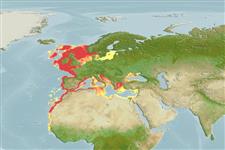
| Native range | All suitable habitat | Point map | Year 2050 |
|
| This map was computer-generated and has not yet been reviewed. |
| Scyliorhinus canicula AquaMaps Data sources: GBIF OBIS |
อัพโหลดของคุณ ภาพถ่าย และ วิดีโอ
รูปภาพหลายรูป | Google image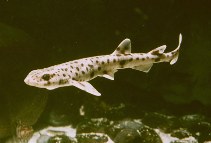 Scyliorhinus canicula
ภาพโดย Aquarium Kiel
รูปภาพหลายรูป | Google image
ภาพโดย Aquarium Kiel
การจำแนกประเภท / ชื่อ ชื่อสามัญ | ชื่อพ้อง | Catalog of Fishes(สกุล, ชนิด) | ITIS | CoL | WoRMS | Cloffa
sub class Elasmobranchii (ฉลามและกระเบน) (sharks and rays) > Carcharhiniformes (Ground sharks) > Scyliorhinidae (Cat sharks) > Scyliorhininae
Etymology: Scyliorhinus: skylion, Greek for dogfish or small shark; rhinus, from rhine (Gr.), rasp, alluding to a shark’s jagged, rasp-like skin (See ETYFish); canicula: Diminutive of canis (L.), dog; sharks were known as “sea dogs” and “dog-fishe” among mariners until the late 16th century, because of their ferocious pack-like feeding behavior (See ETYFish).
More on author: Linnaeus.
Etymology: Scyliorhinus: skylion, Greek for dogfish or small shark; rhinus, from rhine (Gr.), rasp, alluding to a shark’s jagged, rasp-like skin (See ETYFish); canicula: Diminutive of canis (L.), dog; sharks were known as “sea dogs” and “dog-fishe” among mariners until the late 16th century, because of their ferocious pack-like feeding behavior (See ETYFish).
More on author: Linnaeus.
สิ่งแวดล้อม : สิ่งแวดล้อม / เขตภูมิอากาศ / ระดับความลึก / ระยะการกระจายสินค้า นิเวศวิทยา
เกี่ยวกับทะเล,น้ำเค็ม สัตว์น้ำหน้าดิน; ระดับความลึก 10 - 780 m (Ref. 56504), usually 80 - 100 m (Ref. 81056). Subtropical; 63°N - 3°N, 32°W - 37°E
การแพร่กระจาย อาณาเขต | พื้นที่จำแนกตาม FAO | ระบบนิเวศหลายระบบ | การปรากฏขึ้น,การเกิดขึ้น,พบ | ตำแหน่งบนแผนที่ | การแนะนำ | Faunafri
North Sea (sw coast of Sweden to Copenhagen, Denmark), Northeastern Atlantic Ocean (Ireland, United Kingdom, France, Portugal); Mediterranean Sea (Spain, France, Italy, Tunisia, Algeria, Morocco); nw Africa, close to the Strait of Gibraltar and to the north of Mauritania (20º30’N); including Norwegian Sea.
ความยาวเมื่อครบกำหนดครั้งแรก / ขนาด / น้ำหนัก / อายุ
วัยเจริญพันธุ์: Lm 50.0, range 35 - 64 cm
Max length : 100.0 cm TL เพศผู้/กระเทย; (Ref. 244); common length : 60.0 cm TL เพศผู้/กระเทย; (Ref. 4645); น้ำหนักสูงสุดที่มีการรายงาน: 3.7 kg (Ref. 128278); อายุสูงสุดที่ได้รายงาน: 12 ปี (Ref. 81067)
Max length : 100.0 cm TL เพศผู้/กระเทย; (Ref. 244); common length : 60.0 cm TL เพศผู้/กระเทย; (Ref. 4645); น้ำหนักสูงสุดที่มีการรายงาน: 3.7 kg (Ref. 128278); อายุสูงสุดที่ได้รายงาน: 12 ปี (Ref. 81067)
คำอธิบายสั้นๆ เครื่องมือที่ใช้ในการแยกชนิดสัตว์,สิ่งมีชีวิตออกจากกัน | สัณฐานวิทยา | ความยาวต่างๆ
This species is distinguished from all its congeners by the following characters: shallow nasoral grooves and laterally situated posterior nasal flaps (vs. no grooves and posterior flaps on the posterior border of the excurrent apertures in congeners, except in S. duhamelii); distance between the anterior nasal flaps 6-7.5 times smaller than the anterior nasal flap width (vs. 3.5-5 times smaller in S. duhamelii; two times in the other species); lower labial furrow 2.1-2.2 times smaller than mouth width (vs. more than 3 times in other species, except S. duhamelii). Colouration: color pattern with dark spots well-defined, predominantly smaller than spiracles (vs. no dark spots in S. capensis, S. comoroensis, S. hesperius, S. meadi, S. torazame, S. torrei; reticulated pattern in S. rotifer; dark spots predominantly larger than spiracles in S. cervigoni, S. garmani, S. haeckelii, S. stellaris; diffuse spots in S. duhamelii); clasper with rough terminal dermal cover (also found only in S. capensis) (Ref. 120402).
Cross section: oval.
Cross section: oval.
Most common catshark in coastal waters of Europe (Ref. 32804). Inhabits continental shelves and uppermost slopes. Found on sandy, coralline, algal, gravel or muddy bottoms. Occurs mainly between 10-100 m depth in the northeast Atlantic and up to 400 m depth in the Mediterranean Sea (Ref. 88187) and from 288-780 m in the eastern Ionian Sea (Ref. 56504). They sometimes occur in midwater. Nocturnal species, males resting on substrate and females hiding in shallow (0.5-1.5 m depth) caves and crevices during the day (Ref. 88835). Feed on a variety of benthic invertebrates, including mollusks, crustaceans, small cephalopods, polychaete worms, and small bony fishes (Ref. 244, 11889). Males have been found to forage in shallow prey-rich areas with soft sediment or areas covered with filamentous algae (Ref. 88836). Oviparous, with a single egg laid per oviduct at a time. Detect weak electric fields generated by other organisms (e.g. potential prey) (Ref. 10311). Utilized fresh and dried-salted for human consumption, also for oil and fishmeal.
วงจรชีวิตและพฤติกรรมการผสมพันธุ์ วัยเจริญพันธุ์ | การสืบพันธุ์ | การวางไข่ | เซลสืบพันธ์ของเพศเมีย(ไข่) | ความดกของไข่ | ตัวอ่อน
Oviparous, laying paired eggs (one per oviduct) in shallow subtidal areas, although some egg cases have been found in the deeper part of intertidal zones (Ref. 244). Embryos feed solely on yolk (Ref. 50449). The egg cases are anchored to macroalgae, sea grass or sessile erect invertebrates such as poriferans, bryozoans and hydroids (Ref. 32804, 58137). The capsules have tendrils at each corner used for anchorage purposes. Egg capsule size varies according to locality and female size (Ref. 244) and ranges between 4.9-7.0 cm length and 1.5-3.0 cm width (Ref. 88837). Egg cases may be deposited throughout the year, peaking in June and July (Ref. 32804). Recent studies estimate fecundity of females from the northeast Atlantic to be at around 29-62 pups (Ref. 32804). Fully formed pups hatch after 5-11 months, depending on water temperature (Ref. 244, 32804). Newly hatched pups are about 8-10 cm in length (Ref. 78469).
อ้างอิงหลัก
อัพโหลดข้อมูลอ้างอิงของคุณ | อ้างอิง | ผู้ประสานงาน : Compagno, Leonard J.V. | ผู้ร่วมมือ
Soares, K.D.A. and M.R. De Carvalho, 2019. The catshark genus Scyliorhinus (Chondrichthyes: Carcharhiniformes: Scyliorhinidae): taxonomy, morphology and distribution. Zootaxa 4601(1):1-147. (Ref. 120402)
สถานะบัญชีแดงของ IUCN (Ref. 130435: Version 2025-2 (Global))
Least Concern (LC) ; Date assessed: 31 August 2020
CITES
Not Evaluated
ภัยคุกคามต่อมนุษย์
Harmless
การใช้ของมนุษย์
การประมง: มีการค้าเพียงเล็กน้อย; การตกปลาเป็นกีฬา: ใช่
FAO - การประมง: การลงจอด; Publication: search | FishSource | ทะเลรอบๆเรา
ข้อมูลเพิ่มเติม
พลวัตของประชากร
พารามิเตอร์การเจริญเติบโต
อายุสูงสุด / ขนาด
ความยาว-น้ำหนักสัมพันธ์
ความยาว-ความยาวสัมพันธ์
ความยาว-ความถี่
การแปลงมวล
การทดแทนที่
อุดมสมบรูณ์
พารามิเตอร์การเจริญเติบโต
อายุสูงสุด / ขนาด
ความยาว-น้ำหนักสัมพันธ์
ความยาว-ความยาวสัมพันธ์
ความยาว-ความถี่
การแปลงมวล
การทดแทนที่
อุดมสมบรูณ์
วงจรชีวิต
การสืบพันธุ์
วัยเจริญพันธุ์
ความสมบูรณ์พันธุ์/เหงือกที่เกี่ยวข้อง
ความดกของไข่
การวางไข่
การรวมตัวของสปอน
เซลสืบพันธ์ของเพศเมีย(ไข่)
การพัฒนาไข่
ตัวอ่อน
พลวัตของสัตว์น้ำวัยอ่อน
การสืบพันธุ์
วัยเจริญพันธุ์
ความสมบูรณ์พันธุ์/เหงือกที่เกี่ยวข้อง
ความดกของไข่
การวางไข่
การรวมตัวของสปอน
เซลสืบพันธ์ของเพศเมีย(ไข่)
การพัฒนาไข่
ตัวอ่อน
พลวัตของสัตว์น้ำวัยอ่อน
การแพร่กระจาย
อาณาเขต
พื้นที่จำแนกตาม FAO
ระบบนิเวศหลายระบบ
การปรากฏขึ้น,การเกิดขึ้น,พบ
การแนะนำ
BRUVS - วิดีโอ
อาณาเขต
พื้นที่จำแนกตาม FAO
ระบบนิเวศหลายระบบ
การปรากฏขึ้น,การเกิดขึ้น,พบ
การแนะนำ
BRUVS - วิดีโอ
สรีรวิทยา
องค์ประกอบของร่างกาย
สารอาหาร
การใช้ออกซิเจน
ประเภทการว่ายน้ำ
ระดับความเร็วในการว่ายน้ำ
เม็ดสีที่มองเห็นได้
เสียงปลา
โรคและปรสิต
ความเป็นพิษ (LC50s)
องค์ประกอบของร่างกาย
สารอาหาร
การใช้ออกซิเจน
ประเภทการว่ายน้ำ
ระดับความเร็วในการว่ายน้ำ
เม็ดสีที่มองเห็นได้
เสียงปลา
โรคและปรสิต
ความเป็นพิษ (LC50s)
เกี่ยวข้องกับมนุษย์
ระบบการเพาะเลี้ยงสัตว์น้ำ
ประวัติการเพาะเลี้ยงสัตว์น้ำ
สายพันธุ์
กรณีซิเกวเทอรา
แสตมป์ เหรียญ อื่นๆ
ระบบการเพาะเลี้ยงสัตว์น้ำ
ประวัติการเพาะเลี้ยงสัตว์น้ำ
สายพันธุ์
กรณีซิเกวเทอรา
แสตมป์ เหรียญ อื่นๆ
เครื่องมือ
แบบทดสอบชีววิทยา | หนังสืออิเล็กทรอนิกส์ | คู่มือภาคสนาม | เครื่องมือที่ใช้ในการแยกชนิดสัตว์,สิ่งมีชีวิตออกจากกัน | ผู้มีความชำนาญในเรื่องความถี่ของความยาว | เครื่องมือในการศึกษาชีวประวัติ | ตำแหน่งบนแผนที่ |
จับ-MSY |
รายงานพิเศษ
ตรวจสอบการบำรุงรักษาตู้ปลา | ตรวจสอบเอกสารข้อเท็จจริงเกี่ยวกับสายพันธุ์ | ตรวจสอบเอกสารข้อเท็จจริงเกี่ยวกับการเพาะเลี้ยงสัตว์น้ำ
ดาวน์โหลด XML
หน้าสรุป | ข้อมูลสำคัญ | ชื่อสามัญ | ภาพถ่าย
แหล่งที่มาจากอินเตอร์เน็ต
AFORO (otoliths) | Aquatic Commons | BHL | Cloffa | Websites from users | Check FishWatcher | CISTI | Catalog of Fishes: สกุล, ชนิด | DiscoverLife | DORIS | ECOTOX | FAO - การประมง: การลงจอด; Publication: search | Faunafri | Fishipedia | Fishtrace | GloBI | Google Books | Google Scholar | Google | IGFA World Record | ฐานข้อมูลแห่งชาติ | OneZoom | Open Tree of Life | Otolith Atlas of Taiwan Fishes | สถานแสดงสัตว์น้ำของรัฐ | PubMed | Reef Life Survey | Socotra Atlas | TreeBase | แผนภูมิชีวิตแบบต้นไม้ | Wikipedia: Go, ค้นหา | World Records Freshwater Fishing | บันทึกทางด้านสัตววิทยา
การประมาณค่าตามแบบจำลอง
อุณหภูมิที่ต้องการ (อ้างอิง 123201): 7.2 - 16.2, mean 10.1 °C (based on 28 cells).
ดัชนีความหลากหลายทางวิวัฒนาการ (อ้างอิง 82804): PD50 = 0.5000 [Uniqueness, from 0.5 = low to 2.0 = high].
Bayesian length-weight: a=0.00145 (0.00124 - 0.00168), b=3.21 (3.16 - 3.26), in cm total length, based on LWR estimates for this species (Ref. 93245).
ระดับชั้นอาหาร (อ้างอิง 69278): 3.8 ±0.3 se; based on diet studies.
ความสามารถในการกลับคืนสู่ปกติ (อ้างอิง 120179): ต่ำ, เวลาต่ำสุดที่จะทำให้ประชากรเพิ่มขึ้นเป็น 2 เท่าใช้เวลา 4.5 - 14 ปี (K=0.20; tm=9; Fec=96).
Prior r = 0.35, 95% CL = 0.23 - 0.53, Based on 1 full stock assessment.
สารอาหาร (Ref. 124155): Calcium = 18.1 [3.1, 101.7] mg/100g; Iron = 0.642 [0.170, 1.952] mg/100g; Protein = 18.3 [15.2, 21.3] %; Omega3 = 0.207 [0.092, 0.454] g/100g; Selenium = 33.3 [10.3, 93.4] μg/100g; VitaminA = 8.46 [2.86, 24.77] μg/100g; Zinc = 0.55 [0.27, 1.02] mg/100g (wet weight); based on nutrient studies.