



Scyliorhinus canicula (Linnaeus, 1758)
Lesser spotted dogfish
Ajouter votre observation dans Fish Watcher
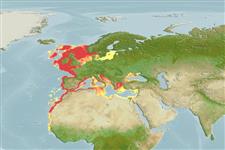
| Native range | All suitable habitat | Point map | Year 2050 |
|
| This map was computer-generated and has not yet been reviewed. |
| Scyliorhinus canicula AquaMaps Data sources: GBIF OBIS |
Envoyez vos Photos et vidéos
Images | Images Google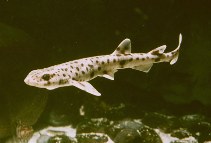 Scyliorhinus canicula
Photo de Aquarium Kiel
Images | Images Google
Photo de Aquarium Kiel
Classification / Noms Noms communs | Synonymes | Catalog of Fishes(Genre, Espèce) | ITIS | CoL | WoRMS | Cloffa
Élasmobranches (requins et raies) (sharks and rays) > Carcharhiniformes (Ground sharks) > Scyliorhinidae (Cat sharks) > Scyliorhininae
Etymology: Scyliorhinus: skylion, Greek for dogfish or small shark; rhinus, from rhine (Gr.), rasp, alluding to a shark’s jagged, rasp-like skin (See ETYFish); canicula: Diminutive of canis (L.), dog; sharks were known as “sea dogs” and “dog-fishe” among mariners until the late 16th century, because of their ferocious pack-like feeding behavior (See ETYFish).
More on author: Linnaeus.
Etymology: Scyliorhinus: skylion, Greek for dogfish or small shark; rhinus, from rhine (Gr.), rasp, alluding to a shark’s jagged, rasp-like skin (See ETYFish); canicula: Diminutive of canis (L.), dog; sharks were known as “sea dogs” and “dog-fishe” among mariners until the late 16th century, because of their ferocious pack-like feeding behavior (See ETYFish).
More on author: Linnaeus.
Environnement : milieu / zone climatique / profondeur / gamme de distribution Écologie
marin démersal; profondeur 10 - 780 m (Ref. 56504), usually 80 - 100 m (Ref. 81056). Subtropical; 63°N - 3°N, 32°W - 37°E
Distribution Territoires | Zones FAO | Écosystèmes | Occurrences | Carte par point | Introductions | Faunafri
North Sea (sw coast of Sweden to Copenhagen, Denmark), Northeastern Atlantic Ocean (Ireland, United Kingdom, France, Portugal); Mediterranean Sea (Spain, France, Italy, Tunisia, Algeria, Morocco); nw Africa, close to the Strait of Gibraltar and to the north of Mauritania (20º30’N); including Norwegian Sea.
Longueur à la première maturité / Taille / Poids / Âge
Maturité: Lm 50.0, range 35 - 64 cm
Max length : 100.0 cm TL mâle / non sexé; (Ref. 244); common length : 60.0 cm TL mâle / non sexé; (Ref. 4645); poids max. publié: 3.7 kg (Ref. 128278); âge max. reporté: 12 années (Ref. 81067)
Max length : 100.0 cm TL mâle / non sexé; (Ref. 244); common length : 60.0 cm TL mâle / non sexé; (Ref. 4645); poids max. publié: 3.7 kg (Ref. 128278); âge max. reporté: 12 années (Ref. 81067)
Description synthétique Clés d'identification | Morphologie | Morphométrie
This species is distinguished from all its congeners by the following characters: shallow nasoral grooves and laterally situated posterior nasal flaps (vs. no grooves and posterior flaps on the posterior border of the excurrent apertures in congeners, except in S. duhamelii); distance between the anterior nasal flaps 6-7.5 times smaller than the anterior nasal flap width (vs. 3.5-5 times smaller in S. duhamelii; two times in the other species); lower labial furrow 2.1-2.2 times smaller than mouth width (vs. more than 3 times in other species, except S. duhamelii). Colouration: color pattern with dark spots well-defined, predominantly smaller than spiracles (vs. no dark spots in S. capensis, S. comoroensis, S. hesperius, S. meadi, S. torazame, S. torrei; reticulated pattern in S. rotifer; dark spots predominantly larger than spiracles in S. cervigoni, S. garmani, S. haeckelii, S. stellaris; diffuse spots in S. duhamelii); clasper with rough terminal dermal cover (also found only in S. capensis) (Ref. 120402).
Cross section: oval.
Cross section: oval.
Most common catshark in coastal waters of Europe (Ref. 32804). Inhabits continental shelves and uppermost slopes. Found on sandy, coralline, algal, gravel or muddy bottoms. Occurs mainly between 10-100 m depth in the northeast Atlantic and up to 400 m depth in the Mediterranean Sea (Ref. 88187) and from 288-780 m in the eastern Ionian Sea (Ref. 56504). They sometimes occur in midwater. Nocturnal species, males resting on substrate and females hiding in shallow (0.5-1.5 m depth) caves and crevices during the day (Ref. 88835). Feed on a variety of benthic invertebrates, including mollusks, crustaceans, small cephalopods, polychaete worms, and small bony fishes (Ref. 244, 11889). Males have been found to forage in shallow prey-rich areas with soft sediment or areas covered with filamentous algae (Ref. 88836). Oviparous, with a single egg laid per oviduct at a time. Detect weak electric fields generated by other organisms (e.g. potential prey) (Ref. 10311). Utilized fresh and dried-salted for human consumption, also for oil and fishmeal.
Cycle de vie et comportement reproducteur Maturité | Reproduction | Frai | Œufs | Fécondité | Larves
Oviparous, laying paired eggs (one per oviduct) in shallow subtidal areas, although some egg cases have been found in the deeper part of intertidal zones (Ref. 244). Embryos feed solely on yolk (Ref. 50449). The egg cases are anchored to macroalgae, sea grass or sessile erect invertebrates such as poriferans, bryozoans and hydroids (Ref. 32804, 58137). The capsules have tendrils at each corner used for anchorage purposes. Egg capsule size varies according to locality and female size (Ref. 244) and ranges between 4.9-7.0 cm length and 1.5-3.0 cm width (Ref. 88837). Egg cases may be deposited throughout the year, peaking in June and July (Ref. 32804). Recent studies estimate fecundity of females from the northeast Atlantic to be at around 29-62 pups (Ref. 32804). Fully formed pups hatch after 5-11 months, depending on water temperature (Ref. 244, 32804). Newly hatched pups are about 8-10 cm in length (Ref. 78469).
Référence principale
Téléchargez vos références | Références | Coordinateur : Compagno, Leonard J.V. | Collaborateurs
Soares, K.D.A. and M.R. De Carvalho, 2019. The catshark genus Scyliorhinus (Chondrichthyes: Carcharhiniformes: Scyliorhinidae): taxonomy, morphology and distribution. Zootaxa 4601(1):1-147. (Ref. 120402)
Statut dans la liste rouge de l'IUCN (Ref. 130435: Version 2025-2 (Global))
Préoccupation mineure (LC) ; Date assessed: 31 August 2020
CITES
Not Evaluated
Menace pour l'homme
Harmless
Utilisations par l'homme
Pêcheries: intérêt commercial mineur; pêche sportive: oui
FAO - pêcheries: débarquements; Publication: search | FishSource | Sea Around Us
Plus d'informations
Écologie trophique
Aliments (proies)
Composition du régime alimentaire
Consommation alimentaire
Rations alimentaires
Prédateurs
Aliments (proies)
Composition du régime alimentaire
Consommation alimentaire
Rations alimentaires
Prédateurs
Dynamique des populations
Paramètres de croissance
Âges / tailles maximales
Longueur-poids rel.
Rel. longueur-longueur.
Fréquences de longueurs
Conversion de masse
Recrutement
Abondance
Paramètres de croissance
Âges / tailles maximales
Longueur-poids rel.
Rel. longueur-longueur.
Fréquences de longueurs
Conversion de masse
Recrutement
Abondance
Cycle de vie
Reproduction
Maturité
Maturité/épines rel.
Fécondité
Frai
Agrégats de frai
Œufs
Développement de l'œuf
Larves
Dynamique des populations larvaires
Reproduction
Maturité
Maturité/épines rel.
Fécondité
Frai
Agrégats de frai
Œufs
Développement de l'œuf
Larves
Dynamique des populations larvaires
Physiologie
Composition corporelle
Nutriments
Consommation d'oxygène
Type de natation
Vitesse de nage
Pigments visuels
Son de poisson
Maladies et parasites
Toxicité (CL50)
Composition corporelle
Nutriments
Consommation d'oxygène
Type de natation
Vitesse de nage
Pigments visuels
Son de poisson
Maladies et parasites
Toxicité (CL50)
Liées à l'homme
Systèmes d'aquaculture
Profils d'aquaculture
Souches
Cas de ciguatera
Timbres, pièces de monnaie, divers
Systèmes d'aquaculture
Profils d'aquaculture
Souches
Cas de ciguatera
Timbres, pièces de monnaie, divers
Outils
Quiz bio | E-book | Guide de terrain | Clés d'identification | Générateur de fréquences de longueur | Outil de dynamique de population | Carte par point |
Capture-MSY |
Articles particuliers
Télécharger en XML
Sources Internet
AFORO (otoliths) | Aquatic Commons | BHL | Cloffa | Websites from users | FishWatcher | CISTI | Catalog of Fishes: Genre, Espèce | DiscoverLife | DORIS | ECOTOX | FAO - pêcheries: débarquements; Publication: search | Faunafri | Fishipedia | Fishtrace | GloBI | Google Books | Google Scholar | Google | IGFA World Record | Bases de données nationales | OneZoom | Open Tree of Life | Otolith Atlas of Taiwan Fishes | Aquariums publics | PubMed | Reef Life Survey | Socotra Atlas | TreeBase | Arbre de Vie | Wikipedia: aller à, chercher | World Records Freshwater Fishing | Zoological Record
Estimations basées sur des modèles
Température préférée (Réf. 123201): 7.2 - 16.2, mean 10.1 °C (based on 28 cells).
Indice de diversité phylogénétique (Réf. 82804): PD50 = 0.5000 [Uniqueness, from 0.5 = low to 2.0 = high].
Bayesian length-weight: a=0.00145 (0.00124 - 0.00168), b=3.21 (3.16 - 3.26), in cm total length, based on LWR estimates for this species (Ref. 93245).
Niveau trophique (Réf. 69278): 3.8 ±0.3 se; based on diet studies.
Résilience (Réf. 120179): Faible, temps minimum de doublement de population : 4,5 à 14 années (K=0.20; tm=9; Fec=96).
Prior r = 0.35, 95% CL = 0.23 - 0.53, Based on 1 full stock assessment.
Nutriments (Ref. 124155): Calcium = 18.1 [3.1, 101.7] mg/100g; Iron = 0.642 [0.170, 1.952] mg/100g; Protein = 18.3 [15.2, 21.3] %; Omega3 = 0.207 [0.092, 0.454] g/100g; Selenium = 33.3 [10.3, 93.4] μg/100g; VitaminA = 8.46 [2.86, 24.77] μg/100g; Zinc = 0.55 [0.27, 1.02] mg/100g (wet weight); based on nutrient studies.