This website uses cookies to enhance your browsing experience and ensure the functionality of our site. For more detailed information about the types of cookies we use and how we protect your privacy, please visit our Privacy Information page.
×
Cookie Settings
This website uses different types of cookies to enhance your experience. Please select your preferences below:
> Eupercaria/misc (Various families in series Eupercaria) > Labridae (Wrasses) > Hypsigenyinae
Etymology: Bodianus:Bodianus after Bodiano or Pudiano, from the Portuguese pudor, meaning modesty (Jordan & Evermann, 1896); eclancheri:Named for M. L’Eclancher (Ref. 75973). Eponymy: Charles René Augustin Leclancher (1804–1857) was a French naval surgeon. [...] (Ref. 128868), visit book page. More on author: Valenciennes.
Entorno: milieu / zona climática / rango de profundidad / gama de distribución Ecología
marino asociado a arrecife; rango de profundidad 5 - 46 m (Ref. 5227). Tropical
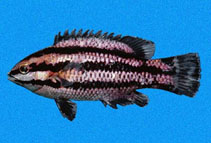
Body moderately deep and compressed; head large and pointed; teeth elongate and compressed, resembling incisors; dorsal fin contiguous, with 12 spines; posterior rays of dorsal and anal fins forming filamentous lobes; lower branch of first gill arch with 9 to 10 gill rakers; variable, depending on size and sex; body brown, black, red or orange, but less than 5 percent of the population is entirely black (Ref. 55763). Body shape (shape guide): fusiform / normal.
A sequentially protogynous hermaphrodite. In the Galapagos, the colorful appearance may be due to selective pressures and their increased feeding and decreased reproductive activities may serve to avoid extraordinary predation (Ref. 9227). Adults forage on a wide range of invertebrates and algae (Ref. 28023). Oviparous, distinct pairing during breeding (Ref. 205).
Ciclo vital y comportamiento de apareamiento Madurez | Reproducción | Puesta | Huevos | Fecundidad | Larva
Pelagic spawner (Ref. 32168). Oviparous, distinct pairing during breeding (Ref. 205). Also Ref. 103751.
Dinámica de la población Coeficiente del crecimiento para Edades / tallas máximas Longitud-peso rel. Longitud-longitud rel. Longitud-frecuencias Conversión de masas Reclutamiento Abundancia
Ciclo de vida Reproducción Madurez Madurez/Gills rel. Fecundidad Puesta Agregaciones de desove Huevos Desarrollo de los huevos Larva Dinámica larvaria
Fisiología Composición corporal Nutrientes Consumo del oxígeno Tipo de natación Velocidad de natación Pigmentos visuales Sonido de peces Enfermedades y parásitos Toxicidad (CL50)
Temperatura preferida (Referencia 123201): 16.6 - 24, mean 21.3 °C (based on 16 cells).
Índice de diversidad filogenética (Referencia 82804): PD50 = 0.5000 [Uniqueness, from 0.5 = low to 2.0 = high].
Bayesian length-weight: a=0.01047 (0.00493 - 0.02225), b=3.08 (2.90 - 3.26), in cm total length, based on LWR estimates for this Genus-body shape (Ref. 93245).
Nivel trófico (Referencia 69278): 2.7 ±0.24 se; based on food items.
Resiliencia (Referencia 120179): Bajo, población duplicada en un tiempo mínimo de 4.5-14 años (Preliminary K or Fecundity.).
Vulnerabilidad pesquera (Ref. 59153): Moderate vulnerability (44 of 100). 🛈