This website uses cookies to enhance your browsing experience and ensure the functionality of our site. For more detailed information about the types of cookies we use and how we protect your privacy, please visit our Privacy Information page.
×
Cookie Settings
This website uses different types of cookies to enhance your experience. Please select your preferences below:
> Eupercaria/misc (Various families in series Eupercaria) > Labridae (Wrasses) > Hypsigenyinae
Etymology: Bodianus:Bodianus after Bodiano or Pudiano, from the Portuguese pudor, meaning modesty (Jordan & Evermann, 1896); eclancheri:Named for M. L’Eclancher (Ref. 75973). Eponymy: Charles René Augustin Leclancher (1804–1857) was a French naval surgeon. [...] (Ref. 128868), visit book page. More on author: Valenciennes.
Umwelt: Milieu / Klimazone / Tiefenbereich / Verbreitungsgebiet Ökologie
seewasser riff-verbunden; tiefenbereich 5 - 46 m (Ref. 5227). Tropical
Southeast Pacific: Ecuador to central Chile. Originating in the Peru-Chile Province, it is found in the cooler waters of the Galapagos Islands.
Größe / Gewicht / Alter
Geschlechtsreife: Lm? range ? - ? cm Max length : 61.0 cm TL Männchen/unbestimmt; (Ref. 5592); common length : 40.0 cm TL Männchen/unbestimmt; (Ref. 55763)
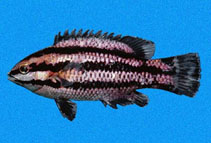
Body moderately deep and compressed; head large and pointed; teeth elongate and compressed, resembling incisors; dorsal fin contiguous, with 12 spines; posterior rays of dorsal and anal fins forming filamentous lobes; lower branch of first gill arch with 9 to 10 gill rakers; variable, depending on size and sex; body brown, black, red or orange, but less than 5 percent of the population is entirely black (Ref. 55763). Body shape (shape guide): fusiform / normal.
A sequentially protogynous hermaphrodite. In the Galapagos, the colorful appearance may be due to selective pressures and their increased feeding and decreased reproductive activities may serve to avoid extraordinary predation (Ref. 9227). Adults forage on a wide range of invertebrates and algae (Ref. 28023). Oviparous, distinct pairing during breeding (Ref. 205).
Bevorzugte Temperatur (Ref. 123201): 16.6 - 24, mean 21.3 °C (based on 16 cells).
Phylogenetischer Diversitätsindex (Ref. 82804): PD50 = 0.5000 [Uniqueness, from 0.5 = low to 2.0 = high].
Bayesian length-weight: a=0.01047 (0.00493 - 0.02225), b=3.08 (2.90 - 3.26), in cm total length, based on LWR estimates for this Genus-body shape (Ref. 93245).
Trophische Ebene (Ref. 69278): 2.7 ±0.24 se; based on food items.
Widerstandsfähigkeit (Ref. 120179): niedrig, Verdopplung der Population dauert 4,5 - 14 Jahre. (Preliminary K or Fecundity.).
Anfälligkeit der Fischerei (Ref. 59153): Moderate vulnerability (44 of 100). 🛈