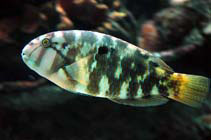
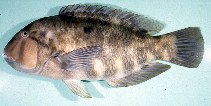
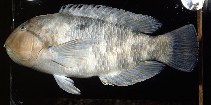
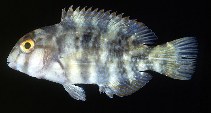
Choerodon graphicus, Graphic tuskfish : fisheries, aquarium

Choerodon graphicus (De Vis, 1885)

Graphic tuskfish
Beobachtung melden im Fish Watcher
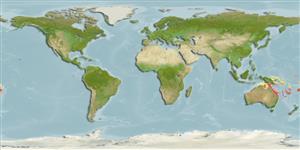
Native range | All suitable habitat | Point map | Year 2050
This map was computer-generated and has not yet been reviewed.
Choerodon graphicus   AquaMaps   Data sources: GBIF OBIS
Hochladen Photos und videos
Bilder | videos | Google Bild

Klassifizierung / Names Namen | Synonyme | Catalog of Fishes(Gattung, Arten) | ITIS | CoL | WoRMS | Cloffa

> Eupercaria/misc (Various families in series Eupercaria) > Labridae (Wrasses) > Hypsigenyinae
Etymology: Choerodon: Greek, choiros = a pig + odous = teeth (Ref. 45335); referrring to the prominent anterior canines of the species in this genus (Ref. 116605).

Umwelt: Milieu / Klimazone / Tiefenbereich / Verbreitungsgebiet Ökologie

seewasser riff-verbunden; tiefenbereich 15 - 40 m (Ref. 86942). Tropical

Verbreitung Territorien | FAO Gebiete | Ökosysteme | Vorkommen | Punkt Karte | Einführungen | Faunafri

Western Pacific: Philippines, Queensland, Australia to New Caledonia.

Größe / Gewicht / Alter

Geschlechtsreife: Lm ?  range ? - ? cm
Max length : 51.5 cm TL Männchen/unbestimmt; (Ref. 5525)

Kurzbeschreibung Bestimmungsschlüssel | Morphologie | Morphometrie

Rückenflossenstacheln (insgesamt) : 13; Rückenflossenweichstrahlen (insgesamt) : 7; Afterflossenstacheln: 3; Afterflossenweichstrahlen: 10. Body with about 5 to 7 complete broad dusky bands. A distinct dark spot centered on lateral line along dusky band below fifth or sixth dorsal-fin spine. Adults with second prominent anterior canine approximately 1/2 the size of the first, directed mostly dorsally. (Ref 9823)
Body shape (shape guide): short and / or deep; Cross section: oval.

Biologie     Fachlexikon (Englisch) (z.B. epibenthic)

Adults inhabit lagoon and seaward reefs, usually on rubble and sand bottoms (Ref. 9710) at depths greater than 20 m. Solitary. Feed mainly on hard-shelled prey including crustaceans, mollusks and sea urchins. Oviparous, distinct pairing during breeding (Ref. 205). Relatively common and easily approached (Ref. 9710).

Lebenszyklus und Paarungsverhalten Geschlechtsreife | Fortpflanzung | Ablaichen | Eier | Fruchtbarkeit | Larven

Oviparous, distinct pairing during breeding (Ref. 205).

Hauptreferenz Laden Sie Ihre Referenzen hoch | Referenzen | Koordinator : Westneat, Mark | Partner

Westneat, M.W., 2001. Labridae. Wrasses, hogfishes, razorfishes, corises, tuskfishes. p. 3381-3467. In K.E. Carpenter and V. Niem (eds.) FAO species identification guide for fishery purposes. The living marine resources of the Western Central Pacific. Vol. 6. Bony fishes part 4 (Labridae to Latimeriidae), estuarine crocodiles. FAO, Rome. (Ref. 9823)

IUCN Rote Liste Status (Ref. 130435: Version 2025-2 (Global))

  nicht bedroht (LC) ; Date assessed: 12 June 2008

CITES

Not Evaluated

CMS (Ref. 116361)

Not Evaluated

Bedrohung für Menschen

  Harmless


Nutzung durch Menschen

Fischereien: weniger kommerziell; Aquarium: Öffentliche Aquarien
FAO - Publication: search | FishSource |

Mehr Information

Trophische Ökologie
Lebensmittel (Beutetiere)
Nahrungszusammensetzung
Nahrungsaufnahme
Lebensmittelrationen
Räuber
Ökologie
Ökologie
Populationsdynamik
Wachstumsparameter
Max. Alter/Größen
Länge-Gewicht-Rel.
Länge-Länge-Verhältnis.
Längenhäufigkeiten
Massenkonvertierung
Rekrutierung
Dichte
Lebenszyklus
Fortpflanzung
Geschlechtsreife
Reifung/Kiemen rel.
Fruchtbarkeit
Ablaichen
Laichaggregationen
Eier
Eientwicklung
Larven
Larven Pop.Dyn.
Verbreitung
Territorien
FAO Gebiete
Ökosysteme
Vorkommen
Einführungen
BRUVS - Videos
Anatomie
Kiemenoberfläche
Gehirn
Otolith
Physiologie
Körperliche Zusammensetzung
Nährstoffe
Sauerstoffverbrauch
Schwimmart
Schwimmgeschwindigkeit
Visuelle Pigmente
Fischgeräusche
Krankheiten und Parasiten
Toxizität (LC50s)
Genetik
Genom
Genetik
Heterozygotie
Vererbbarkeit
Genetische Vielfalt
Menschenbezogen
Aquakultur-Systeme
Aquakultur Profile
Zuchtlinien
Ciguatera-Fälle
Briefmarken, Münzen, Verschiedenes.
Aufsuchen
Partner
Referenzen
Referenzen

Tools

Zusatzinformationen

Download XML

Internet Quellen

AFORO (otoliths) | Aquatic Commons | BHL | Cloffa | Websites from users | FishWatcher Einträge suchen | CISTI | Catalog of Fishes: Gattung, Arten | DiscoverLife | ECOTOX | FAO - Publication: search | Faunafri | Fishipedia | Fishtrace | GloBI | Google Books | Google Scholar | Google | IGFA World Record | OneZoom | Open Tree of Life | Otolith Atlas of Taiwan Fishes | PubMed | Reef Life Survey | Socotra Atlas | TreeBase | Tree of Life | Wikipedia: Gehe zu, Suchen | World Records Freshwater Fishing | Zoologischer Rekord

Schätzungen auf der Grundlage von Modellen

Bevorzugte Temperatur (Ref. 123201): 24.5 - 26.6, mean 26.1 °C (based on 42 cells).
Phylogenetischer Diversitätsindex (Ref. 82804):  PD50 = 0.5000   [Uniqueness, from 0.5 = low to 2.0 = high].
Bayesian length-weight: a=0.01445 (0.00856 - 0.02440), b=3.01 (2.85 - 3.17), in cm total length, based on LWR estimates for this species & (Sub)family-body (Ref. 93245).
Trophische Ebene (Ref. 69278):  4.3   ±0.0 se; based on diet studies.
Widerstandsfähigkeit (Ref. 120179):  mittel, Verdopplung der Population dauert 1,4 - 4,4 Jahre. (Preliminary K or Fecundity.).
Anfälligkeit der Fischerei (Ref. 59153):  Moderate vulnerability (41 of 100). 🛈
Preiskategorie (Ref. 80766):   Very high.
Nährstoffe (Ref. 124155):  Calcium = 34.4 [16.9, 61.0] mg/100g; Iron = 0.469 [0.255, 0.921] mg/100g; Protein = 18.5 [15.6, 20.9] %; Omega3 = 0.109 [0.066, 0.177] g/100g; Selenium = 32.3 [16.9, 63.8] μg/100g; VitaminA = 67.7 [17.0, 325.4] μg/100g; Zinc = 0.894 [0.598, 1.432] mg/100g (wet weight);