This website uses cookies to enhance your browsing experience and ensure the functionality of our site. For more detailed information about the types of cookies we use and how we protect your privacy, please visit our Privacy Information page.
×
Cookie Settings
This website uses different types of cookies to enhance your experience. Please select your preferences below:
> Eupercaria/misc (Various families in series Eupercaria) > Labridae (Wrasses) > Hypsigenyinae
Etymology: Choerodon:Greek, choiros = a pig + odous = teeth (Ref. 45335); referrring to the prominent anterior canines of the species in this genus (Ref. 116605).
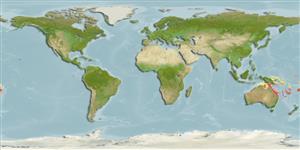
Environnement : milieu / zone climatique / profondeur / gamme de distribution Écologie
marin récifal; profondeur 15 - 40 m (Ref. 86942). Tropical
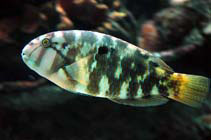
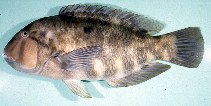
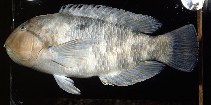
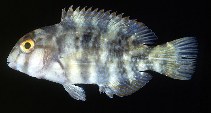
Épines dorsales (Total) : 13; Rayons mous dorsaux (Total) : 7; Épines anales: 3; Rayons mous anaux: 10. Body with about 5 to 7 complete broad dusky bands. A distinct dark spot centered on lateral line along dusky band below fifth or sixth dorsal-fin spine. Adults with second prominent anterior canine approximately 1/2 the size of the first, directed mostly dorsally. (Ref 9823) Body shape (shape guide): short and / or deep; Cross section: oval.
Adults inhabit lagoon and seaward reefs, usually on rubble and sand bottoms (Ref. 9710) at depths greater than 20 m. Solitary. Feed mainly on hard-shelled prey including crustaceans, mollusks and sea urchins. Oviparous, distinct pairing during breeding (Ref. 205). Relatively common and easily approached (Ref. 9710).
Cycle de vie et comportement reproducteur Maturité | Reproduction | Frai | Œufs | Fécondité | Larves
Oviparous, distinct pairing during breeding (Ref. 205).
Westneat, M.W., 2001. Labridae. Wrasses, hogfishes, razorfishes, corises, tuskfishes. p. 3381-3467. In K.E. Carpenter and V. Niem (eds.) FAO species identification guide for fishery purposes. The living marine resources of the Western Central Pacific. Vol. 6. Bony fishes part 4 (Labridae to Latimeriidae), estuarine crocodiles. FAO, Rome. (Ref. 9823)
Statut dans la liste rouge de l'IUCN (Ref. 130435: Version 2025-2 (Global))
Dynamique des populations Paramètres de croissance Âges / tailles maximales Longueur-poids rel. Rel. longueur-longueur. Fréquences de longueurs Conversion de masse Recrutement Abondance
Cycle de vie Reproduction Maturité Maturité/épines rel. Fécondité Frai Agrégats de frai Œufs Développement de l'œuf Larves Dynamique des populations larvaires
Physiologie Composition corporelle Nutriments Consommation d'oxygène Type de natation Vitesse de nage Pigments visuels Son de poisson Maladies et parasites Toxicité (CL50)
Température préférée (Réf. 123201): 24.5 - 26.6, mean 26.1 °C (based on 42 cells).
Indice de diversité phylogénétique (Réf. 82804): PD50 = 0.5000 [Uniqueness, from 0.5 = low to 2.0 = high].
Bayesian length-weight: a=0.01445 (0.00856 - 0.02440), b=3.01 (2.85 - 3.17), in cm total length, based on LWR estimates for this species & (Sub)family-body (Ref. 93245).
Niveau trophique (Réf. 69278): 4.3 ±0.0 se; based on diet studies.
Résilience (Réf. 120179): Milieu, temps minimum de doublement de population : 1,4 à 4,4 années (Preliminary K or Fecundity.).
Vulnérabilité de la pêche (Ref. 59153): Moderate vulnerability (41 of 100). 🛈