



Carcharias taurus Rafinesque, 1810
Sand tiger shark
Añada su observación en Fish Watcher
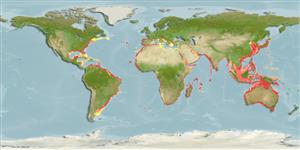
| Native range | All suitable habitat | Point map | Year 2050 |
|
| This map was computer-generated and has not yet been reviewed. |
| Carcharias taurus AquaMaps Data sources: GBIF OBIS |
Sube tu fotos y Vídeos
Imágenes | Vídeos | Sellos, monedas, varios | Google image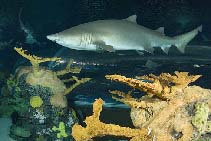 Carcharias taurus
Foto de Choromanski, J.M.
Imágenes | Vídeos | Sellos, monedas, varios | Google image
Foto de Choromanski, J.M.
Clasificación / Nombres Nombres comunes | Sinónimos | Catalog of Fishes(Género, Especie) | ITIS | CoL | WoRMS | Cloffa
Elasmobranquios (tiburones y rayas) (sharks and rays) > Lamniformes (Mackerel sharks) > Carchariidae (Ragged-tooth sharks)
Etymology: Carcharias: From the Ancient Greek karkharías, shark, derived from kárkharos, sharp or jagged, referring to a shark’s teeth (See ETYFish); taurus: Latin for bull, from Pesce Tauro, local name for this shark in Sicily, Italy, type locality (See ETYFish).
More on author: Rafinesque.
Etymology: Carcharias: From the Ancient Greek karkharías, shark, derived from kárkharos, sharp or jagged, referring to a shark’s teeth (See ETYFish); taurus: Latin for bull, from Pesce Tauro, local name for this shark in Sicily, Italy, type locality (See ETYFish).
More on author: Rafinesque.
Entorno: milieu / zona climática / rango de profundidad / gama de distribución Ecología
marino asociado a arrecife; oceanodromo (Ref. 51243); rango de profundidad 1 - 191 m (Ref. 247), usually 15 - 25 m (Ref. 43278). Subtropical; 45°N - 48°S, 100°W - 155°E
Distribución Territorios | Áreas FAO | Ecosistemas | Ocurrencias, apariciones | Mapa de puntos | Introducciones | Faunafri
Circumtropical: Except perhaps the eastern Pacific (Ref. 13568). Indo-West Pacific: Red Sea and off the coasts of South Africa to Japan, Korea and Australia (Ref. 13568). Present in Arafura Sea (Ref. 9819). Western Atlantic: Gulf of Maine to Argentina. Old record from Bermuda, south Brazil (Ref. 26938). Eastern Atlantic: Mediterranean to Cameroon. Northwest Atlantic: Canada (Ref. 5951).
Longitud en la primera madurez / Tamaño / Peso / Edad
Madurez: Lm 225.0, range 220 - 230 cm
Max length : 330 cm TL macho / no sexado; (Ref. 27549); common length : 250 cm TL macho / no sexado; (Ref. 6077); peso máximo publicado: 158.8 kg (Ref. 40637)
Max length : 330 cm TL macho / no sexado; (Ref. 27549); common length : 250 cm TL macho / no sexado; (Ref. 6077); peso máximo publicado: 158.8 kg (Ref. 40637)
Descripción breve Claves de identificación | Morfología | Morfometría
Espinas dorsales (total) : 0; Espinas anales: 0. A shark with a short, pointed snout, small eyes, protruding spike-like teeth and small, equal-sized dorsal and anal fins; 1st dorsal fin closer to pelvic than to pectoral fins (Ref. 5578). Caudal fin with a pronounced subterminal notch and a short ventral lobe (Ref. 13575). Pale brown or grey, paler below, with dark spots that appear faded in adults; fins plain (Ref. 6586).
Body shape (shape guide): fusiform / normal.
Body shape (shape guide): fusiform / normal.
A common littoral shark found inshore from the surf zone and in shallow bays to at least 191 m on the outer continental shelves (Ref. 13568). Often on or near the bottom but also occurs in midwater or at the surface (Ref. 247). Only shark known to gulp and store air in its stomach to maintain neutral buoyancy while swimming (Ref. 13568). Found singly or in small to large schools (Ref. 247). Feeds on bony fishes, small sharks, rays, squids, crabs, and lobsters (Ref. 5578). Ovoviviparous, embryos feeding on yolk sac and other ova produced by the mother as well as other siblings in the womb (uterine cannibalism) (Ref. 50449). Usually gives birth to 2 pups after a 9-12 months gestation period (Ref.58048). A migratory species in parts of its range, particularly in its northern and southern extremities where pronounced poleward migration occur in the summer and equatorial movements in autumn and winter (Ref. 247). Usually inoffensive and not aggressive when not provoked (Ref. 247) but has known to bite swimmers and be aggressive towards divers with speared fish (Ref. 6586). Utilized for fresh, frozen, smoked and dried for human consumption (Ref. 247); also for fishmeal, liver oil, fins, and hides for leather (Ref. 13568). Flesh highly appreciated in Japan (Ref. 36731).
Ciclo vital y comportamiento de apareamiento Madurez | Reproducción | Puesta | Huevos | Fecundidad | Larva
Exhibit ovoviparity (aplacental viviparity), with embryos feeding on other ova produced by the mother (oophagy) after the yolk sac is absorbed, then cannibalize siblings (adelphophagy) (Ref. 50449). Distinct pairing with embrace (Ref. 205). Eggs leave the ovaries, and while in transit in the oviducts are fertilized and enclosed in groups of 16 to 23 in egg cases. However, at some time between fertilization and birth only two (Ref. 5578, 6586) embryos of its group prevails, possibly by devouring its rivals, and proceeds to eat fertilized eggs and smaller potential siblings in utero until birth. According to Springer (1948) (Ref. 39565), it is evident that this species sends forth into the world not only large, well-developed, and even experienced young but may send them forth with a full stomach. The yolk sac is resorbed at a small size, less than 17 cm, and the umbilical scar may be lost. Gestation period may be from 8 to 9 months long. Size at birth 100 cm (Ref. 6586).
Pratt (2001) (Ref. 49562) relates Gordon's (1993) (Ref. 51113) detailed account of the mating behavior of the sand tiger sharks as follows: "mating activities began when the two male C. taurus, having become reluctant to feed, increased their swimming speed, accompanied by clasper flexion and eventual interest in their female tank mates...aggressive displays such as snapping and stalking became frequent, mostly toward species of smaller Carcharhinus in the tank. The males did not become interested in the female until she slowed, moved to the sand area and started cupping her pelvic fins. The two males then became competitive toward each other, circling and tailing, until the alpha male forced the beta male out of the sand area. The female bit the male prior to copulation. She exhibited shielding behavior for several days and then resumed cupping and flaring. The female gradually changed her swimming position and began displaying the submissive behavior. The alpha male swam in increasingly larger circles and began splaying its claspers, then approached the female and exhibited tailing and nosing. Copulation occurred as the male bit into the right flank and trailing edge of the pectoral fin of the female. The male swam side by side with the female, copulating with the right clasper for one to two minutes. After copulation, the male showed little interest in the female." In captivity, males show aggression toward other species after copulation (Ref. 51113, 49562). Females avoid patrolling males by 'shielding' with pelvics close to the substrate (Ref. 51113, 49562). However, female acceptance of future male partner is indicated by a show of 'submissive' body, 'cupping' and 'flaring' of pelvic fins (Ref. 51113, 49562).
Referencia principal
Suba sus referencias | Referencias | Coordinador : Compagno, Leonard J.V. | Colaboradores
Last, P.R. and J.D. Stevens, 1994. Sharks and rays of Australia. CSIRO, Australia. 513 p. (Ref. 6871)
Situación en la Lista Roja de la UICN (Ref. 130435: Version 2025-2 (Global))
Critically Endangered (CR) (A2bd); Date assessed: 07 December 2020
CITES
Not Evaluated
Amenaza para el ser humano
Traumatogenic (Ref. 4690)
Usos humanos
Pesquerías: comercial; pesca deportiva: si
FAO - pesquerías: desembarques, perfil de la especie; Publication: search | FishSource | Sea Around Us
Más información
Ecología Trófica
Alimentos (presas)
Composición de la dieta
consumo de alimento
Raciones de comida
Despredadores
Alimentos (presas)
Composición de la dieta
consumo de alimento
Raciones de comida
Despredadores
Dinámica de la población
Coeficiente del crecimiento para
Edades / tallas máximas
Longitud-peso rel.
Longitud-longitud rel.
Longitud-frecuencias
Conversión de masas
Reclutamiento
Abundancia
Coeficiente del crecimiento para
Edades / tallas máximas
Longitud-peso rel.
Longitud-longitud rel.
Longitud-frecuencias
Conversión de masas
Reclutamiento
Abundancia
Ciclo de vida
Reproducción
Madurez
Madurez/Gills rel.
Fecundidad
Puesta
Agregaciones de desove
Huevos
Desarrollo de los huevos
Larva
Dinámica larvaria
Reproducción
Madurez
Madurez/Gills rel.
Fecundidad
Puesta
Agregaciones de desove
Huevos
Desarrollo de los huevos
Larva
Dinámica larvaria
Distribución
Territorios
Áreas FAO
Ecosistemas
Ocurrencias, apariciones
Introducciones
BRUVS - Vídeos
Territorios
Áreas FAO
Ecosistemas
Ocurrencias, apariciones
Introducciones
BRUVS - Vídeos
Fisiología
Composición corporal
Nutrientes
Consumo del oxígeno
Tipo de natación
Velocidad de natación
Pigmentos visuales
Sonido de peces
Enfermedades y parásitos
Toxicidad (CL50)
Composición corporal
Nutrientes
Consumo del oxígeno
Tipo de natación
Velocidad de natación
Pigmentos visuales
Sonido de peces
Enfermedades y parásitos
Toxicidad (CL50)
Relacionados con el ser humano
Sistemas de acuicultura
Perfiles de acuicultura
Razas
Ciguatera cases
Sellos, monedas, varios
Sistemas de acuicultura
Perfiles de acuicultura
Razas
Ciguatera cases
Sellos, monedas, varios
Herramientas
Cuestionario orgánico | Libro electrónico | Guía de campo | Claves de identificación | Asistente para frecuencias de tallas | Herramienta de ciclo de vida | Mapa de puntos |
Catch-MSY |
Informes especiales
Comprobar el mantenimiento del acuario | Buscar fichas sobre especies | Consulte las hojas informativas sobre acuicultura
Descargar XML
Fuentes de Internet
AFORO (otoliths) | Aquatic Commons | BHL | Cloffa | Websites from users | Check FishWatcher | CISTI | Catalog of Fishes: Género, Especie | DiscoverLife | DORIS | ECOTOX | FAO - pesquerías: desembarques, perfil de la especie; Publication: search | Faunafri | Fishipedia | Fishtrace | GloBI | GoMexSI (interaction data) | Google Books | Google Scholar | Google | IGFA World Record | Bases de datos nacionales | OneZoom | Open Tree of Life | Otolith Atlas of Taiwan Fishes | Acuarios públicos | PubMed | Reef Life Survey | Socotra Atlas | TreeBase | Árbol de la vida | Wikipedia: Go, búsqueda | World Records Freshwater Fishing | Zoobank | Expediente Zoológico
Estimaciones basadas en modelos
Temperatura preferida (Referencia 123201): 12.5 - 28, mean 24.6 °C (based on 648 cells).
Índice de diversidad filogenética (Referencia 82804): PD50 = 1.0000 [Uniqueness, from 0.5 = low to 2.0 = high].
Bayesian length-weight: a=0.00741 (0.00277 - 0.01983), b=2.99 (2.76 - 3.22), in cm total length, based on LWR estimates for this (Sub)family-body shape (Ref. 93245).
Nivel trófico (Referencia 69278): 4.5 ±0.4 se; based on diet studies.
Resiliencia (Referencia 120179): Muy bajo, población duplicada en un tiempo mínimo superior a 14 años (Fec=2; K=0.14-0.17; tmax=17).
Nutrientes (Ref. 124155): Calcium = 4.12 [0.71, 19.42] mg/100g; Iron = 0.397 [0.092, 1.092] mg/100g; Protein = 21.2 [18.7, 23.6] %; Omega3 = 0.215 [0.084, 0.534] g/100g; Selenium = 20.9 [5.9, 65.0] μg/100g; VitaminA = 20 [7, 64] μg/100g; Zinc = 0.286 [0.136, 0.590] mg/100g (wet weight);