This website uses cookies to enhance your browsing experience and ensure the functionality of our site. For more detailed information about the types of cookies we use and how we protect your privacy, please visit our Privacy Information page.
×
Cookie Settings
This website uses different types of cookies to enhance your experience. Please select your preferences below:
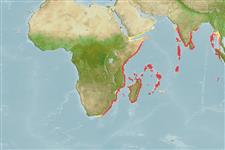
Indian Ocean: Gulf of Aden south to Port Alfred, South Africa and east to the northwest tip of Sumatra, Indonesia. Also found in the islands of western Indian Ocean, including Cargados Carajos and Rodriguez. Not known from the Red Sea and Persian Gulf.
Comprimento de primeira maturação / Tamanho / Peso / Idade
Maturidade: Lm?, range 49 - ? cm Max length : 90.0 cm TL macho/indeterminado; (Ref. 4319); common length : 45.0 cm TL macho/indeterminado; (Ref. 5450); peso máx. publicado: 15.0 kg (Ref. 4319)
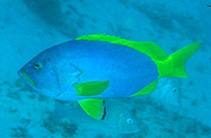
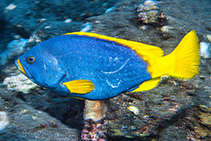
Espinhos dorsais (total) : 11; Raios dorsais (total) : 16 - 17; Espinhos anais: 3; Raios anais : 8. Adults have yellow fins. Small juveniles about half blue, half yellow (Ref. 48635); distinguished by having sky blue color of head and body in juveniles to dark bluish violet or dark greyish blue in adults; yellow upper lip; ctenoid scales on body except cycloid scales anterodorsally above lateral line and on thorax and abdomen; body of adult with numerous auxiliary scales; moderately deep bodied, greatest depth 2.4-2.8 in SL; truncate to slightly emarginate caudal fin; pelvic fins 1.7-2.0 in head length (Ref. 90102); further characterized by having head length 2.4-2.7 times in SL; preorbital depth 6.8-8.8 times in head length for fish 36-66 cm SL; interorbital area convex; adults posterior nostrils 4-5 times larger than anterior nostrils; subangular preopercle, serrae at angle enlarged; straight to slightly convex upper edge of operculum; maxilla reaches to or slightly past vertical at rear edge of eye; 2-4 rows of teeth on midlateral part of lower jaw (Ref. 89707). Body shape (shape guide): fusiform / normal; Cross section: compressed.
Juveniles inhabit shallow reefs while adults are found on deeper reefs. Feeds on a variety of fishes, crabs, shrimps, spiny lobsters, squids, and small octopi. Solitary (Ref 90102).
Ciclo de vida ou comportamento de acasalamento Maturidade | Reprodução | Desova | Ovos | Fecundidade | Larvas
Heemstra, P.C. and J.E. Randall, 1993. FAO Species Catalogue. Vol. 16. Groupers of the world (family Serranidae, subfamily Epinephelinae). An annotated and illustrated catalogue of the grouper, rockcod, hind, coral grouper and lyretail species known to date. Rome: FAO. FAO Fish. Synop. 125(16):382 p. (Ref. 5222)
Status na Lista Vermelha da UICN (Ref. 130435: Version 2025-2 (Global))
Ciclo de vida Reprodução Maturidade Maturidade/Rel. das guelras Fecundidade Desova Agregações de desova Ovos Desenvolvimento dos ovos Larvas Dinâmica larval
Fisiologia Composição corporal Nutrientes Consumo de oxigênio Tipo de natação Velocidade de natação Pigmentos visuais Som de peixe Doenças e Parasitas Toxicidade (LC50s)
Temperatura preferida (Ref. 123201): 23.3 - 28.1, mean 26.1 °C (based on 78 cells).
Índice de diversidade filogenética (Ref. 82804): PD50 = 0.5000 [Uniqueness, from 0.5 = low to 2.0 = high].
Bayesian length-weight: a=0.01148 (0.00555 - 0.02374), b=3.04 (2.87 - 3.21), in cm total length, based on LWR estimates for this Genus-body shape (Ref. 93245).
Nível Trófico (Ref. 69278): 4.2 ±0.55 se; based on food items.
Resiliência (Ref. 120179): Baixo, tempo mínimo de duplicação da população 4,5 - 14 anos (Preliminary K or Fecundity.).
Vulnerabilidade da pesca (Ref. 59153): High vulnerability (56 of 100). 🛈