



Lophius piscatorius Linnaeus, 1758
Angler
Waarneming toevoegen in Fish Watcher
| Native range | All suitable habitat | Point map | Year 2050 |

|
| This map was computer-generated and has not yet been reviewed. |
| Lophius piscatorius AquaMaps Data sources: GBIF OBIS |
Uploaden van uw Foto's en video's
Afbeeldingen | video's | Postzegels, munten, diversen. | Google afbeelding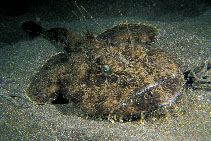 Lophius piscatorius
Afbeelding van Salesjö, A.
Afbeeldingen | video's | Postzegels, munten, diversen. | Google afbeelding
Afbeelding van Salesjö, A.
Classificatie / Namen Lokale namen | Synoniemen | Catalog of Fishes(Genus, Soort(en)) | ITIS | CoL | WoRMS | Cloffa
> Lophiiformes (Anglerfishes) > Lophiidae (Goosefishes)
Etymology: Lophius: Greek, lophos = crest (Ref. 45335).
More on author: Linnaeus.
Etymology: Lophius: Greek, lophos = crest (Ref. 45335).
More on author: Linnaeus.
Milieu: milieu / Klimaatzone / Diepte / verspreidingsgebied Ecologie
marien bathydemersaal; diepte 20 - 1000 m (Ref. 6302). Deep-water; 75°N - 30°N, 28°W - 46°E (Ref. 54568)
Verspreiding Gebieden | FAO regio's | Ecosystemen | Voorkomen | Verspreidingskaart | Introducties | Faunafri
Eastern Atlantic: south-western Barents Sea to Strait of Gibraltar including the Mediterranean and Black Sea. Reported from Iceland (Ref. 4712) and Mauritania (Ref. 5377). North Atlantic specimens attain larger sizes than those collected off West Africa and they also occur in shallower depths.
Lengte bij maturiteit / Grootte / Gewicht / Leeftijd
Maturiteit: Lm 55.0, range 35 - 60 cm
Max length : 200 cm SL mannelijk / geslacht onbekend; (Ref. 4712); common length : 100.0 cm SL mannelijk / geslacht onbekend; (Ref. 4712); max. gepubliceerd gewicht: 57.7 kg (Ref. 40637); max. gerapporteerde leeftijd: 24 Jaren (Ref. 46508)
Max length : 200 cm SL mannelijk / geslacht onbekend; (Ref. 4712); common length : 100.0 cm SL mannelijk / geslacht onbekend; (Ref. 4712); max. gepubliceerd gewicht: 57.7 kg (Ref. 40637); max. gerapporteerde leeftijd: 24 Jaren (Ref. 46508)
Korte beschrijving Determinatiesleutels | Morfologie | Morfometrie
Dorsale stekels (totaal) : 8; Dorsale zachte stralen (totaal) : 11 - 12; Anale zachte stralen: 9 - 10. Peritoneum pale. Head and body depressed. Mouth wide and cavernous. Skin thin and loose, scales absent. Esca bifid, 2 broad, flattened , leaf-like blades. Dorsal spines long, stout and bearing many well-developed tendrils; 4th spine greater than snout width (Ref. 4712).
Body shape (shape guide): short and / or deep; Cross section: flattened.
Body shape (shape guide): short and / or deep; Cross section: flattened.
Occurs on sandy and muddy bottoms from the coast (below 20 m, Ref. 12382) down to depths of 1,000 m. May also be found on rocky bottoms (Ref. 12382). It lies half-buried in the sediment waiting for its prey. It attracts prey by means of its fishing filament (Ref. 5377). Feeds mainly on fishes, occasionally sea-birds. Marketed fresh and frozen; eaten steamed, sautéed, broiled, boiled, fried, microwaved and baked (Ref. 9988). It is a well-studied species in Europe and is sold without the skin and the head under the name 'queue de Lotte' (Ref. 5377). Does not adapt well in home aquariums due to its large size (Ref. 12382).
Levenscyclus en paargedrag Maturiteit | Voortplanting | Paaien | Eieren | Fecunditeit | Larven
Hoofdreferentie
Upload uw referenties | Referenties | Coördinator : Ho, Hsuan-Ching | Medewerkers
Caruso, J.H., 1986. Lophiidae. p. 1362-1363. In P.J.P. Whitehead, M.-L. Bauchot, J.-C. Hureau, J. Nielsen and E. Tortonese (eds.) Fishes of the North-eastern Atlantic and the Mediterranean, Volume 3. Unesco, Paris. (Ref. 4712)
Status op de Rode Lijst van het IUCN (Ref. 130435: Version 2025-2 (Global))
Niet bedreigd (LC) ; Date assessed: 09 May 2013
CITES
Not Evaluated
Gevaar voor de mens
Harmless
Gebruik door de mens
Visserij: van groot commercieel belang
FAO - visserij: aanvoer, soortsprofiel; Publication: search | FIRMS - Stock assessments | FishSource | Sea Around Us
Meer informatie
Trofische ecologie
Voedsel (prooien)
Dieetsamenstelling
Voedselconsumptie
Voedselrantsoenen
Predatoren
Voedsel (prooien)
Dieetsamenstelling
Voedselconsumptie
Voedselrantsoenen
Predatoren
Levenscyclus
Voortplanting
Maturiteit
Rijpheid/kieuwen rel.
Fecunditeit
Paaien
Paaibestanden
Eieren
Ontwikkeling van de eieren
Larven
Larvale populatiedynamiek
Voortplanting
Maturiteit
Rijpheid/kieuwen rel.
Fecunditeit
Paaien
Paaibestanden
Eieren
Ontwikkeling van de eieren
Larven
Larvale populatiedynamiek
Fysiologie
Lichaamssamenstelling
Voedingsstoffen
Zuurstofverbruik
Type zwemmen
Zwemsnelheid
Visuele pigmenten
Vis geluid
Ziekten en parasieten
Toxiciteit (LC50)
Lichaamssamenstelling
Voedingsstoffen
Zuurstofverbruik
Type zwemmen
Zwemsnelheid
Visuele pigmenten
Vis geluid
Ziekten en parasieten
Toxiciteit (LC50)
Menselijk gerelateerd
Aquacultuursystemen
Aquacultuurprofielen
Kweeklijnen
Ciguatera gevallen
Postzegels, munten, diversen.
Aquacultuursystemen
Aquacultuurprofielen
Kweeklijnen
Ciguatera gevallen
Postzegels, munten, diversen.
Tools
Biologische quiz | E-boek | Veldgids | Determinatiesleutels | Lengtefrequentie Tool | Levenscyclus tool | Verspreidingskaart |
Vangst-MSY |
Speciale rapporten
Bekijk gegevens voor het houden in een aquarium | Bekijk Fact Sheets voor de soort | Bekijk Aquacultuur Fact Sheets
Download XML
Internetbronnen
AFORO (otoliths) | Aquatic Commons | BHL | Cloffa | Websites from users | Bekijk FishWatcher | CISTI | Catalog of Fishes: Genus, Soort(en) | DiscoverLife | DORIS | ECOTOX | FAO - visserij: aanvoer, soortsprofiel; Publication: search | Faunafri | Fishipedia | Fishtrace | GloBI | Google Books | Google Scholar | Google | IGFA World Record | Nationale databanken | OneZoom | Open Tree of Life | Otolith Atlas of Taiwan Fishes | Publieke aquaria | PubMed | Reef Life Survey | Socotra Atlas | TreeBase | Tree of Life | Wikipedia: ga naar, zoek | World Records Freshwater Fishing | Zoobank | Zoological Record
Schattingen op basis van modellen
Gewenste temperatuur (Ref. 123201): 3.8 - 14.2, mean 7.7 °C (based on 468 cells).
Fylogenetische diversiteitsindex (Ref. 82804): PD50 = 0.5078 [Uniqueness, from 0.5 = low to 2.0 = high].
Bayesian length-weight: a=0.01585 (0.01277 - 0.01966), b=2.92 (2.85 - 2.99), in cm total length, based on LWR estimates for this species (Ref. 93245).
Trofisch niveau (Ref. 69278): 4.5 ±0.1 se; based on diet studies.
Generation time: 11.0 (8.5 - 14.1) years. Estimated as median ln(3)/K based on 13 growth studies.
Weerstandsvermogen (Ref. 120179): Gemiddeld, minimale populatieverdubbelingstijd 1,4-4,4 jaar (K=0.07-0.33; tm=4.5-14; tmax=24; Fec=1 million).
Prior r = 0.47, 95% CL = 0.31 - 0.70, Based on 8 full stock assessments.
Voedingsstoffen (Ref. 124155): Calcium = 10.8 [5.5, 23.4] mg/100g; Iron = 0.381 [0.157, 0.847] mg/100g; Protein = 19.9 [16.2, 22.3] %; Omega3 = 0.214 [0.097, 0.481] g/100g; Selenium = 19.7 [7.1, 58.6] μg/100g; VitaminA = 4.58 [0.76, 28.24] μg/100g; Zinc = 0.137 [0.073, 0.438] mg/100g (wet weight); based on nutrient studies.