



Squaliolus laticaudus Smith & Radcliffe, 1912
Spined pygmy shark
Ajouter votre observation dans Fish Watcher
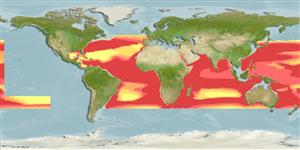
| Native range | All suitable habitat | Point map | Year 2050 |
|
| This map was computer-generated and has not yet been reviewed. |
| Squaliolus laticaudus AquaMaps Data sources: GBIF OBIS |
Envoyez vos Photos et vidéos
Images | Images Google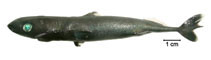 Squaliolus laticaudus
Photo de Fischer, L.G.
Images | Images Google
Photo de Fischer, L.G.
Classification / Noms Noms communs | Synonymes | Catalog of Fishes(Genre, Espèce) | ITIS | CoL | WoRMS | Cloffa
Élasmobranches (requins et raies) (sharks and rays) > Squaliformes (Sleeper and dogfish sharks) > Dalatiidae (Sleeper sharks)
Etymology: Squaliolus: Diminutive of squalus (L.), a sea-fish, usually applied to sharks, referring to small size of S. laticaudus (See ETYFish); laticaudus: latus (L.), wide or broad; cauda (L.), tail, referring to its broad (but short) caudal fin (See ETYFish).
More on authors: Smith & Radcliffe.
Etymology: Squaliolus: Diminutive of squalus (L.), a sea-fish, usually applied to sharks, referring to small size of S. laticaudus (See ETYFish); laticaudus: latus (L.), wide or broad; cauda (L.), tail, referring to its broad (but short) caudal fin (See ETYFish).
More on authors: Smith & Radcliffe.
Environnement : milieu / zone climatique / profondeur / gamme de distribution Écologie
marin bathypélagique; océanodrome (Ref. 51243); profondeur 200 - 1200 m (Ref. 27000). Deep-water; 48°N - 40°S, 180°W - 180°E
Distribution Territoires | Zones FAO | Écosystèmes | Occurrences | Carte par point | Introductions | Faunafri
Nearly circumtropical. Western Atlantic: off Bermuda, southern Brazil, and northern Argentina. Eastern Atlantic: off France and Madeira. Western Indian Ocean: off Somalia. Western Pacific: Japan, Taiwan and Philippines (Ref. 13748), as well as Australia (Ref. 7300).
Longueur à la première maturité / Taille / Poids / Âge
Maturité: Lm 18.5, range 17 - 20 cm
Max length : 22.0 cm TL mâle / non sexé; (Ref. 247); 25.0 cm TL (female)
Max length : 22.0 cm TL mâle / non sexé; (Ref. 247); 25.0 cm TL (female)
Description synthétique Clés d'identification | Morphologie | Morphométrie
Épines dorsales (Total) : 1; Épines anales: 0. The spined pygmy shark Squaliolus laticaudus is a very small dogfish (about 25cm) with a large eye (diameter 73-86% of interorbital width), upper margin nearly straight; upper lip without papillae (Ref. 31367, 6871). Color: dark with conspicuously light-margined fins (Ref. 247) . Edge of fins with bright border (Ref. 43998).
S. laticaudus is the type species of the genus which has the following distinctive features: fin spine on its first dorsal fin but not on its second dorsal fin; second dorsal fin long-based and low, about twice the length of first dorsal fin base; first dorsal-fin base closer to pectoral fins than to pelvic fins; and caudal fin nearly symmetrical, paddle-shaped, with subterminal notch present; low lateral keels on caudal peduncle . Body cigar-shaped; snout very long, bulbously conical but slightly pointed; mouth ventral; lips thin; teeth strongly different in both jaws, uppers small, narrow and erect cusps, lowers larger, blade-like and semi erect. Tooth rows 22-23/16-21. (Ref. 247, 6871).
Body shape (shape guide): elongated.
Body shape (shape guide): elongated.
An oceanic, wide-ranging, tropical pelagic species occurring near continental and insular land masses, sometimes over the shelves, but usually over the slopes (Ref. 247). Displays vertical migrations on a diel cycle, seen at the bottom during the day and travels to 200 m at night (Ref. 247). Feeds on deepwater squid, lanternfish, gonostomatids and idiacanthids, and probably follows its prey on their diel migrations (Ref. 247). Ovoviviparous (Ref. 205). Has well-developed photophores densely covering the ventral part of the body and sparsely seen on the sides and hardly developed on the dorsal surface (Ref. 247).
Cycle de vie et comportement reproducteur Maturité | Reproduction | Frai | Œufs | Fécondité | Larves
Probably ovoviviparous. Twelve mature eggs have been found in a single ovary of a mature female but this does not imply that large litters are produced (Ref. 247). Distinct pairing with embrace (Ref. 205).
Référence principale
Téléchargez vos références | Références | Coordinateur : Compagno, Leonard J.V. | Collaborateurs
Compagno, L.J.V., 1984. FAO Species Catalogue. Vol. 4. Sharks of the world. An annotated and illustrated catalogue of shark species known to date. Part 1 - Hexanchiformes to Lamniformes. FAO Fish. Synop. 125(4/1):1-249. Rome, FAO. (Ref. 247)
Statut dans la liste rouge de l'IUCN (Ref. 130435: Version 2025-2 (Global))
Préoccupation mineure (LC) ; Date assessed: 21 November 2019
CITES
Not Evaluated
Menace pour l'homme
Harmless
Utilisations par l'homme
Pêcheries: sans intérêt
FAO - Publication: search | FishSource |
Plus d'informations
Écologie trophique
Aliments (proies)
Composition du régime alimentaire
Consommation alimentaire
Rations alimentaires
Prédateurs
Aliments (proies)
Composition du régime alimentaire
Consommation alimentaire
Rations alimentaires
Prédateurs
Dynamique des populations
Paramètres de croissance
Âges / tailles maximales
Longueur-poids rel.
Rel. longueur-longueur.
Fréquences de longueurs
Conversion de masse
Recrutement
Abondance
Paramètres de croissance
Âges / tailles maximales
Longueur-poids rel.
Rel. longueur-longueur.
Fréquences de longueurs
Conversion de masse
Recrutement
Abondance
Cycle de vie
Reproduction
Maturité
Maturité/épines rel.
Fécondité
Frai
Agrégats de frai
Œufs
Développement de l'œuf
Larves
Dynamique des populations larvaires
Reproduction
Maturité
Maturité/épines rel.
Fécondité
Frai
Agrégats de frai
Œufs
Développement de l'œuf
Larves
Dynamique des populations larvaires
Physiologie
Composition corporelle
Nutriments
Consommation d'oxygène
Type de natation
Vitesse de nage
Pigments visuels
Son de poisson
Maladies et parasites
Toxicité (CL50)
Composition corporelle
Nutriments
Consommation d'oxygène
Type de natation
Vitesse de nage
Pigments visuels
Son de poisson
Maladies et parasites
Toxicité (CL50)
Génétique
génôme
Génétique
Hétérozygotie
Héritabilité
Diversité génétique
génôme
Génétique
Hétérozygotie
Héritabilité
Diversité génétique
Liées à l'homme
Systèmes d'aquaculture
Profils d'aquaculture
Souches
Cas de ciguatera
Timbres, pièces de monnaie, divers
Systèmes d'aquaculture
Profils d'aquaculture
Souches
Cas de ciguatera
Timbres, pièces de monnaie, divers
Outils
E-book | Guide de terrain | Clés d'identification | Générateur de fréquences de longueur | Outil de dynamique de population | Carte par point |
Capture-MSY |
Articles particuliers
Télécharger en XML
Sources Internet
AFORO (otoliths) | Aquatic Commons | BHL | Cloffa | Websites from users | FishWatcher | CISTI | Catalog of Fishes: Genre, Espèce | DiscoverLife | ECOTOX | FAO - Publication: search | Faunafri | Fishipedia | Fishtrace | GloBI | Google Books | Google Scholar | Google | IGFA World Record | Bases de données nationales | OneZoom | Open Tree of Life | Otolith Atlas of Taiwan Fishes | PubMed | Reef Life Survey | Socotra Atlas | TreeBase | Arbre de Vie | Wikipedia: aller à, chercher | World Records Freshwater Fishing | Zoobank | Zoological Record
Estimations basées sur des modèles
Température préférée (Réf. 123201): 7.1 - 14.6, mean 10 °C (based on 649 cells).
Indice de diversité phylogénétique (Réf. 82804): PD50 = 0.7510 [Uniqueness, from 0.5 = low to 2.0 = high].
Bayesian length-weight: a=0.00263 (0.00132 - 0.00522), b=3.13 (2.94 - 3.32), in cm total length, based on LWR estimates for this species & (Sub)family-body (Ref. 93245).
Niveau trophique (Réf. 69278): 4.2 ±0.73 se; based on food items.
Résilience (Réf. 120179): Faible, temps minimum de doublement de population : 4,5 à 14 années (Fec assumed to be <10).
Nutriments (Ref. 124155): Calcium = 15.1 [2.2, 91.4] mg/100g; Iron = 0.273 [0.062, 1.162] mg/100g; Protein = 19.1 [17.0, 21.3] %; Omega3 = 0.179 [0.048, 0.671] g/100g; Selenium = 8.32 [1.83, 33.05] μg/100g; VitaminA = 95.1 [10.1, 921.0] μg/100g; Zinc = 0.651 [0.261, 1.877] mg/100g (wet weight);