



Squaliolus laticaudus Smith & Radcliffe, 1912
Spined pygmy shark
Waarneming toevoegen in Fish Watcher
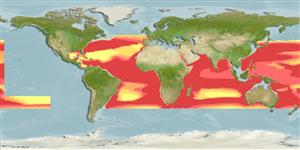
| Native range | All suitable habitat | Point map | Year 2050 |
|
| This map was computer-generated and has not yet been reviewed. |
| Squaliolus laticaudus AquaMaps Data sources: GBIF OBIS |
Uploaden van uw Foto's en video's
Afbeeldingen | Google afbeelding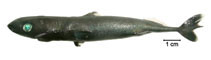 Squaliolus laticaudus
Afbeelding van Fischer, L.G.
Afbeeldingen | Google afbeelding
Afbeelding van Fischer, L.G.
Classificatie / Namen Lokale namen | Synoniemen | Catalog of Fishes(Genus, Soort(en)) | ITIS | CoL | WoRMS | Cloffa
Elasmobranchii (haaien en roggen) (sharks and rays) > Squaliformes (Sleeper and dogfish sharks) > Dalatiidae (Sleeper sharks)
Etymology: Squaliolus: Diminutive of squalus (L.), a sea-fish, usually applied to sharks, referring to small size of S. laticaudus (See ETYFish); laticaudus: latus (L.), wide or broad; cauda (L.), tail, referring to its broad (but short) caudal fin (See ETYFish).
More on authors: Smith & Radcliffe.
Etymology: Squaliolus: Diminutive of squalus (L.), a sea-fish, usually applied to sharks, referring to small size of S. laticaudus (See ETYFish); laticaudus: latus (L.), wide or broad; cauda (L.), tail, referring to its broad (but short) caudal fin (See ETYFish).
More on authors: Smith & Radcliffe.
Milieu: milieu / Klimaatzone / Diepte / verspreidingsgebied Ecologie
marien bathypelagisch; oceanodroom (Ref. 51243); diepte 200 - 1200 m (Ref. 27000). Deep-water; 48°N - 40°S, 180°W - 180°E
Verspreiding Gebieden | FAO regio's | Ecosystemen | Voorkomen | Verspreidingskaart | Introducties | Faunafri
Nearly circumtropical. Western Atlantic: off Bermuda, southern Brazil, and northern Argentina. Eastern Atlantic: off France and Madeira. Western Indian Ocean: off Somalia. Western Pacific: Japan, Taiwan and Philippines (Ref. 13748), as well as Australia (Ref. 7300).
Lengte bij maturiteit / Grootte / Gewicht / Leeftijd
Maturiteit: Lm 18.5, range 17 - 20 cm
Max length : 22.0 cm TL mannelijk / geslacht onbekend; (Ref. 247); 25.0 cm TL (female)
Max length : 22.0 cm TL mannelijk / geslacht onbekend; (Ref. 247); 25.0 cm TL (female)
Korte beschrijving Determinatiesleutels | Morfologie | Morfometrie
Dorsale stekels (totaal) : 1; Anale stekels: 0. The spined pygmy shark Squaliolus laticaudus is a very small dogfish (about 25cm) with a large eye (diameter 73-86% of interorbital width), upper margin nearly straight; upper lip without papillae (Ref. 31367, 6871). Color: dark with conspicuously light-margined fins (Ref. 247) . Edge of fins with bright border (Ref. 43998).
S. laticaudus is the type species of the genus which has the following distinctive features: fin spine on its first dorsal fin but not on its second dorsal fin; second dorsal fin long-based and low, about twice the length of first dorsal fin base; first dorsal-fin base closer to pectoral fins than to pelvic fins; and caudal fin nearly symmetrical, paddle-shaped, with subterminal notch present; low lateral keels on caudal peduncle . Body cigar-shaped; snout very long, bulbously conical but slightly pointed; mouth ventral; lips thin; teeth strongly different in both jaws, uppers small, narrow and erect cusps, lowers larger, blade-like and semi erect. Tooth rows 22-23/16-21. (Ref. 247, 6871).
Body shape (shape guide): elongated.
Body shape (shape guide): elongated.
An oceanic, wide-ranging, tropical pelagic species occurring near continental and insular land masses, sometimes over the shelves, but usually over the slopes (Ref. 247). Displays vertical migrations on a diel cycle, seen at the bottom during the day and travels to 200 m at night (Ref. 247). Feeds on deepwater squid, lanternfish, gonostomatids and idiacanthids, and probably follows its prey on their diel migrations (Ref. 247). Ovoviviparous (Ref. 205). Has well-developed photophores densely covering the ventral part of the body and sparsely seen on the sides and hardly developed on the dorsal surface (Ref. 247).
Levenscyclus en paargedrag Maturiteit | Voortplanting | Paaien | Eieren | Fecunditeit | Larven
Probably ovoviviparous. Twelve mature eggs have been found in a single ovary of a mature female but this does not imply that large litters are produced (Ref. 247). Distinct pairing with embrace (Ref. 205).
Hoofdreferentie
Upload uw referenties | Referenties | Coördinator : Compagno, Leonard J.V. | Medewerkers
Compagno, L.J.V., 1984. FAO Species Catalogue. Vol. 4. Sharks of the world. An annotated and illustrated catalogue of shark species known to date. Part 1 - Hexanchiformes to Lamniformes. FAO Fish. Synop. 125(4/1):1-249. Rome, FAO. (Ref. 247)
Status op de Rode Lijst van het IUCN (Ref. 130435: Version 2025-2 (Global))
Niet bedreigd (LC) ; Date assessed: 21 November 2019
CITES
Not Evaluated
Gevaar voor de mens
Harmless
Gebruik door de mens
Visserij: van geen belang
FAO - Publication: search | FishSource |
Meer informatie
Trofische ecologie
Voedsel (prooien)
Dieetsamenstelling
Voedselconsumptie
Voedselrantsoenen
Predatoren
Voedsel (prooien)
Dieetsamenstelling
Voedselconsumptie
Voedselrantsoenen
Predatoren
Populatiedynamica
Groeiparameters
Max. leeftijden / maten
Lengte-gewicht rel.
Lengte-lengte rel.
Lengtefrequenties
Massaconversie
Rekrutering
Abundantie
Groeiparameters
Max. leeftijden / maten
Lengte-gewicht rel.
Lengte-lengte rel.
Lengtefrequenties
Massaconversie
Rekrutering
Abundantie
Levenscyclus
Voortplanting
Maturiteit
Rijpheid/kieuwen rel.
Fecunditeit
Paaien
Paaibestanden
Eieren
Ontwikkeling van de eieren
Larven
Larvale populatiedynamiek
Voortplanting
Maturiteit
Rijpheid/kieuwen rel.
Fecunditeit
Paaien
Paaibestanden
Eieren
Ontwikkeling van de eieren
Larven
Larvale populatiedynamiek
Fysiologie
Lichaamssamenstelling
Voedingsstoffen
Zuurstofverbruik
Type zwemmen
Zwemsnelheid
Visuele pigmenten
Vis geluid
Ziekten en parasieten
Toxiciteit (LC50)
Lichaamssamenstelling
Voedingsstoffen
Zuurstofverbruik
Type zwemmen
Zwemsnelheid
Visuele pigmenten
Vis geluid
Ziekten en parasieten
Toxiciteit (LC50)
Genetica
genoom
Genetica
Heterozygositeit
Erfelijkheid
Genetische diversiteit
genoom
Genetica
Heterozygositeit
Erfelijkheid
Genetische diversiteit
Menselijk gerelateerd
Aquacultuursystemen
Aquacultuurprofielen
Kweeklijnen
Ciguatera gevallen
Postzegels, munten, diversen.
Aquacultuursystemen
Aquacultuurprofielen
Kweeklijnen
Ciguatera gevallen
Postzegels, munten, diversen.
Tools
E-boek | Veldgids | Determinatiesleutels | Lengtefrequentie Tool | Levenscyclus tool | Verspreidingskaart |
Vangst-MSY |
Speciale rapporten
Bekijk gegevens voor het houden in een aquarium | Bekijk Fact Sheets voor de soort | Bekijk Aquacultuur Fact Sheets
Download XML
Internetbronnen
AFORO (otoliths) | Aquatic Commons | BHL | Cloffa | Websites from users | Bekijk FishWatcher | CISTI | Catalog of Fishes: Genus, Soort(en) | DiscoverLife | ECOTOX | FAO - Publication: search | Faunafri | Fishipedia | Fishtrace | GloBI | Google Books | Google Scholar | Google | IGFA World Record | Nationale databanken | OneZoom | Open Tree of Life | Otolith Atlas of Taiwan Fishes | PubMed | Reef Life Survey | Socotra Atlas | TreeBase | Tree of Life | Wikipedia: ga naar, zoek | World Records Freshwater Fishing | Zoobank | Zoological Record
Schattingen op basis van modellen
|
Fylogenetische diversiteitsindex (Ref. 82804) |
PD50 = 0.7510 [Uniqueness, from 0.5 = low to 2.0 = high]. |
| Bayesian length-weight | a=0.00269 (0.00136 - 0.00534), b=3.13 (2.94 - 3.32), in cm total length, based on LWR estimates for this species & (Sub)family-body (Ref. 93245). |
|
Trofisch niveau (Ref. 69278) |
4.2 ±0.73 se; based on food items. |
|
Weerstandsvermogen (Ref. 120179) |
laag, minimale populatieverdubbelingstijd 4,5-14 jaar (Fec assumed to be <10). |
|
Kwetsbaarheid van de visserij (Ref. 59153) |
Low vulnerability (20 of 100). 🛈 |
|
Voedingsstoffen (Ref. 124155) |
Calcium = 15.1 [2.2, 91.4] mg/100g; Iron = 0.273 [0.062, 1.162] mg/100g; Protein = 19.1 [17.0, 21.3] %; Omega3 = 0.179 [0.048, 0.671] g/100g; Selenium = 8.32 [1.83, 33.05] μg/100g; VitaminA = 95.1 [10.1, 921.0] μg/100g; Zinc = 0.651 [0.261, 1.877] mg/100g (wet weight); |