



Labeotropheus candipygia Pauers & Phiri, 2023
Загрузить свой Фото и Видео
Изображение на Google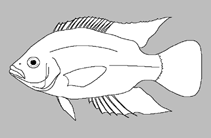 No image available for this species;
drawing shows typical species in Cichlidae.
Изображение на Google
drawing shows typical species in Cichlidae.
Классификация / Имена народные названия | синонимы | Catalog of Fishes(род, виды) | ITIS | CoL | WoRMS | Cloffa
> Cichliformes (Cichlids, convict blennies) > Cichlidae (Cichlids) > Pseudocrenilabrinae
Etymology: Labeotropheus: Latin, labeo = one who has large lips + Greek, tropaion = defeat, a memorial of a fighting war, trophy; because of their specialized teeth were such an obvious feeding adaptation (Ref. 45335); candipygia: The specific epithet combines the Latin adjective for white or brilliant, candidum, and the new Latin noun pygia, meaning rump or buttocks; this refers to the bright white or bluish-white ventrum of the males (Ref. 128773).
Etymology: Labeotropheus: Latin, labeo = one who has large lips + Greek, tropaion = defeat, a memorial of a fighting war, trophy; because of their specialized teeth were such an obvious feeding adaptation (Ref. 45335); candipygia: The specific epithet combines the Latin adjective for white or brilliant, candidum, and the new Latin noun pygia, meaning rump or buttocks; this refers to the bright white or bluish-white ventrum of the males (Ref. 128773).
Окружающая среда: среда / климатическая зона / пределы глубины / диапазон распространения экология
; пресноводный донно-пелагический. Tropical
распространение Территории | регионы FAO | Экосистемы | места находок | карта точек | интродукции | Faunafri
Africa: Malawi.
Размер / Вес / Возраст
Краткое описание определительные ключи | морфология | морфометрия
колючие лучи спинного плавника (общее число) : 16 - 19; членистые (мягкие) лучи спинного плавника (общее число) : 7 - 10; колючие лучи анального плавника: 3; членистые (мягкие) лучи анального плавника: 7 - 9. Diagnosis: Labeotropheus candipygia differs from all other species of Labeotropheus by the typical nuptial colouration of the males: male L. candipygia have a distinct iridescent silvery-blue or silvery-white ventral surface; this unique colouration extends from the branchiostegals to the anus in all individuals, and will extend to through the caudal peduncle to the ventral attachment of the caudal fin in some individuals; above this silvery-white ventrum, males are ochreous orange, which covers most of the head and can extend to the base of the dorsal fin, and extends posteriorly through the caudal peduncle to the base of the caudal fin, or they will be a dull greyish blue with ochreous-orange highlights on the scales of the dorsum; both colour patterns feature a brilliantly iridescent white dorsal fin that has ochreous-orange tips, and patches of iridescent blue, black, orange, or red pigmentation (Ref. 128773). Labeotropheus candipygia differs from the slender-bodied Labeotropheus, L. trewavasae, L. simoneae, L. chirangali, except L. rubidorsalis, due to its greater body depth, 32.0-38.6% of standard length vs. 26.3-33.4% in L. trewavasae, 26.9-30.8% in L. simoneae, 26.6-33.2% in L. chirangali; it does have a generally deeper body than L. rubidorsalis, although the ranges overlap, 31.6-36.1% in L. rubidorsalis; It differs from L. rubidorsalis primarily in the nuptial colouration of the males, but also by a generally shorter snout length, 19.7-33.9% of head length vs. 29.8-42.7%, a longer snout pad, 11.3-19.2% of head length vs. 10.3-14.4%, and a greater number of tooth rows in the upper jaw, 4-6 vs. 3-4 (Ref. 128773). Labeotropheus candipygia differs from the other robust-bodied Labeotropheus primarily via male nuptial colouration (Ref. 128773). While the morphometric and meristic values largely overlap with the other robust Labeotropheus, there are some distinctions: Labeotropheus candipygia has a greater distance between the tip of the snout and the origin of the dorsal fin, 32.2-36.8% of standard length vs. 30.8-33.8%, a shorter distance between the insertion of the dorsal and anal fins, 13.9-16.7% of standard length vs. 16.5-17.4%, and fewer teeth in the left side of the lower jaw, 23-24 vs. 31-43, than L. fuelleborni; it typically has a shorter snout, 19.7-33.9% of head length vs. 25.2-40.8%, greater rostral length, 35.1-49.7% of head length vs. 22.9-43.7%, and a larger snout pad, 11.3-19.2% of head length vs. 7.4-16.1%, than L. artatorostris; it has a narrower interorbital width, 32.7-42.8% of head length vs. 40.1-43.5%, and typically fewer infraorbital neuromasts, 13-33 vs. 25-40, than L. chlorosiglos; it differs from L. obscurus due to a shorter distance between the insertions of the dorsal and anal fins, 13.9-16.7% of standard length vs. 15.8-17.8%, a shorter distance between the insertion of the dorsal fin and the origin of the anal fin, 27.4-31.7% of standard length vs. 30.3-33.2%, a typically shorter lower jaw, 21.5-39.4% of head length vs. 27.6-40.4%, more rows of teeth in the upper jaw, 4-6 vs. 3-4, more teeth in the left half of the lower jaw, 23-34 vs. 20-26, and fewer infraorbital neuromasts, 13-33 vs. 22-46 (Ref. 128773).
Жизненный цикл и брачное поведение половая зрелость | размножение | нерест | икра | Плодовитость | личинки
Основная ссылка
Загрузите свои рекомендации | ссылки | координатор : Kullander, Sven O. | соавторы
Pauers, M.J. and T.B. Phiri, 2023. Six new species of Labeotropheus (Cichliformes: Cichlidae) from the Malawian shore of Lake Malawi, Africa. Ichthyology & Herpetology 111(2):264-292. (Ref. 128773)
CITES
Not Evaluated
Угроза для людей
Harmless
Использование человеком
рыболовство: интереса не представляет
FAO - Publication: search | FishSource |
дополнительная информация
Трофическая экология
Пищевые предметы (добыча)
состав пищи
потребление пищи
Продовольственные пайки
хищники
Пищевые предметы (добыча)
состав пищи
потребление пищи
Продовольственные пайки
хищники
Динамика численности населения
Параметры роста
Макс. возраст / размер
Отношение длины к весу.
Отношение длины к длине.
Размерный состав
Преобразование массы
пополнение
численность
Параметры роста
Макс. возраст / размер
Отношение длины к весу.
Отношение длины к длине.
Размерный состав
Преобразование массы
пополнение
численность
Жизненный цикл
размножение
половая зрелость
Зрелость/Жиры относительно.
Плодовитость
нерест
Нерестовые скопления
икра
Развитие икры
личинки
динамика численности личинок
размножение
половая зрелость
Зрелость/Жиры относительно.
Плодовитость
нерест
Нерестовые скопления
икра
Развитие икры
личинки
динамика численности личинок
Анатомия
жаберная область
Мозг
Отолит
жаберная область
Мозг
Отолит
Физиология
Состав тела
Питательные вещества
Потребление кислорода
Тип плавания
Скорость плавания
Зрительные пигменты
Звук рыбы
Болезни и паразиты
Токсичность (LC50s)
Состав тела
Питательные вещества
Потребление кислорода
Тип плавания
Скорость плавания
Зрительные пигменты
Звук рыбы
Болезни и паразиты
Токсичность (LC50s)
генетика
Геном
генетика
Гетерозиготность
наследуемость
Генетическое разнообразие
Геном
генетика
Гетерозиготность
наследуемость
Генетическое разнообразие
Связанные с человеком
Системы аквакультуры
особенности рыбоводства
степень растяжения
Случаи заболевания сигуатерой
Марки, монеты и прочее.
Системы аквакультуры
особенности рыбоводства
степень растяжения
Случаи заболевания сигуатерой
Марки, монеты и прочее.
инструменты
Специальные отчеты
Проверить содержание в аквариумах | Проверить опубликованные видовые данные | Проверить опубликованные данные по аквакультуре
Скачать в формате XML
ресурсы в Интернет
AFORO (otoliths) | Aquatic Commons | BHL | Cloffa | Websites from users | Проверить FishWatcher | CISTI | Catalog of Fishes: род, виды | DiscoverLife | ECOTOX | FAO - Publication: search | Faunafri | Fishipedia | Fishtrace | GloBI | Google Books | Google Scholar | Google | IGFA World Record | OneZoom | Open Tree of Life | Otolith Atlas of Taiwan Fishes | PubMed | Reef Life Survey | Socotra Atlas | TreeBase | Tree of Life | Wikipedia: Вперёд, поиск | | Zoobank | Зоологическая летопись
Оценки, основанные на моделях
|
Индекс филогенетического разнообразия (ссылка 82804) |
PD50 = 0.5005 [Uniqueness, from 0.5 = low to 2.0 = high]. |
| Bayesian length-weight | a=0.01445 (0.00671 - 0.03113), b=2.99 (2.82 - 3.16), in cm total length, based on LWR estimates for this (Sub)family-body shape (Ref. 93245). |
|
Трофический уровень (ссылка 69278) |
3.3 ±0.4 se; based on size and trophs of closest relatives |
|
устойчивость к внешним воздействиям (ссылка 120179) |
высокий, минимальное время удвоения популяции до 15 месяцев (Preliminary K or Fecundity.). |
|
Уязвимость рыбной ловли (Ref. 59153) |
Low vulnerability (14 of 100). 🛈 |