



Labeotropheus candipygia Pauers & Phiri, 2023
Hochladen Photos und videos
Google Bild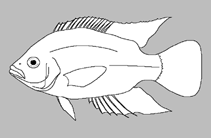 No image available for this species;
drawing shows typical species in Cichlidae.
Google Bild
drawing shows typical species in Cichlidae.
Klassifizierung / Names Namen | Synonyme | Catalog of Fishes(Gattung, Arten) | ITIS | CoL | WoRMS | Cloffa
> Cichliformes (Cichlids, convict blennies) > Cichlidae (Cichlids) > Pseudocrenilabrinae
Etymology: Labeotropheus: Latin, labeo = one who has large lips + Greek, tropaion = defeat, a memorial of a fighting war, trophy; because of their specialized teeth were such an obvious feeding adaptation (Ref. 45335); candipygia: The specific epithet combines the Latin adjective for white or brilliant, candidum, and the new Latin noun pygia, meaning rump or buttocks; this refers to the bright white or bluish-white ventrum of the males (Ref. 128773).
Etymology: Labeotropheus: Latin, labeo = one who has large lips + Greek, tropaion = defeat, a memorial of a fighting war, trophy; because of their specialized teeth were such an obvious feeding adaptation (Ref. 45335); candipygia: The specific epithet combines the Latin adjective for white or brilliant, candidum, and the new Latin noun pygia, meaning rump or buttocks; this refers to the bright white or bluish-white ventrum of the males (Ref. 128773).
Umwelt: Milieu / Klimazone / Tiefenbereich / Verbreitungsgebiet Ökologie
; süßwasser benthopelagisch. Tropical
Verbreitung Territorien | FAO Gebiete | Ökosysteme | Vorkommen | Punkt Karte | Einführungen | Faunafri
Africa: Malawi.
Größe / Gewicht / Alter
Kurzbeschreibung Bestimmungsschlüssel | Morphologie | Morphometrie
Rückenflossenstacheln (insgesamt) : 16 - 19; Rückenflossenweichstrahlen (insgesamt) : 7 - 10; Afterflossenstacheln: 3; Afterflossenweichstrahlen: 7 - 9. Diagnosis: Labeotropheus candipygia differs from all other species of Labeotropheus by the typical nuptial colouration of the males: male L. candipygia have a distinct iridescent silvery-blue or silvery-white ventral surface; this unique colouration extends from the branchiostegals to the anus in all individuals, and will extend to through the caudal peduncle to the ventral attachment of the caudal fin in some individuals; above this silvery-white ventrum, males are ochreous orange, which covers most of the head and can extend to the base of the dorsal fin, and extends posteriorly through the caudal peduncle to the base of the caudal fin, or they will be a dull greyish blue with ochreous-orange highlights on the scales of the dorsum; both colour patterns feature a brilliantly iridescent white dorsal fin that has ochreous-orange tips, and patches of iridescent blue, black, orange, or red pigmentation (Ref. 128773). Labeotropheus candipygia differs from the slender-bodied Labeotropheus, L. trewavasae, L. simoneae, L. chirangali, except L. rubidorsalis, due to its greater body depth, 32.0-38.6% of standard length vs. 26.3-33.4% in L. trewavasae, 26.9-30.8% in L. simoneae, 26.6-33.2% in L. chirangali; it does have a generally deeper body than L. rubidorsalis, although the ranges overlap, 31.6-36.1% in L. rubidorsalis; It differs from L. rubidorsalis primarily in the nuptial colouration of the males, but also by a generally shorter snout length, 19.7-33.9% of head length vs. 29.8-42.7%, a longer snout pad, 11.3-19.2% of head length vs. 10.3-14.4%, and a greater number of tooth rows in the upper jaw, 4-6 vs. 3-4 (Ref. 128773). Labeotropheus candipygia differs from the other robust-bodied Labeotropheus primarily via male nuptial colouration (Ref. 128773). While the morphometric and meristic values largely overlap with the other robust Labeotropheus, there are some distinctions: Labeotropheus candipygia has a greater distance between the tip of the snout and the origin of the dorsal fin, 32.2-36.8% of standard length vs. 30.8-33.8%, a shorter distance between the insertion of the dorsal and anal fins, 13.9-16.7% of standard length vs. 16.5-17.4%, and fewer teeth in the left side of the lower jaw, 23-24 vs. 31-43, than L. fuelleborni; it typically has a shorter snout, 19.7-33.9% of head length vs. 25.2-40.8%, greater rostral length, 35.1-49.7% of head length vs. 22.9-43.7%, and a larger snout pad, 11.3-19.2% of head length vs. 7.4-16.1%, than L. artatorostris; it has a narrower interorbital width, 32.7-42.8% of head length vs. 40.1-43.5%, and typically fewer infraorbital neuromasts, 13-33 vs. 25-40, than L. chlorosiglos; it differs from L. obscurus due to a shorter distance between the insertions of the dorsal and anal fins, 13.9-16.7% of standard length vs. 15.8-17.8%, a shorter distance between the insertion of the dorsal fin and the origin of the anal fin, 27.4-31.7% of standard length vs. 30.3-33.2%, a typically shorter lower jaw, 21.5-39.4% of head length vs. 27.6-40.4%, more rows of teeth in the upper jaw, 4-6 vs. 3-4, more teeth in the left half of the lower jaw, 23-34 vs. 20-26, and fewer infraorbital neuromasts, 13-33 vs. 22-46 (Ref. 128773).
Lebenszyklus und Paarungsverhalten Geschlechtsreife | Fortpflanzung | Ablaichen | Eier | Fruchtbarkeit | Larven
Hauptreferenz
Laden Sie Ihre Referenzen hoch | Referenzen | Koordinator : Kullander, Sven O. | Partner
Pauers, M.J. and T.B. Phiri, 2023. Six new species of Labeotropheus (Cichliformes: Cichlidae) from the Malawian shore of Lake Malawi, Africa. Ichthyology & Herpetology 111(2):264-292. (Ref. 128773)
CITES
Not Evaluated
Bedrohung für Menschen
Harmless
Nutzung durch Menschen
Fischereien: nicht kommerziell
FAO - Publication: search | FishSource |
Mehr Information
Trophische Ökologie
Lebensmittel (Beutetiere)
Nahrungszusammensetzung
Nahrungsaufnahme
Lebensmittelrationen
Räuber
Lebensmittel (Beutetiere)
Nahrungszusammensetzung
Nahrungsaufnahme
Lebensmittelrationen
Räuber
Populationsdynamik
Wachstumsparameter
Max. Alter/Größen
Länge-Gewicht-Rel.
Länge-Länge-Verhältnis.
Längenhäufigkeiten
Massenkonvertierung
Rekrutierung
Dichte
Wachstumsparameter
Max. Alter/Größen
Länge-Gewicht-Rel.
Länge-Länge-Verhältnis.
Längenhäufigkeiten
Massenkonvertierung
Rekrutierung
Dichte
Lebenszyklus
Fortpflanzung
Geschlechtsreife
Reifung/Kiemen rel.
Fruchtbarkeit
Ablaichen
Laichaggregationen
Eier
Eientwicklung
Larven
Larven Pop.Dyn.
Fortpflanzung
Geschlechtsreife
Reifung/Kiemen rel.
Fruchtbarkeit
Ablaichen
Laichaggregationen
Eier
Eientwicklung
Larven
Larven Pop.Dyn.
Anatomie
Kiemenoberfläche
Gehirn
Otolith
Kiemenoberfläche
Gehirn
Otolith
Physiologie
Körperliche Zusammensetzung
Nährstoffe
Sauerstoffverbrauch
Schwimmart
Schwimmgeschwindigkeit
Visuelle Pigmente
Fischgeräusche
Krankheiten und Parasiten
Toxizität (LC50s)
Körperliche Zusammensetzung
Nährstoffe
Sauerstoffverbrauch
Schwimmart
Schwimmgeschwindigkeit
Visuelle Pigmente
Fischgeräusche
Krankheiten und Parasiten
Toxizität (LC50s)
Genetik
Genom
Genetik
Heterozygotie
Vererbbarkeit
Genetische Vielfalt
Genom
Genetik
Heterozygotie
Vererbbarkeit
Genetische Vielfalt
Menschenbezogen
Aquakultur-Systeme
Aquakultur Profile
Zuchtlinien
Ciguatera-Fälle
Briefmarken, Münzen, Verschiedenes.
Aquakultur-Systeme
Aquakultur Profile
Zuchtlinien
Ciguatera-Fälle
Briefmarken, Münzen, Verschiedenes.
Tools
Zusatzinformationen
Download XML
Zusammenfassung | Punktdaten | Namen | Photos
Internet Quellen
AFORO (otoliths) | Aquatic Commons | BHL | Cloffa | Websites from users | FishWatcher Einträge suchen | CISTI | Catalog of Fishes: Gattung, Arten | DiscoverLife | ECOTOX | FAO - Publication: search | Faunafri | Fishipedia | Fishtrace | GloBI | Google Books | Google Scholar | Google | IGFA World Record | OneZoom | Open Tree of Life | Otolith Atlas of Taiwan Fishes | PubMed | Reef Life Survey | Socotra Atlas | TreeBase | Tree of Life | Wikipedia: Gehe zu, Suchen | World Records Freshwater Fishing | Zoobank | Zoologischer Rekord
Schätzungen auf der Grundlage von Modellen
Phylogenetischer Diversitätsindex (Ref. 82804): PD50 = 0.5005 [Uniqueness, from 0.5 = low to 2.0 = high].
Bayesian length-weight: a=0.01445 (0.00671 - 0.03113), b=2.99 (2.82 - 3.16), in cm total length, based on LWR estimates for this (Sub)family-body shape (Ref. 93245).
Trophische Ebene (Ref. 69278): 3.3 ±0.4 se; based on size and trophs of closest relatives
Widerstandsfähigkeit (Ref. 120179): hoch, Verdopplung der Population dauert weniger als 15 Monate. (Preliminary K or Fecundity.).