



Symphurus leptosomus Lee & Munroe, 2021
Slender tonguefish
Envoyez vos Photos et vidéos
Images Google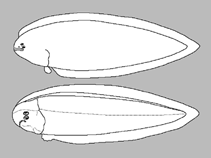 No image available for this species;
drawing shows typical species in Cynoglossidae.
Images Google
drawing shows typical species in Cynoglossidae.
Classification / Noms Noms communs | Synonymes | Catalog of Fishes(Genre, Espèce) | ITIS | CoL | WoRMS | Cloffa
> Pleuronectiformes (Flatfishes) > Cynoglossidae (Tonguefishes) > Symphurinae
Etymology: Symphurus: Greek, syn, symphysis = grown together + Greek, oura = tail (Ref. 45335); leptosomus: Name from Greek 'lepto' meaning slender, and 'somus' for body, referring to its relatively slender, elongate body compared with that other similar species of shallow-water tonguefishes.
Etymology: Symphurus: Greek, syn, symphysis = grown together + Greek, oura = tail (Ref. 45335); leptosomus: Name from Greek 'lepto' meaning slender, and 'somus' for body, referring to its relatively slender, elongate body compared with that other similar species of shallow-water tonguefishes.
Environnement : milieu / zone climatique / profondeur / gamme de distribution Écologie
marin démersal; profondeur ? - 15 m (Ref. 126065). Tropical
Distribution Territoires | Zones FAO | Écosystèmes | Occurrences | Carte par point | Introductions | Faunafri
Western Pacific: Philippines.
Taille / Poids / Âge
Description synthétique Clés d'identification | Morphologie | Morphométrie
Rayons mous dorsaux (Total) : 88; Rayons mous anaux: 72; Vertèbres: 47. This species is distinguished from all its congeners by the following set of characters: ID pattern1-2-2-2-2; caudal-fin rays 12; vertebrae, abdominal 9 (3 + 6), total 7; hypurals4; D 88, A 72; longitudinal scale rows 76; transverse scale rows 37; scale rows on head posterior to lower orbit 20; an elongate body, with preanal length much longer than body depth (PAL/BD = 1.09); head moderately long (HL = 23.9% of SL), head length slightly shorter than head width (HW/HL = 1.02); postorbital length short (POL = 65.5% of HL); the upper head lobe larger than lower head lobe; dorsal-fin origin at vertical through midpoint of upper eye; predorsal length moderately long (PDL = 20.4% of HL); snout short (SNL = 16.8% of HL), rounded anteriorly; upper eye slightly in advance of lower eye; fleshy ridge well-developed on posterior part of ocular-side lower jaw, with fleshy membrane covering both upper and lower eyes, and membranous fleshy flap continuous between ocular-side anterior nostril and lower part of eye. Colouration: ocular-side pigmentation uniformly yellow to light-brown with dark-brown irregular speckles and blotches while the blind-side pigmentation is uniformly white, with well-developed pepper-dots and dermal melanophores at bases of dorsal and anal fins; bases of anteriormost dorsal- and anal-fin rays with obvious dermal spots on both sides; peritoneum bluish-black (Ref. 126065).
Cross section: flattened.
Cross section: flattened.
A shallow-water tonguefish occurring at depths of ca. 15 m (Ref. 126065).
Cycle de vie et comportement reproducteur Maturité | Reproduction | Frai | Œufs | Fécondité | Larves
Référence principale
Téléchargez vos références | Références | Coordinateur | Collaborateurs
Lee, M.-Y. and T.A. Munroe, 2021. Unraveling cryptic diversity among shallow-water tonguefishes (Pleuronectiformes: Cynoglossidae: Symphurus) from the Indo-West Pacific region, with descriptions of five new species. Zootaxa 5039(1):1-5.5 (Ref. 126065)
CITES
Not Evaluated
Menace pour l'homme
Harmless
Utilisations par l'homme
FAO - Publication: search | FishSource |
Plus d'informations
Écologie trophique
Aliments (proies)
Composition du régime alimentaire
Consommation alimentaire
Rations alimentaires
Prédateurs
Aliments (proies)
Composition du régime alimentaire
Consommation alimentaire
Rations alimentaires
Prédateurs
Écologie
Écologie
Écologie
Dynamique des populations
Paramètres de croissance
Âges / tailles maximales
Longueur-poids rel.
Rel. longueur-longueur.
Fréquences de longueurs
Conversion de masse
Recrutement
Abondance
Paramètres de croissance
Âges / tailles maximales
Longueur-poids rel.
Rel. longueur-longueur.
Fréquences de longueurs
Conversion de masse
Recrutement
Abondance
Cycle de vie
Reproduction
Maturité
Maturité/épines rel.
Fécondité
Frai
Agrégats de frai
Œufs
Développement de l'œuf
Larves
Dynamique des populations larvaires
Reproduction
Maturité
Maturité/épines rel.
Fécondité
Frai
Agrégats de frai
Œufs
Développement de l'œuf
Larves
Dynamique des populations larvaires
Anatomie
Surface branchiale
Cerveau
Otolithe
Surface branchiale
Cerveau
Otolithe
Physiologie
Composition corporelle
Nutriments
Consommation d'oxygène
Type de natation
Vitesse de nage
Pigments visuels
Son de poisson
Maladies et parasites
Toxicité (CL50)
Composition corporelle
Nutriments
Consommation d'oxygène
Type de natation
Vitesse de nage
Pigments visuels
Son de poisson
Maladies et parasites
Toxicité (CL50)
Génétique
génôme
Génétique
Hétérozygotie
Héritabilité
Diversité génétique
génôme
Génétique
Hétérozygotie
Héritabilité
Diversité génétique
Liées à l'homme
Systèmes d'aquaculture
Profils d'aquaculture
Souches
Cas de ciguatera
Timbres, pièces de monnaie, divers
Systèmes d'aquaculture
Profils d'aquaculture
Souches
Cas de ciguatera
Timbres, pièces de monnaie, divers
Outils
E-book | Guide de terrain | Clés d'identification | Générateur de fréquences de longueur | Outil de dynamique de population | Carte par point |
Capture-MSY |
Articles particuliers
Télécharger en XML
Sources Internet
AFORO (otoliths) | Aquatic Commons | BHL | Cloffa | Websites from users | FishWatcher | CISTI | Catalog of Fishes: Genre, Espèce | DiscoverLife | ECOTOX | FAO - Publication: search | Faunafri | Fishipedia | Fishtrace | GloBI | Google Books | Google Scholar | Google | IGFA World Record | OneZoom | Open Tree of Life | Otolith Atlas of Taiwan Fishes | PubMed | Reef Life Survey | Socotra Atlas | TreeBase | Arbre de Vie | Wikipedia: aller à, chercher | World Records Freshwater Fishing | Zoobank | Zoological Record
Estimations basées sur des modèles
Indice de diversité phylogénétique (Réf. 82804): PD50 = 0.5000 [Uniqueness, from 0.5 = low to 2.0 = high].
Bayesian length-weight: a=0.00427 (0.00211 - 0.00863), b=3.14 (2.97 - 3.31), in cm total length, based on LWR estimates for this Genus-body shape (Ref. 93245).
Niveau trophique (Réf. 69278): 3.1 ±0.4 se; based on size and trophs of closest relatives
Résilience (Réf. 120179): Haut, temps minimum de doublement de population inférieur à 15 mois (Preliminary K or Fecundity.).