



Symphurus leptosomus Lee & Munroe, 2021
Slender tonguefish
Uploaden van uw Foto's en video's
Google afbeelding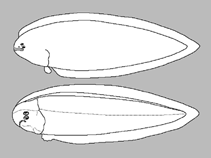 No image available for this species;
drawing shows typical species in Cynoglossidae.
Google afbeelding
drawing shows typical species in Cynoglossidae.
Classificatie / Namen Lokale namen | Synoniemen | Catalog of Fishes(Genus, Soort(en)) | ITIS | CoL | WoRMS | Cloffa
> Pleuronectiformes (Flatfishes) > Cynoglossidae (Tonguefishes) > Symphurinae
Etymology: Symphurus: Greek, syn, symphysis = grown together + Greek, oura = tail (Ref. 45335); leptosomus: Name from Greek 'lepto' meaning slender, and 'somus' for body, referring to its relatively slender, elongate body compared with that other similar species of shallow-water tonguefishes.
Etymology: Symphurus: Greek, syn, symphysis = grown together + Greek, oura = tail (Ref. 45335); leptosomus: Name from Greek 'lepto' meaning slender, and 'somus' for body, referring to its relatively slender, elongate body compared with that other similar species of shallow-water tonguefishes.
Milieu: milieu / Klimaatzone / Diepte / verspreidingsgebied Ecologie
marien demersaal; diepte ? - 15 m (Ref. 126065). Tropical
Verspreiding Gebieden | FAO regio's | Ecosystemen | Voorkomen | Verspreidingskaart | Introducties | Faunafri
Western Pacific: Philippines.
Grootte / Gewicht / Leeftijd
Korte beschrijving Determinatiesleutels | Morfologie | Morfometrie
Dorsale zachte stralen (totaal) : 88; Anale zachte stralen: 72; Wervels: 47. This species is distinguished from all its congeners by the following set of characters: ID pattern1-2-2-2-2; caudal-fin rays 12; vertebrae, abdominal 9 (3 + 6), total 7; hypurals4; D 88, A 72; longitudinal scale rows 76; transverse scale rows 37; scale rows on head posterior to lower orbit 20; an elongate body, with preanal length much longer than body depth (PAL/BD = 1.09); head moderately long (HL = 23.9% of SL), head length slightly shorter than head width (HW/HL = 1.02); postorbital length short (POL = 65.5% of HL); the upper head lobe larger than lower head lobe; dorsal-fin origin at vertical through midpoint of upper eye; predorsal length moderately long (PDL = 20.4% of HL); snout short (SNL = 16.8% of HL), rounded anteriorly; upper eye slightly in advance of lower eye; fleshy ridge well-developed on posterior part of ocular-side lower jaw, with fleshy membrane covering both upper and lower eyes, and membranous fleshy flap continuous between ocular-side anterior nostril and lower part of eye. Colouration: ocular-side pigmentation uniformly yellow to light-brown with dark-brown irregular speckles and blotches while the blind-side pigmentation is uniformly white, with well-developed pepper-dots and dermal melanophores at bases of dorsal and anal fins; bases of anteriormost dorsal- and anal-fin rays with obvious dermal spots on both sides; peritoneum bluish-black (Ref. 126065).
Cross section: flattened.
Cross section: flattened.
A shallow-water tonguefish occurring at depths of ca. 15 m (Ref. 126065).
Levenscyclus en paargedrag Maturiteit | Voortplanting | Paaien | Eieren | Fecunditeit | Larven
Hoofdreferentie
Upload uw referenties | Referenties | Coördinator | Medewerkers
Lee, M.-Y. and T.A. Munroe, 2021. Unraveling cryptic diversity among shallow-water tonguefishes (Pleuronectiformes: Cynoglossidae: Symphurus) from the Indo-West Pacific region, with descriptions of five new species. Zootaxa 5039(1):1-5.5 (Ref. 126065)
CITES
Not Evaluated
Gevaar voor de mens
Harmless
Gebruik door de mens
FAO - Publication: search | FishSource |
Meer informatie
Trofische ecologie
Voedsel (prooien)
Dieetsamenstelling
Voedselconsumptie
Voedselrantsoenen
Predatoren
Voedsel (prooien)
Dieetsamenstelling
Voedselconsumptie
Voedselrantsoenen
Predatoren
Ecologie
Ecologie
Ecologie
Populatiedynamica
Groeiparameters
Max. leeftijden / maten
Lengte-gewicht rel.
Lengte-lengte rel.
Lengtefrequenties
Massaconversie
Rekrutering
Abundantie
Groeiparameters
Max. leeftijden / maten
Lengte-gewicht rel.
Lengte-lengte rel.
Lengtefrequenties
Massaconversie
Rekrutering
Abundantie
Levenscyclus
Voortplanting
Maturiteit
Rijpheid/kieuwen rel.
Fecunditeit
Paaien
Paaibestanden
Eieren
Ontwikkeling van de eieren
Larven
Larvale populatiedynamiek
Voortplanting
Maturiteit
Rijpheid/kieuwen rel.
Fecunditeit
Paaien
Paaibestanden
Eieren
Ontwikkeling van de eieren
Larven
Larvale populatiedynamiek
Anatomie
Kieuwoppervlak
Hersenen
Otoliet
Kieuwoppervlak
Hersenen
Otoliet
Fysiologie
Lichaamssamenstelling
Voedingsstoffen
Zuurstofverbruik
Type zwemmen
Zwemsnelheid
Visuele pigmenten
Vis geluid
Ziekten en parasieten
Toxiciteit (LC50)
Lichaamssamenstelling
Voedingsstoffen
Zuurstofverbruik
Type zwemmen
Zwemsnelheid
Visuele pigmenten
Vis geluid
Ziekten en parasieten
Toxiciteit (LC50)
Genetica
genoom
Genetica
Heterozygositeit
Erfelijkheid
Genetische diversiteit
genoom
Genetica
Heterozygositeit
Erfelijkheid
Genetische diversiteit
Menselijk gerelateerd
Aquacultuursystemen
Aquacultuurprofielen
Kweeklijnen
Ciguatera gevallen
Postzegels, munten, diversen.
Aquacultuursystemen
Aquacultuurprofielen
Kweeklijnen
Ciguatera gevallen
Postzegels, munten, diversen.
Tools
E-boek | Veldgids | Determinatiesleutels | Lengtefrequentie Tool | Levenscyclus tool | Verspreidingskaart |
Vangst-MSY |
Speciale rapporten
Bekijk gegevens voor het houden in een aquarium | Bekijk Fact Sheets voor de soort | Bekijk Aquacultuur Fact Sheets
Download XML
Internetbronnen
AFORO (otoliths) | Aquatic Commons | BHL | Cloffa | Websites from users | Bekijk FishWatcher | CISTI | Catalog of Fishes: Genus, Soort(en) | DiscoverLife | ECOTOX | FAO - Publication: search | Faunafri | Fishipedia | Fishtrace | GloBI | Google Books | Google Scholar | Google | IGFA World Record | OneZoom | Open Tree of Life | Otolith Atlas of Taiwan Fishes | PubMed | Reef Life Survey | Socotra Atlas | TreeBase | Tree of Life | Wikipedia: ga naar, zoek | World Records Freshwater Fishing | Zoobank | Zoological Record
Schattingen op basis van modellen
Fylogenetische diversiteitsindex (Ref. 82804): PD50 = 0.5000 [Uniqueness, from 0.5 = low to 2.0 = high].
Bayesian length-weight: a=0.00427 (0.00211 - 0.00863), b=3.14 (2.97 - 3.31), in cm total length, based on LWR estimates for this Genus-body shape (Ref. 93245).
Trofisch niveau (Ref. 69278): 3.1 ±0.4 se; based on size and trophs of closest relatives
Weerstandsvermogen (Ref. 120179): Hoog, minimale populatieverdubbelingstijd minder dan 15 maanden (Preliminary K or Fecundity.).