



Geotria macrostoma (Burmeister, 1868)
Carregue seu(sua) Fotos e vídeos
Fotos | Imagem do Google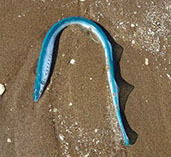 Geotria macrostoma
Foto de Scarlato, N.
Fotos | Imagem do Google
Foto de Scarlato, N.
Classificação / Nomes Nomes comuns | Sinônimos | Catalog of Fishes(Gênero, Espécies) | ITIS | CoL | WoRMS | Cloffa
> Petromyzontiformes (Lampreys) > Geotriidae (Southern lampreys)
Etymology: Geotria: Etymology not explained, although three possibilities, all problematical, have been proposed: (1) from the Greek geotragia, “eating of earth-like substances,” referring to how this lamprey, like other lampreys, uses its suctorial mouth to attach itself to submerged rocks and stones, thus creating the impression that it is feeding on the earth (problem: geotragia does not mean “earthy,” as in rocks and minerals, but “products of the earth,” such as grains and vegetables; (2) geo- (Gr.), earth, and atrium (L.), room, referring to this lamprey’s nest, presumably made of stones and pebbles assembled by one or both parents (problem: nest-building, while known in other river lampreys, was probably not known to Gray in 1851 and has not been documented for this species); (3) a variation of #2, proposed by Meagher (2010), referring to its discovery in underground chambers, in which it survives dry periods (problem: G. australis does not, nor does any other lamprey, aestivate, nor did Gray indicate it was discovered underground, although he did speculate whether the pouch was an adaptation to the “long drought of the Australian rivers”). See EthyFish.org for more details (See ETYFish); macrostoma: macro-, from makros (Gr.), large; stoma (Gr.), mouth (but used here as an adjective, mouthed), presumably referring to greatly expanded oral disc of spawning adults (See ETYFish).
Etymology: Geotria: Etymology not explained, although three possibilities, all problematical, have been proposed: (1) from the Greek geotragia, “eating of earth-like substances,” referring to how this lamprey, like other lampreys, uses its suctorial mouth to attach itself to submerged rocks and stones, thus creating the impression that it is feeding on the earth (problem: geotragia does not mean “earthy,” as in rocks and minerals, but “products of the earth,” such as grains and vegetables; (2) geo- (Gr.), earth, and atrium (L.), room, referring to this lamprey’s nest, presumably made of stones and pebbles assembled by one or both parents (problem: nest-building, while known in other river lampreys, was probably not known to Gray in 1851 and has not been documented for this species); (3) a variation of #2, proposed by Meagher (2010), referring to its discovery in underground chambers, in which it survives dry periods (problem: G. australis does not, nor does any other lamprey, aestivate, nor did Gray indicate it was discovered underground, although he did speculate whether the pouch was an adaptation to the “long drought of the Australian rivers”). See EthyFish.org for more details (See ETYFish); macrostoma: macro-, from makros (Gr.), large; stoma (Gr.), mouth (but used here as an adjective, mouthed), presumably referring to greatly expanded oral disc of spawning adults (See ETYFish).
Taxonomic Remarks
Previously synonymized with Geotria australis Gray, 1851. See Ref. 125540 for explanations about the resurrection from Geotria australis.
Meio ambiente: milieu / Zona climática / intervalo de profundidade / faixa de distribuição Ecologia
marinhas; Água doce; estuarina demersal; desconhecido(a). Temperate
Distribuição Territórios | Áreas da FAO | Ecossistemas | Ocorrências | Mapa de pontos | Introduções | Faunafri
South America and Southwest Atlantic Islands: De la Plata River, Uruguay; de la Plata
River to Tierra del Fuego, Argentina; Malvinas (Falkland) Islands, South Georgia. One record in a river tributary of Magellan Strait in Chile.
Tamanho / Peso / Idade
Descrição suscinta Chaves de identificação | Morfologia | Morfometria
This species is distinguished from G. australis by having a second dorsal fin connected with the caudal fin by a low skin fold (vs. separate), and by the position of the cloaca posterior to the origin of the second dorsal fin in immature and mature adults (cloaca anterior to or under the origin of the second dorsal fin); while the position of fins and cloaca of mature G. macrostoma remains similar to that of juvenile and sub-adults, in spawning adults of G. australis the separation between the second dorsal fin and the caudal fin becomes reduced to a notch (Ref. 125560).
Cross section: oval.
Cross section: oval.
Length of sub-adult individuals 41.2-62.9 cm TL (Ref. 125560).
Ciclo de vida ou comportamento de acasalamento Maturidade | Reprodução | Desova | Ovos | Fecundidade | Larvas
Referência principal
Carregar suas referências | Referências | Coordenador | Colaboradores
Firpo Lacoste, F., L. Fernández and C. Scioscia, 2021. On an unknown lamprey holotype (Petromyzon macrostomus Burmeister 1868) and the genus Exomegas Gill 1883 from South America. J. Fish Biol. 99(4):1507-1512. (Ref. 125540)
Status na Lista Vermelha da UICN (Ref. 130435: Version 2025-2 (Global))
Segura ou pouco preocupante (LC) ; Date assessed: 06 May 2022
CITES
Not Evaluated
Ameaça para os humanos
Uso pelos humanos
FAO - Publication: search | FishSource |
Mais informação
Ecologia Trófica
Itens alimentares (presas)
Composição da dieta
Consumo alimentar
Rações alimentares
Predadores
Itens alimentares (presas)
Composição da dieta
Consumo alimentar
Rações alimentares
Predadores
Ecologia
Ecologia
Ecologia
Dinâmica populacional
Parâmetros de crescimento
Idade máxima / tamanhos
Relação comprimento-peso.
Relação comprimento-comprimento.
Frequências de comprimento
Conversão de massa
Recrutamento
Abundância
Parâmetros de crescimento
Idade máxima / tamanhos
Relação comprimento-peso.
Relação comprimento-comprimento.
Frequências de comprimento
Conversão de massa
Recrutamento
Abundância
Ciclo de vida
Reprodução
Maturidade
Maturidade/Rel. das guelras
Fecundidade
Desova
Agregações de desova
Ovos
Desenvolvimento dos ovos
Larvas
Dinâmica larval
Reprodução
Maturidade
Maturidade/Rel. das guelras
Fecundidade
Desova
Agregações de desova
Ovos
Desenvolvimento dos ovos
Larvas
Dinâmica larval
Anatomia
Área branquial
Cérebro
Otólito
Área branquial
Cérebro
Otólito
Fisiologia
Composição corporal
Nutrientes
Consumo de oxigênio
Tipo de natação
Velocidade de natação
Pigmentos visuais
Som de peixe
Doenças e Parasitas
Toxicidade (LC50s)
Composição corporal
Nutrientes
Consumo de oxigênio
Tipo de natação
Velocidade de natação
Pigmentos visuais
Som de peixe
Doenças e Parasitas
Toxicidade (LC50s)
Genética
genoma
Genética
Heterozigosidade
Hereditariedade
Diversidade genética
genoma
Genética
Heterozigosidade
Hereditariedade
Diversidade genética
Relacionado a humanos
Sistemas de aquicultura
Perfis para aquacultura
Estirpes
Casos de Ciguatera
Selos, moedas, diversos.
Sistemas de aquicultura
Perfis para aquacultura
Estirpes
Casos de Ciguatera
Selos, moedas, diversos.
Ferramentas
Livro eletrônico | Guia de campo | Ferramenta auxiliar de frequências de comprimento | Ferramenta sobre a história de vida | Mapa de pontos |
Catch-MSY |
Relatórios especiais
Checar Manutenção em Aquário | Checar Planilhas de Fatos sobre as Espécies | Checar Planilhas de Fatos sobre Aquicultura
Baixar XML
Fontes da internet
AFORO (otoliths) | Aquatic Commons | BHL | Cloffa | Websites from users | Checar Observador de Peixes (FishWatcher) | CISTI | Catalog of Fishes: Gênero, Espécies | DiscoverLife | ECOTOX | FAO - Publication: search | Faunafri | Fishipedia | Fishtrace | GloBI | Google Books | Google Scholar | Google | IGFA World Record | Bases de dados nacionais | OneZoom | Open Tree of Life | Otolith Atlas of Taiwan Fishes | PubMed | Reef Life Survey | Socotra Atlas | TreeBase | Árvore da vida | Wikipedia: Ir para, procura | World Records Freshwater Fishing | Registro zoológico
Estimativas baseadas em modelos
Índice de diversidade filogenética (Ref. 82804): PD50 = 1.0000 [Uniqueness, from 0.5 = low to 2.0 = high].
Bayesian length-weight: a=0.00102 (0.00046 - 0.00225), b=3.06 (2.88 - 3.24), in cm total length, based on all LWR estimates for this body shape (Ref. 93245).
Nível Trófico (Ref. 69278): 4.4 ±0.8 se; based on size and trophs of closest relatives