



Geotria macrostoma (Burmeister, 1868)
Carica il tuo foto e Video
Immagini | Google image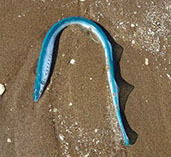 Geotria macrostoma
Immagine di Scarlato, N.
Immagini | Google image
Immagine di Scarlato, N.
Classificazione / Nomi Nomi Comuni | Sinonimi | Catalog of Fishes(Genere, Specie) | ITIS | CoL | WoRMS | Cloffa
> Petromyzontiformes (Lampreys) > Geotriidae (Southern lampreys)
Etymology: Geotria: Etymology not explained, although three possibilities, all problematical, have been proposed: (1) from the Greek geotragia, “eating of earth-like substances,” referring to how this lamprey, like other lampreys, uses its suctorial mouth to attach itself to submerged rocks and stones, thus creating the impression that it is feeding on the earth (problem: geotragia does not mean “earthy,” as in rocks and minerals, but “products of the earth,” such as grains and vegetables; (2) geo- (Gr.), earth, and atrium (L.), room, referring to this lamprey’s nest, presumably made of stones and pebbles assembled by one or both parents (problem: nest-building, while known in other river lampreys, was probably not known to Gray in 1851 and has not been documented for this species); (3) a variation of #2, proposed by Meagher (2010), referring to its discovery in underground chambers, in which it survives dry periods (problem: G. australis does not, nor does any other lamprey, aestivate, nor did Gray indicate it was discovered underground, although he did speculate whether the pouch was an adaptation to the “long drought of the Australian rivers”). See EthyFish.org for more details (See ETYFish); macrostoma: macro-, from makros (Gr.), large; stoma (Gr.), mouth (but used here as an adjective, mouthed), presumably referring to greatly expanded oral disc of spawning adults (See ETYFish).
Etymology: Geotria: Etymology not explained, although three possibilities, all problematical, have been proposed: (1) from the Greek geotragia, “eating of earth-like substances,” referring to how this lamprey, like other lampreys, uses its suctorial mouth to attach itself to submerged rocks and stones, thus creating the impression that it is feeding on the earth (problem: geotragia does not mean “earthy,” as in rocks and minerals, but “products of the earth,” such as grains and vegetables; (2) geo- (Gr.), earth, and atrium (L.), room, referring to this lamprey’s nest, presumably made of stones and pebbles assembled by one or both parents (problem: nest-building, while known in other river lampreys, was probably not known to Gray in 1851 and has not been documented for this species); (3) a variation of #2, proposed by Meagher (2010), referring to its discovery in underground chambers, in which it survives dry periods (problem: G. australis does not, nor does any other lamprey, aestivate, nor did Gray indicate it was discovered underground, although he did speculate whether the pouch was an adaptation to the “long drought of the Australian rivers”). See EthyFish.org for more details (See ETYFish); macrostoma: macro-, from makros (Gr.), large; stoma (Gr.), mouth (but used here as an adjective, mouthed), presumably referring to greatly expanded oral disc of spawning adults (See ETYFish).
Taxonomic Remarks
Previously synonymized with Geotria australis Gray, 1851. See Ref. 125540 for explanations about the resurrection from Geotria australis.
Ambiente: milieu / zona climatica / distribuzione batimetrica / gamma di distribuzione Ecologia
marino; acqua dolce; salmastro demersale; unknown. Temperate
Distribuzione Territories | Aree FAO | Ecosistemi | Presenze | Mappa dei ritrovamenti | Introduzioni | Faunafri
South America and Southwest Atlantic Islands: De la Plata River, Uruguay; de la Plata
River to Tierra del Fuego, Argentina; Malvinas (Falkland) Islands, South Georgia. One record in a river tributary of Magellan Strait in Chile.
Dimensione / Peso / Età
Breve descrizione Chiavi di identificazione | Morfologia | Morfometria
This species is distinguished from G. australis by having a second dorsal fin connected with the caudal fin by a low skin fold (vs. separate), and by the position of the cloaca posterior to the origin of the second dorsal fin in immature and mature adults (cloaca anterior to or under the origin of the second dorsal fin); while the position of fins and cloaca of mature G. macrostoma remains similar to that of juvenile and sub-adults, in spawning adults of G. australis the separation between the second dorsal fin and the caudal fin becomes reduced to a notch (Ref. 125560).
Cross section: oval.
Cross section: oval.
Length of sub-adult individuals 41.2-62.9 cm TL (Ref. 125560).
Ciclo vitale e comportamento di accoppiamento Maturità | Riproduzione | Deposizione | Uova | Fecondità | Larve
Riferimento principale
Caricare le referenze | Bibliografia | Coordinatore | Collaboratori
Firpo Lacoste, F., L. Fernández and C. Scioscia, 2021. On an unknown lamprey holotype (Petromyzon macrostomus Burmeister 1868) and the genus Exomegas Gill 1883 from South America. J. Fish Biol. 99(4):1507-1512. (Ref. 125540)
Stato della Lista Rossa IUCN (Ref. 130435: Version 2025-2 (Global))
Least Concern (LC) ; Date assessed: 06 May 2022
CITES
Not Evaluated
Minaccia per l'uomo
Usi umani
FAO - Publication: search | FishSource |
Informazioni ulteriori
Ecologia trofica
Articoli alimentari (prede)
Alimentazione
Consumo di cibo
Razioni alimentari
Predatori
Articoli alimentari (prede)
Alimentazione
Consumo di cibo
Razioni alimentari
Predatori
Ecologia
Ecologia
Ecologia
Dinamica della popolazione
Parametri di crescita
Età massima / dimensioni massime
Rapporto lunghezza-peso.
Lunghezza-lunghezza rel.
Lunghezza-frequenze
Conversione di massa
Reclutamento
Abbondanza
Parametri di crescita
Età massima / dimensioni massime
Rapporto lunghezza-peso.
Lunghezza-lunghezza rel.
Lunghezza-frequenze
Conversione di massa
Reclutamento
Abbondanza
Ciclo di vita
Riproduzione
Maturità
Maturità/Gli occhielli sono relativi.
Fecondità
Deposizione
Aggregazioni riproduttive
Uova
Sviluppo delle uova
Larve
Dinamica popolazioni larvali
Riproduzione
Maturità
Maturità/Gli occhielli sono relativi.
Fecondità
Deposizione
Aggregazioni riproduttive
Uova
Sviluppo delle uova
Larve
Dinamica popolazioni larvali
Anatomia
Area branchiale
Cervello
Otolite
Area branchiale
Cervello
Otolite
Fisiologia
Composizione corporea
Nutrienti
Consumo di ossigeno
Tipo di nuoto
Velocità di nuoto
Pigmenti visivi
Suono del pesce
Malattie e parassiti
Tossicità (LC50)
Composizione corporea
Nutrienti
Consumo di ossigeno
Tipo di nuoto
Velocità di nuoto
Pigmenti visivi
Suono del pesce
Malattie e parassiti
Tossicità (LC50)
Genetica
Genome
Genetica
Eterozigosi
Ereditarietà
Diversità genetica
Genome
Genetica
Eterozigosi
Ereditarietà
Diversità genetica
Legato all'uomo
Sistemi di acquacoltura
Profili di acquacoltura
Varietà
Casi di Ciguatera
Francobolli, monete, materiale vario.
Sistemi di acquacoltura
Profili di acquacoltura
Varietà
Casi di Ciguatera
Francobolli, monete, materiale vario.
Strumenti
Libro elettronico | Giuda pratica | Generatore frequenze di lunghezza | Strumento Parametri Biologici | Mappa dei ritrovamenti |
Cattura-MSY |
Rapporti speciali
Controllo della manutenzione dell'acquario | Verificare la presenza di schede informative sulle specie | Verifica delle schede informative sull'acquacoltura
Scarica XML
Fonti Internet
AFORO (otoliths) | Aquatic Commons | BHL | Cloffa | Websites from users | Check FishWatcher | CISTI | Catalog of Fishes: Genere, Specie | DiscoverLife | ECOTOX | FAO - Publication: search | Faunafri | Fishipedia | Fishtrace | GloBI | Google Books | Google Scholar | Google | IGFA World Record | Database Nazionali | OneZoom | Open Tree of Life | Otolith Atlas of Taiwan Fishes | PubMed | Reef Life Survey | Socotra Atlas | TreeBase | Tree of Life | Wikipedia: Go, ricerca | World Records Freshwater Fishing | Record zoologico
Stime basate su modelli
Indice di diversità filogenetica (Fonte Biblio. 82804): PD50 = 1.0000 [Uniqueness, from 0.5 = low to 2.0 = high].
Bayesian length-weight: a=0.00102 (0.00046 - 0.00225), b=3.06 (2.88 - 3.24), in cm total length, based on all LWR estimates for this body shape (Ref. 93245).
Livello trofico (Fonte Biblio. 69278): 4.4 ±0.8 se; based on size and trophs of closest relatives