



Barryichthys hutchinsi Conway, Moore & Summers, 2019
Brown rat clingfish
Ladda upp din foton och Videor
Google image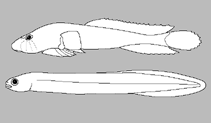 No image available for this species;
drawing shows typical species in Gobiesocidae.
Google image
drawing shows typical species in Gobiesocidae.
Klassificering / Namn Populärnamn | synonymer | Catalog of Fishes(Släkte, Arter) | ITIS | CoL | WoRMS | Cloffa
> Gobiesociformes (Clingfishes) > Gobiesocidae (Clingfishes and singleslits) > Cheilobranchinae
Etymology: Barryichthys: Named for Barry Hutchins, in honour of his work on Australian clingfishes; hutchinsi: Named for Barry Hutchins; noun in the genitive.
Eponymy: Dr J Barry Hutchins (d: 1946) was Curator of Fishes at the Western Australian Museum (1998–2007), which he joined as a Technical Officer (1972) and where he worked until he retired. [...] Dr J Barry Hutchins (d: 1946) was Curator of Fishes at the Western Australian Museum (1998–2007), which he joined as a Technical Officer (1972) and where he worked until he retired. [...] (Ref. 128868), visit book page.
Etymology: Barryichthys: Named for Barry Hutchins, in honour of his work on Australian clingfishes; hutchinsi: Named for Barry Hutchins; noun in the genitive.
Eponymy: Dr J Barry Hutchins (d: 1946) was Curator of Fishes at the Western Australian Museum (1998–2007), which he joined as a Technical Officer (1972) and where he worked until he retired. [...] Dr J Barry Hutchins (d: 1946) was Curator of Fishes at the Western Australian Museum (1998–2007), which he joined as a Technical Officer (1972) and where he worked until he retired. [...] (Ref. 128868), visit book page.
Miljö: miljö / Klimatzon / djupintervall / distributionsområde Ekologi
marina revassocierade; djupintervall 0 - 1 m (Ref. 120657). Subtropical
Utbredning Territorier | FAO områden | Ekosystem | Förekomster | Prickkarta | Utplanteringar | Faunafri
Eastern Indian Ocean: Western Australia to South Australia.
Storlek / Vikt / Ålder
Könsmognad: Lm ? range ? - ? cm
Max length : 1.5 cm SL hane/ej könsbestämd; (Ref. 120657); 1.9 cm SL (female)
Max length : 1.5 cm SL hane/ej könsbestämd; (Ref. 120657); 1.9 cm SL (female)
Kort beskrivning Bestämningsnycklar | Morfologi | Morfometri
Mjukstrålar i ryggfenan (totalt) : 4 - 5; Mjukstrålar i analfenan: 4 - 6; Ryggkotor: 38 - 39. This species is distinguished from Barryichthys algicolaby having a shorter, deeper body (body depth at dorsal-fin origin 10-11% SL vs. 7-8% SL); wider, deeper head (head width at widest point 66-75% HL vs. 55-61%; depth at orbit 30-32% HL vs. 27-29%; interorbital width 27-33% HL vs. 20-24%); the ventral margin of orbit obscured by cheek in ventral view (vs. entire ventral margin of orbit visible in ventral view); shorter abdominal region with fewer vertebrae (17 vs. 21); with fewer ribs (11-12 vs. 15), epicentrals (14-15 vs. 18-19) and total vertebrae ( 38-39 vs. 42-44). Live colour pattern, including body background golden-yellow to olive-brown, a variable number of irregularly shaped light to dark brown markings along dorsal midline, presence of a series of light to dark brown elongate lateral markings
forming an incomplete or complete horizontal stripe (Ref. 120657).
Body shape (shape guide): elongated; Cross section: oval.
Body shape (shape guide): elongated; Cross section: oval.
This species was collected from dense mats of macroalgae attached to rocky substrate in water up to 1 meter depth. A female specimen (1.42 cm SL) contained ca. 20 mature eggs (ca. 10 within each ovary) of ca. 0.3-0.@ mm diameter. The largest eggs in each ovary exhibited a dark orange cap that may represent an 'attachment apparatus' at the animal pole as described from the eggs of three species of European gobiesocid (Ref. 120657).
Livscykel och parningsbeteende Könsmognad | Reproduktion | Lek | Ägg | Fekunditet | Larver
Huvudreferens
Ladda upp dina referenser | referenser | Koordinator : Williams, Jeffrey T. | Medarbetare
Conway, K.W., G.I. Moore and A.P. Summers, 2019. A new genus and two new species of miniature clingfishes from temperate southern Australia (Teleostei, Gobiesocidae). ZooKeys 864:35-65. (Ref. 120657)
Status på IUCN:s rödlista (Ref. 130435: Version 2025-2 (Global))
Least Concern (LC) ; Date assessed: 18 March 2024
CITES
Not Evaluated
Hot mot människor
Harmless
Mänskliga användningsområden
FAO - Publication: search | FishSource |
Ytterligare information
Trofisk ekologi
Livsmedelsartiklar (preys)
Födosammansättning
Födointag
Matransoner
Predatorer
Livsmedelsartiklar (preys)
Födosammansättning
Födointag
Matransoner
Predatorer
Ekologi
Ekologi
Ekologi
Populationsdynamik
Tillväxtparametrar
Max. åldrar / storlekar
Längd-vikt rel.
Längd-längd rel.
Längd-frekvenser
Massakonvertering
Rekrytering
Abundans
Tillväxtparametrar
Max. åldrar / storlekar
Längd-vikt rel.
Längd-längd rel.
Längd-frekvenser
Massakonvertering
Rekrytering
Abundans
Livscykel
Reproduktion
Könsmognad
Mognad/Gills rel.
Fekunditet
Lek
Lekande aggregat
Ägg
Utveckling av ägg
Larver
Larvdynamik
Reproduktion
Könsmognad
Mognad/Gills rel.
Fekunditet
Lek
Lekande aggregat
Ägg
Utveckling av ägg
Larver
Larvdynamik
Anatomi
Gälyta
Hjärna
Otolit
Gälyta
Hjärna
Otolit
Fysiologi
Kroppssammansättning
Näringsämnen
Syreförbrukning
Typ av simning
Simhastighet
Visuella pigment
Ljud från fisk
Sjukdomar & Parasiter
Toxicitet (LC50)
Kroppssammansättning
Näringsämnen
Syreförbrukning
Typ av simning
Simhastighet
Visuella pigment
Ljud från fisk
Sjukdomar & Parasiter
Toxicitet (LC50)
Genetik
Genom
Genetik
Heterozygositet
Ärftlighet
Genetisk mångfald
Genom
Genetik
Heterozygositet
Ärftlighet
Genetisk mångfald
Människorelaterad
Vattenbrukssystem
Vattenbruksprofiler
Avelslinjer
Ciguatera-fall
Frimärken, mynt, diverse.
Vattenbrukssystem
Vattenbruksprofiler
Avelslinjer
Ciguatera-fall
Frimärken, mynt, diverse.
Verktyg
Särskilda rapporter
Kontrollera för underhåll av akvarium | Kontrollera om det finns faktablad om arter | Kontrollera om det finns faktablad om vattenbruk
Ladda ner XML
Internet-källor
AFORO (otoliths) | Aquatic Commons | BHL | Cloffa | Websites from users | Check FishWatcher | CISTI | Catalog of Fishes: Släkte, Arter | DiscoverLife | ECOTOX | FAO - Publication: search | Faunafri | Fishipedia | Fishtrace | GloBI | Google Books | Google Scholar | Google | IGFA World Record | OneZoom | Open Tree of Life | Otolith Atlas of Taiwan Fishes | PubMed | Reef Life Survey | Socotra Atlas | TreeBase | Tree of Life | Wikipedia: Go, sök | | Zoobank | Zoologiskt register
Uppskattningar baserade på modeller
|
Index för fylogenetisk mångfald (Ref. 82804) |
PD50 = 0.7500 [Uniqueness, from 0.5 = low to 2.0 = high]. |
| Bayesian length-weight | a=0.00389 (0.00180 - 0.00842), b=3.12 (2.94 - 3.30), in cm total length, based on all LWR estimates for this body shape (Ref. 93245). |
|
Trofisk nivå (Ref. 69278) |
3.0 ±0.2 se; based on size and trophs of closest relatives |
|
Resiliens (Ref. 120179) |
Hög, lägsta populationsfördubblingstid mindre än 15 månader (Preliminary K or Fecundity.). |
|
Sårbarhet i fisket (Ref. 59153) |
Low vulnerability (14 of 100). 🛈 |