



Barryichthys hutchinsi Conway, Moore & Summers, 2019
Brown rat clingfish
Adicionar o seu Fotografias e vídeos
Imagem do Google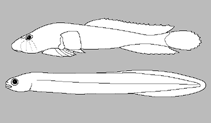 No image available for this species;
drawing shows typical species in Gobiesocidae.
Imagem do Google
drawing shows typical species in Gobiesocidae.
Classificação / Nomes Nomes comuns | Sinónimos | Catalog of Fishes(Género, Espécies) | ITIS | CoL | WoRMS | Cloffa
> Gobiesociformes (Clingfishes) > Gobiesocidae (Clingfishes and singleslits) > Cheilobranchinae
Etymology: Barryichthys: Named for Barry Hutchins, in honour of his work on Australian clingfishes; hutchinsi: Named for Barry Hutchins; noun in the genitive.
Eponymy: Dr J Barry Hutchins (d: 1946) was Curator of Fishes at the Western Australian Museum (1998–2007), which he joined as a Technical Officer (1972) and where he worked until he retired. [...] Dr J Barry Hutchins (d: 1946) was Curator of Fishes at the Western Australian Museum (1998–2007), which he joined as a Technical Officer (1972) and where he worked until he retired. [...] (Ref. 128868), visit book page.
Etymology: Barryichthys: Named for Barry Hutchins, in honour of his work on Australian clingfishes; hutchinsi: Named for Barry Hutchins; noun in the genitive.
Eponymy: Dr J Barry Hutchins (d: 1946) was Curator of Fishes at the Western Australian Museum (1998–2007), which he joined as a Technical Officer (1972) and where he worked until he retired. [...] Dr J Barry Hutchins (d: 1946) was Curator of Fishes at the Western Australian Museum (1998–2007), which he joined as a Technical Officer (1972) and where he worked until he retired. [...] (Ref. 128868), visit book page.
Ambiente: milieu / zona climática / intervalo de profundidade / gama de distribuição Ecologia
marinhas associadas(os) a recifes; intervalo de profundidade 0 - 1 m (Ref. 120657). Subtropical
Distribuição Territórios | Áreas FAO | Ecossistemas | Ocorrências | Mapa dos pontos | Introduções | Faunafri
Eastern Indian Ocean: Western Australia to South Australia.
Tamanho / Peso / Idade
Maturidade: Lm ? range ? - ? cm
Max length : 1.5 cm SL macho/indeterminado; (Ref. 120657); 1.9 cm SL (female)
Max length : 1.5 cm SL macho/indeterminado; (Ref. 120657); 1.9 cm SL (female)
Descrição breve Chaves de identificação | Morfologia | Morfometria
Raios dorsais moles (total) : 4 - 5; Raios anais moles: 4 - 6; Vértebras: 38 - 39. This species is distinguished from Barryichthys algicolaby having a shorter, deeper body (body depth at dorsal-fin origin 10-11% SL vs. 7-8% SL); wider, deeper head (head width at widest point 66-75% HL vs. 55-61%; depth at orbit 30-32% HL vs. 27-29%; interorbital width 27-33% HL vs. 20-24%); the ventral margin of orbit obscured by cheek in ventral view (vs. entire ventral margin of orbit visible in ventral view); shorter abdominal region with fewer vertebrae (17 vs. 21); with fewer ribs (11-12 vs. 15), epicentrals (14-15 vs. 18-19) and total vertebrae ( 38-39 vs. 42-44). Live colour pattern, including body background golden-yellow to olive-brown, a variable number of irregularly shaped light to dark brown markings along dorsal midline, presence of a series of light to dark brown elongate lateral markings
forming an incomplete or complete horizontal stripe (Ref. 120657).
Body shape (shape guide): elongated; Cross section: oval.
Body shape (shape guide): elongated; Cross section: oval.
This species was collected from dense mats of macroalgae attached to rocky substrate in water up to 1 meter depth. A female specimen (1.42 cm SL) contained ca. 20 mature eggs (ca. 10 within each ovary) of ca. 0.3-0.@ mm diameter. The largest eggs in each ovary exhibited a dark orange cap that may represent an 'attachment apparatus' at the animal pole as described from the eggs of three species of European gobiesocid (Ref. 120657).
Ciclo de vida e comportamento de acasalamento Maturidade | Reprodução | Desova | Ovos | Fecundidade | Larvas
Referência principal
Carregar as suas referências | Referências | Coordenador : Williams, Jeffrey T. | Colaboradores
Conway, K.W., G.I. Moore and A.P. Summers, 2019. A new genus and two new species of miniature clingfishes from temperate southern Australia (Teleostei, Gobiesocidae). ZooKeys 864:35-65. (Ref. 120657)
Categoria na Lista Vermelha da IUCN (Ref. 130435: Version 2025-2 (Global))
Preocupação menor (LC) ; Date assessed: 18 March 2024
CITES
Not Evaluated
Ameaça para o homem
Harmless
Utilização humana
FAO - Publication: search | FishSource |
Mais informação
Ecologia Trófica
Produtos alimentares (presas)
Composição da dieta
Consumo alimentar
Rações alimentares
Predadores
Produtos alimentares (presas)
Composição da dieta
Consumo alimentar
Rações alimentares
Predadores
Ecologia
Ecologia
Ecologia
Dinâmica das populações
Parâmetros de crescimento
Idades / tamanhos máximos
Comprimento-peso rel.
Comprimento-comprimento rel.
Frequência de comprimento
Conversão de massa
Recrutamento
Abundância
Parâmetros de crescimento
Idades / tamanhos máximos
Comprimento-peso rel.
Comprimento-comprimento rel.
Frequência de comprimento
Conversão de massa
Recrutamento
Abundância
Ciclo de vida
Reprodução
Maturidade
Maturidade/Rel. das guelras
Fecundidade
Desova
Agregações de desova
Ovos
Desenvolvimento dos ovos
Larvas
Dinâmica larvar
Reprodução
Maturidade
Maturidade/Rel. das guelras
Fecundidade
Desova
Agregações de desova
Ovos
Desenvolvimento dos ovos
Larvas
Dinâmica larvar
Anatomia
Área branquial
Cérebro
Otólitos
Área branquial
Cérebro
Otólitos
Fisiologia
Composição corporal
Nutrientes
Consumo de oxigénio
Tipo de natação
Velocidade de natação
Pigmentos visuais
Som de peixe
Doenças e Parasitas
Toxicidade (LC50s)
Composição corporal
Nutrientes
Consumo de oxigénio
Tipo de natação
Velocidade de natação
Pigmentos visuais
Som de peixe
Doenças e Parasitas
Toxicidade (LC50s)
Genética
genoma
Genética
Heterozigotia
Hereditariedade
Diversidade genética
genoma
Genética
Heterozigotia
Hereditariedade
Diversidade genética
Relacionado com o ser humano
Sistemas de aquacultura
Perfis para aquacultura
Estirpes
Casos de Ciguatera
Selos, moedas, diversos.
Sistemas de aquacultura
Perfis para aquacultura
Estirpes
Casos de Ciguatera
Selos, moedas, diversos.
Ferramentas
E-book | Guia de campo | Ferramenta auxiliar de frequências de comprimento | Ferramenta sobre a história de vida | Mapa dos pontos |
Captura-MSY |
Relatórios especiais
Descarregue XML
Fontes da internet
AFORO (otoliths) | Aquatic Commons | BHL | Cloffa | Websites from users | Consultar FishWatcher | CISTI | Catalog of Fishes: Género, Espécies | DiscoverLife | ECOTOX | FAO - Publication: search | Faunafri | Fishipedia | Fishtrace | GloBI | Google Books | Google Scholar | Google | IGFA World Record | OneZoom | Open Tree of Life | Otolith Atlas of Taiwan Fishes | PubMed | Reef Life Survey | Socotra Atlas | TreeBase | Árvore da vida | Wikipedia: ir para, procurar | World Records Freshwater Fishing | Zoobank | Registo zoológico
Estimativas baseadas em modelos
Índice de diversidade filogenética (Ref. 82804): PD50 = 0.7500 [Uniqueness, from 0.5 = low to 2.0 = high].
Bayesian length-weight: a=0.00389 (0.00180 - 0.00842), b=3.12 (2.94 - 3.30), in cm total length, based on all LWR estimates for this body shape (Ref. 93245).
Nível Trófico (Ref. 69278): 3.0 ±0.2 se; based on size and trophs of closest relatives
Resiliência (Ref. 120179): Elevada, tempo mínimo de duplicação da população menor que 15 meses (Preliminary K or Fecundity.).