



Barryichthys hutchinsi Conway, Moore & Summers, 2019
Brown rat clingfish
Uploaden van uw Foto's en video's
Google afbeelding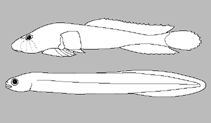 No image available for this species;
drawing shows typical species in Gobiesocidae.
Google afbeelding
drawing shows typical species in Gobiesocidae.
Classificatie / Namen Lokale namen | Synoniemen | Catalog of Fishes(Genus, Soort(en)) | ITIS | CoL | WoRMS | Cloffa
> Gobiesociformes (Clingfishes) > Gobiesocidae (Clingfishes and singleslits) > Cheilobranchinae
Etymology: Barryichthys: Named for Barry Hutchins, in honour of his work on Australian clingfishes; hutchinsi: Named for Barry Hutchins; noun in the genitive.
Eponymy: Dr J Barry Hutchins (d: 1946) was Curator of Fishes at the Western Australian Museum (1998–2007), which he joined as a Technical Officer (1972) and where he worked until he retired. [...] Dr J Barry Hutchins (d: 1946) was Curator of Fishes at the Western Australian Museum (1998–2007), which he joined as a Technical Officer (1972) and where he worked until he retired. [...] (Ref. 128868), visit book page.
Etymology: Barryichthys: Named for Barry Hutchins, in honour of his work on Australian clingfishes; hutchinsi: Named for Barry Hutchins; noun in the genitive.
Eponymy: Dr J Barry Hutchins (d: 1946) was Curator of Fishes at the Western Australian Museum (1998–2007), which he joined as a Technical Officer (1972) and where he worked until he retired. [...] Dr J Barry Hutchins (d: 1946) was Curator of Fishes at the Western Australian Museum (1998–2007), which he joined as a Technical Officer (1972) and where he worked until he retired. [...] (Ref. 128868), visit book page.
Milieu: milieu / Klimaatzone / Diepte / verspreidingsgebied Ecologie
marien rifbewoner; diepte 0 - 1 m (Ref. 120657). Subtropical
Verspreiding Gebieden | FAO regio's | Ecosystemen | Voorkomen | Verspreidingskaart | Introducties | Faunafri
Eastern Indian Ocean: Western Australia to South Australia.
Grootte / Gewicht / Leeftijd
Maturiteit: Lm ? range ? - ? cm
Max length : 1.5 cm SL mannelijk / geslacht onbekend; (Ref. 120657); 1.9 cm SL (female)
Max length : 1.5 cm SL mannelijk / geslacht onbekend; (Ref. 120657); 1.9 cm SL (female)
Korte beschrijving Determinatiesleutels | Morfologie | Morfometrie
Dorsale zachte stralen (totaal) : 4 - 5; Anale zachte stralen: 4 - 6; Wervels: 38 - 39. This species is distinguished from Barryichthys algicolaby having a shorter, deeper body (body depth at dorsal-fin origin 10-11% SL vs. 7-8% SL); wider, deeper head (head width at widest point 66-75% HL vs. 55-61%; depth at orbit 30-32% HL vs. 27-29%; interorbital width 27-33% HL vs. 20-24%); the ventral margin of orbit obscured by cheek in ventral view (vs. entire ventral margin of orbit visible in ventral view); shorter abdominal region with fewer vertebrae (17 vs. 21); with fewer ribs (11-12 vs. 15), epicentrals (14-15 vs. 18-19) and total vertebrae ( 38-39 vs. 42-44). Live colour pattern, including body background golden-yellow to olive-brown, a variable number of irregularly shaped light to dark brown markings along dorsal midline, presence of a series of light to dark brown elongate lateral markings
forming an incomplete or complete horizontal stripe (Ref. 120657).
Body shape (shape guide): elongated; Cross section: oval.
Body shape (shape guide): elongated; Cross section: oval.
This species was collected from dense mats of macroalgae attached to rocky substrate in water up to 1 meter depth. A female specimen (1.42 cm SL) contained ca. 20 mature eggs (ca. 10 within each ovary) of ca. 0.3-0.@ mm diameter. The largest eggs in each ovary exhibited a dark orange cap that may represent an 'attachment apparatus' at the animal pole as described from the eggs of three species of European gobiesocid (Ref. 120657).
Levenscyclus en paargedrag Maturiteit | Voortplanting | Paaien | Eieren | Fecunditeit | Larven
Hoofdreferentie
Upload uw referenties | Referenties | Coördinator : Williams, Jeffrey T. | Medewerkers
Conway, K.W., G.I. Moore and A.P. Summers, 2019. A new genus and two new species of miniature clingfishes from temperate southern Australia (Teleostei, Gobiesocidae). ZooKeys 864:35-65. (Ref. 120657)
Status op de Rode Lijst van het IUCN (Ref. 130435: Version 2025-2 (Global))
Niet bedreigd (LC) ; Date assessed: 18 March 2024
CITES
Not Evaluated
Gevaar voor de mens
Harmless
Gebruik door de mens
FAO - Publication: search | FishSource |
Meer informatie
Trofische ecologie
Voedsel (prooien)
Dieetsamenstelling
Voedselconsumptie
Voedselrantsoenen
Predatoren
Voedsel (prooien)
Dieetsamenstelling
Voedselconsumptie
Voedselrantsoenen
Predatoren
Ecologie
Ecologie
Ecologie
Populatiedynamica
Groeiparameters
Max. leeftijden / maten
Lengte-gewicht rel.
Lengte-lengte rel.
Lengtefrequenties
Massaconversie
Rekrutering
Abundantie
Groeiparameters
Max. leeftijden / maten
Lengte-gewicht rel.
Lengte-lengte rel.
Lengtefrequenties
Massaconversie
Rekrutering
Abundantie
Levenscyclus
Voortplanting
Maturiteit
Rijpheid/kieuwen rel.
Fecunditeit
Paaien
Paaibestanden
Eieren
Ontwikkeling van de eieren
Larven
Larvale populatiedynamiek
Voortplanting
Maturiteit
Rijpheid/kieuwen rel.
Fecunditeit
Paaien
Paaibestanden
Eieren
Ontwikkeling van de eieren
Larven
Larvale populatiedynamiek
Anatomie
Kieuwoppervlak
Hersenen
Otoliet
Kieuwoppervlak
Hersenen
Otoliet
Fysiologie
Lichaamssamenstelling
Voedingsstoffen
Zuurstofverbruik
Type zwemmen
Zwemsnelheid
Visuele pigmenten
Vis geluid
Ziekten en parasieten
Toxiciteit (LC50)
Lichaamssamenstelling
Voedingsstoffen
Zuurstofverbruik
Type zwemmen
Zwemsnelheid
Visuele pigmenten
Vis geluid
Ziekten en parasieten
Toxiciteit (LC50)
Genetica
genoom
Genetica
Heterozygositeit
Erfelijkheid
Genetische diversiteit
genoom
Genetica
Heterozygositeit
Erfelijkheid
Genetische diversiteit
Menselijk gerelateerd
Aquacultuursystemen
Aquacultuurprofielen
Kweeklijnen
Ciguatera gevallen
Postzegels, munten, diversen.
Aquacultuursystemen
Aquacultuurprofielen
Kweeklijnen
Ciguatera gevallen
Postzegels, munten, diversen.
Tools
Speciale rapporten
Bekijk gegevens voor het houden in een aquarium | Bekijk Fact Sheets voor de soort | Bekijk Aquacultuur Fact Sheets
Download XML
Internetbronnen
AFORO (otoliths) | Aquatic Commons | BHL | Cloffa | Websites from users | Bekijk FishWatcher | CISTI | Catalog of Fishes: Genus, Soort(en) | DiscoverLife | ECOTOX | FAO - Publication: search | Faunafri | Fishipedia | Fishtrace | GloBI | Google Books | Google Scholar | Google | IGFA World Record | OneZoom | Open Tree of Life | Otolith Atlas of Taiwan Fishes | PubMed | Reef Life Survey | Socotra Atlas | TreeBase | Tree of Life | Wikipedia: ga naar, zoek | | Zoobank | Zoological Record
Schattingen op basis van modellen
|
Fylogenetische diversiteitsindex (Ref. 82804) |
PD50 = 0.7500 [Uniqueness, from 0.5 = low to 2.0 = high]. |
| Bayesian length-weight | a=0.00389 (0.00180 - 0.00842), b=3.12 (2.94 - 3.30), in cm total length, based on all LWR estimates for this body shape (Ref. 93245). |
|
Trofisch niveau (Ref. 69278) |
3.0 ±0.2 se; based on size and trophs of closest relatives |
|
Weerstandsvermogen (Ref. 120179) |
Hoog, minimale populatieverdubbelingstijd minder dan 15 maanden (Preliminary K or Fecundity.). |
|
Kwetsbaarheid van de visserij (Ref. 59153) |
Low vulnerability (14 of 100). 🛈 |