



Ladda upp din foton och Videor
Google image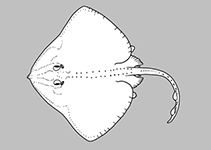 No image available for this species;
drawing shows typical species in Arhynchobatidae.
Google image
drawing shows typical species in Arhynchobatidae.
Klassificering / Namn Populärnamn | synonymer | Catalog of Fishes(Släkte, Arter) | ITIS | CoL | WoRMS | Cloffa
Elasmobranchii (hajar och rockor) (sharks and rays) > Rajiformes (Skates and rays) > Arhynchobatidae (Softnose skates)
Etymology: Notoraja: Greek, noton = back + Latin, raja = fish, Raja sp. (Ref. 45335); sereti: Named after the highly respected French ichthyologist, Dr. Bernard Séret.
Eponymy: Dr Bernard Séret (d: 1949) is an ichthyologist and marine biologist who is a senior scientist at IRD (Institut de Recherche pour le Développement) and is currently hosted by the Department of Systematics and Evolution, Muséum National d’Histoire [...] (Ref. 128868), visit book page.
Etymology: Notoraja: Greek, noton = back + Latin, raja = fish, Raja sp. (Ref. 45335); sereti: Named after the highly respected French ichthyologist, Dr. Bernard Séret.
Eponymy: Dr Bernard Séret (d: 1949) is an ichthyologist and marine biologist who is a senior scientist at IRD (Institut de Recherche pour le Développement) and is currently hosted by the Department of Systematics and Evolution, Muséum National d’Histoire [...] (Ref. 128868), visit book page.
Miljö: miljö / Klimatzon / djupintervall / distributionsområde Ekologi
marina djupbottenlevande; djupintervall 800 - 980 m (Ref. 116308). Tropical
Utbredning Territorier | FAO områden | Ekosystem | Förekomster | Prickkarta | Utplanteringar | Faunafri
Western Central Pacific: Papua New Guinea.
Storlek / Vikt / Ålder
Könsmognad: Lm ? range ? - ? cm
Max length : 45.9 cm TL (female)
Max length : 45.9 cm TL (female)
Kort beskrivning Bestämningsnycklar | Morfologi | Morfometri
This medium-size species is distinguished by the following set of characters: disc wider than long, width 47.1-50.3% TL, length 42.0-43.6% TL; head short (dorsal head length 15.2-16.2% TL; ventral head length 21.6-22.9% TL); snout relatively short (preorbital length 10.1-11.1% TL; ventral snout length 11.2-12.1% TL); interspiracular distance 5.3-5.9 TL, internasal distance 6.2-6.8% TL, preorbital length 2.4-3.0 times orbit length and 2.9-3.6 times interorbital; dorsal fins two, interdorsal space 1.1-1.9% TL; tail width at pelvic-fin axil 0.9-1.6 times its height; preorbital thorn single and small ; dorsal and most of ventral surface of disc entirely velvety, covered with fine denticles; adolescent male with median disc and pelvic fins naked; in females, anterior pelvic-fin lobe naked (skin naked or with sparse denticles ventrally on mid belly, chin, nasal curtain, and around cloaca); tail is long and slender, entirely velvety and without thorn-like denticles; lateral tail folds are moderately well developed; nasal lobes expanded, width of nasal curtain 7.9-8.3% TL; anterior pelvic-fin lobe is slightly shorter or similar length to posterior lobe; dorsal and ventral surfaces are greyish brown to dark bluish grey; total pectoral-fin radials 58-60; monospondylous centra 23-25, total diplospondylous centra 103-106, total centra 126-131 (Ref. 116308).
Body shape (shape guide): other; Cross section: flattened.
Body shape (shape guide): other; Cross section: flattened.
The species is known from three type specimens consisting of two females (45.9 and 45.8 cm TL) and an adolescent male (36.3 cm TL); based on the adolescent male size, the females are most likely adults (Ref. 116308).
Livscykel och parningsbeteende Könsmognad | Reproduktion | Lek | Ägg | Fekunditet | Larver
Huvudreferens
Ladda upp dina referenser | referenser | Koordinator : McEachran, John | Medarbetare
White, W.T., P.R. Last and R.R. Mana, 2017. A new species of velvet skate, Notoraja sereti n.sp. (Rajiformes: Arhynchobatidae) from Papua New Guinea. Zootaxa 4244(2):219-230. (Ref. 116308)
Status på IUCN:s rödlista (Ref. 130435: Version 2025-2 (Global))
Least Concern (LC) ; Date assessed: 21 November 2019
CITES
Not Evaluated
Hot mot människor
Harmless
Mänskliga användningsområden
Fiskeri: saknar intresse
FAO - Publication: search | FishSource |
Ytterligare information
Trofisk ekologi
Livsmedelsartiklar (preys)
Födosammansättning
Födointag
Matransoner
Predatorer
Livsmedelsartiklar (preys)
Födosammansättning
Födointag
Matransoner
Predatorer
Ekologi
Ekologi
Ekologi
Populationsdynamik
Tillväxtparametrar
Max. åldrar / storlekar
Längd-vikt rel.
Längd-längd rel.
Längd-frekvenser
Massakonvertering
Rekrytering
Abundans
Tillväxtparametrar
Max. åldrar / storlekar
Längd-vikt rel.
Längd-längd rel.
Längd-frekvenser
Massakonvertering
Rekrytering
Abundans
Livscykel
Reproduktion
Könsmognad
Mognad/Gills rel.
Fekunditet
Lek
Lekande aggregat
Ägg
Utveckling av ägg
Larver
Larvdynamik
Reproduktion
Könsmognad
Mognad/Gills rel.
Fekunditet
Lek
Lekande aggregat
Ägg
Utveckling av ägg
Larver
Larvdynamik
Anatomi
Gälyta
Hjärna
Otolit
Gälyta
Hjärna
Otolit
Fysiologi
Kroppssammansättning
Näringsämnen
Syreförbrukning
Typ av simning
Simhastighet
Visuella pigment
Ljud från fisk
Sjukdomar & Parasiter
Toxicitet (LC50)
Kroppssammansättning
Näringsämnen
Syreförbrukning
Typ av simning
Simhastighet
Visuella pigment
Ljud från fisk
Sjukdomar & Parasiter
Toxicitet (LC50)
Genetik
Genom
Genetik
Heterozygositet
Ärftlighet
Genetisk mångfald
Genom
Genetik
Heterozygositet
Ärftlighet
Genetisk mångfald
Människorelaterad
Vattenbrukssystem
Vattenbruksprofiler
Avelslinjer
Ciguatera-fall
Frimärken, mynt, diverse.
Vattenbrukssystem
Vattenbruksprofiler
Avelslinjer
Ciguatera-fall
Frimärken, mynt, diverse.
Verktyg
Särskilda rapporter
Kontrollera för underhåll av akvarium | Kontrollera om det finns faktablad om arter | Kontrollera om det finns faktablad om vattenbruk
Ladda ner XML
Internet-källor
AFORO (otoliths) | Aquatic Commons | BHL | Cloffa | Websites from users | Check FishWatcher | CISTI | Catalog of Fishes: Släkte, Arter | DiscoverLife | ECOTOX | FAO - Publication: search | Faunafri | Fishipedia | Fishtrace | GloBI | Google Books | Google Scholar | Google | IGFA World Record | OneZoom | Open Tree of Life | Otolith Atlas of Taiwan Fishes | PubMed | Reef Life Survey | Socotra Atlas | TreeBase | Tree of Life | Wikipedia: Go, sök | World Records Freshwater Fishing | Zoobank | Zoologiskt register
Uppskattningar baserade på modeller
Index för fylogenetisk mångfald (Ref. 82804): PD50 = 0.5000 [Uniqueness, from 0.5 = low to 2.0 = high].
Bayesian length-weight: a=0.00550 (0.00279 - 0.01081), b=3.11 (2.94 - 3.28), in cm total length, based on LWR estimates for this (Sub)family-body shape (Ref. 93245).
Trofisk nivå (Ref. 69278): 3.8 ±0.7 se; based on size and trophs of closest relatives
Resiliens (Ref. 120179): Mellan, lägsta populationsfördubblingstid 1,4-4,4 år (Preliminary K or Fecundity.).