



Sube tu fotos y Vídeos
Google image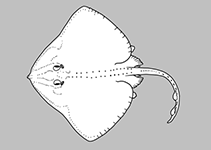 No image available for this species;
drawing shows typical species in Arhynchobatidae.
Google image
drawing shows typical species in Arhynchobatidae.
Clasificación / Nombres Nombres comunes | Sinónimos | Catalog of Fishes(Género, Especie) | ITIS | CoL | WoRMS | Cloffa
Elasmobranquios (tiburones y rayas) (sharks and rays) > Rajiformes (Skates and rays) > Arhynchobatidae (Softnose skates)
Etymology: Notoraja: Greek, noton = back + Latin, raja = fish, Raja sp. (Ref. 45335); sereti: Named after the highly respected French ichthyologist, Dr. Bernard Séret.
Eponymy: Dr Bernard Séret (d: 1949) is an ichthyologist and marine biologist who is a senior scientist at IRD (Institut de Recherche pour le Développement) and is currently hosted by the Department of Systematics and Evolution, Muséum National d’Histoire [...] (Ref. 128868), visit book page.
Etymology: Notoraja: Greek, noton = back + Latin, raja = fish, Raja sp. (Ref. 45335); sereti: Named after the highly respected French ichthyologist, Dr. Bernard Séret.
Eponymy: Dr Bernard Séret (d: 1949) is an ichthyologist and marine biologist who is a senior scientist at IRD (Institut de Recherche pour le Développement) and is currently hosted by the Department of Systematics and Evolution, Muséum National d’Histoire [...] (Ref. 128868), visit book page.
Entorno: milieu / zona climática / rango de profundidad / gama de distribución Ecología
marino batidemersal; rango de profundidad 800 - 980 m (Ref. 116308). Tropical
Distribución Territorios | Áreas FAO | Ecosistemas | Ocurrencias, apariciones | Mapa de puntos | Introducciones | Faunafri
Western Central Pacific: Papua New Guinea.
Tamaño / Peso / Edad
Madurez: Lm ? range ? - ? cm
Max length : 45.9 cm TL (female)
Max length : 45.9 cm TL (female)
Descripción breve Claves de identificación | Morfología | Morfometría
This medium-size species is distinguished by the following set of characters: disc wider than long, width 47.1-50.3% TL, length 42.0-43.6% TL; head short (dorsal head length 15.2-16.2% TL; ventral head length 21.6-22.9% TL); snout relatively short (preorbital length 10.1-11.1% TL; ventral snout length 11.2-12.1% TL); interspiracular distance 5.3-5.9 TL, internasal distance 6.2-6.8% TL, preorbital length 2.4-3.0 times orbit length and 2.9-3.6 times interorbital; dorsal fins two, interdorsal space 1.1-1.9% TL; tail width at pelvic-fin axil 0.9-1.6 times its height; preorbital thorn single and small ; dorsal and most of ventral surface of disc entirely velvety, covered with fine denticles; adolescent male with median disc and pelvic fins naked; in females, anterior pelvic-fin lobe naked (skin naked or with sparse denticles ventrally on mid belly, chin, nasal curtain, and around cloaca); tail is long and slender, entirely velvety and without thorn-like denticles; lateral tail folds are moderately well developed; nasal lobes expanded, width of nasal curtain 7.9-8.3% TL; anterior pelvic-fin lobe is slightly shorter or similar length to posterior lobe; dorsal and ventral surfaces are greyish brown to dark bluish grey; total pectoral-fin radials 58-60; monospondylous centra 23-25, total diplospondylous centra 103-106, total centra 126-131 (Ref. 116308).
Body shape (shape guide): other; Cross section: flattened.
Body shape (shape guide): other; Cross section: flattened.
The species is known from three type specimens consisting of two females (45.9 and 45.8 cm TL) and an adolescent male (36.3 cm TL); based on the adolescent male size, the females are most likely adults (Ref. 116308).
Ciclo vital y comportamiento de apareamiento Madurez | Reproducción | Puesta | Huevos | Fecundidad | Larva
Referencia principal
Suba sus referencias | Referencias | Coordinador : McEachran, John | Colaboradores
White, W.T., P.R. Last and R.R. Mana, 2017. A new species of velvet skate, Notoraja sereti n.sp. (Rajiformes: Arhynchobatidae) from Papua New Guinea. Zootaxa 4244(2):219-230. (Ref. 116308)
Situación en la Lista Roja de la UICN (Ref. 130435: Version 2025-2 (Global))
Least Concern (LC) ; Date assessed: 21 November 2019
CITES
Not Evaluated
Amenaza para el ser humano
Harmless
Usos humanos
Pesquerías: sin interés
FAO - Publication: search | FishSource |
Más información
Ecología Trófica
Alimentos (presas)
Composición de la dieta
consumo de alimento
Raciones de comida
Despredadores
Alimentos (presas)
Composición de la dieta
consumo de alimento
Raciones de comida
Despredadores
Ecología
Ecología
Ecología
Dinámica de la población
Coeficiente del crecimiento para
Edades / tallas máximas
Longitud-peso rel.
Longitud-longitud rel.
Longitud-frecuencias
Conversión de masas
Reclutamiento
Abundancia
Coeficiente del crecimiento para
Edades / tallas máximas
Longitud-peso rel.
Longitud-longitud rel.
Longitud-frecuencias
Conversión de masas
Reclutamiento
Abundancia
Ciclo de vida
Reproducción
Madurez
Madurez/Gills rel.
Fecundidad
Puesta
Agregaciones de desove
Huevos
Desarrollo de los huevos
Larva
Dinámica larvaria
Reproducción
Madurez
Madurez/Gills rel.
Fecundidad
Puesta
Agregaciones de desove
Huevos
Desarrollo de los huevos
Larva
Dinámica larvaria
Distribución
Territorios
Áreas FAO
Ecosistemas
Ocurrencias, apariciones
Introducciones
BRUVS - Vídeos
Territorios
Áreas FAO
Ecosistemas
Ocurrencias, apariciones
Introducciones
BRUVS - Vídeos
Anatomía
Superficie branquial
Cerebro
Otolito
Superficie branquial
Cerebro
Otolito
Fisiología
Composición corporal
Nutrientes
Consumo del oxígeno
Tipo de natación
Velocidad de natación
Pigmentos visuales
Sonido de peces
Enfermedades y parásitos
Toxicidad (CL50)
Composición corporal
Nutrientes
Consumo del oxígeno
Tipo de natación
Velocidad de natación
Pigmentos visuales
Sonido de peces
Enfermedades y parásitos
Toxicidad (CL50)
Genética
Genoma
Genética
Heterocigosidad
heritabilidad
Diversidad genética
Genoma
Genética
Heterocigosidad
heritabilidad
Diversidad genética
Relacionados con el ser humano
Sistemas de acuicultura
Perfiles de acuicultura
Razas
Ciguatera cases
Sellos, monedas, varios
Sistemas de acuicultura
Perfiles de acuicultura
Razas
Ciguatera cases
Sellos, monedas, varios
Herramientas
Libro electrónico | Guía de campo | Asistente para frecuencias de tallas | Herramienta de ciclo de vida | Mapa de puntos |
Catch-MSY |
Informes especiales
Comprobar el mantenimiento del acuario | Buscar fichas sobre especies | Consulte las hojas informativas sobre acuicultura
Descargar XML
Fuentes de Internet
AFORO (otoliths) | Aquatic Commons | BHL | Cloffa | Websites from users | Check FishWatcher | CISTI | Catalog of Fishes: Género, Especie | DiscoverLife | ECOTOX | FAO - Publication: search | Faunafri | Fishipedia | Fishtrace | GloBI | Google Books | Google Scholar | Google | IGFA World Record | OneZoom | Open Tree of Life | Otolith Atlas of Taiwan Fishes | PubMed | Reef Life Survey | Socotra Atlas | TreeBase | Árbol de la vida | Wikipedia: Go, búsqueda | World Records Freshwater Fishing | Zoobank | Expediente Zoológico
Estimaciones basadas en modelos
Índice de diversidad filogenética (Referencia 82804): PD50 = 0.5000 [Uniqueness, from 0.5 = low to 2.0 = high].
Bayesian length-weight: a=0.00550 (0.00279 - 0.01081), b=3.11 (2.94 - 3.28), in cm total length, based on LWR estimates for this (Sub)family-body shape (Ref. 93245).
Nivel trófico (Referencia 69278): 3.8 ±0.7 se; based on size and trophs of closest relatives
Resiliencia (Referencia 120179): Medio, población duplicada en un tiempo mínimo de 1.4-4.4 años (Preliminary K or Fecundity.).