



Rhinobatos borneensis Last, Séret & Naylor, 2016
Borneo guitarfish
Sube tu fotos y Vídeos
Google image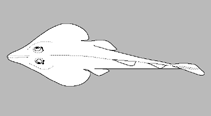 No image available for this species;
drawing shows typical species in Rhinobatidae.
Google image
drawing shows typical species in Rhinobatidae.
Clasificación / Nombres Nombres comunes | Sinónimos | Catalog of Fishes(Género, Especie) | ITIS | CoL | WoRMS | Cloffa
Elasmobranquios (tiburones y rayas) (sharks and rays) > Rhinopristiformes (Shovelnose rays) > Rhinobatidae (Guitarfishes)
Etymology: Rhinobatos: Greek, rhinos = nose + Greek, batis, -idos = a ray (Raja sp.) (Ref. 45335); borneensis: Named for its type locality, Borneo.
Etymology: Rhinobatos: Greek, rhinos = nose + Greek, batis, -idos = a ray (Raja sp.) (Ref. 45335); borneensis: Named for its type locality, Borneo.
Entorno: milieu / zona climática / rango de profundidad / gama de distribución Ecología
marino bentopelágico. Tropical; 8°N - 1°N, 108°E - 118°E (Ref. 114953)
Distribución Territorios | Áreas FAO | Ecosistemas | Ocurrencias, apariciones | Mapa de puntos | Introducciones | Faunafri
West Pacific: Malaysia (Borneo) and the Philippines.
Tamaño / Peso / Edad
Madurez: Lm ? range ? - 63 cm
Max length : 68.6 cm TL macho / no sexado; (Ref. 108568); 90.0 cm TL (female)
Max length : 68.6 cm TL macho / no sexado; (Ref. 108568); 90.0 cm TL (female)
Descripción breve Claves de identificación | Morfología | Morfometría
This species is distinguished by the following characters in adults: a wedge-shaped disc, its width 29-31% TL and length 1.30-1.42 times width; snout length 2.5-3.3 times the interspiracular distance, 3.8-5.6 times the interorbital width; medium-sized orbit, 1.5-2.2 times the spiracle length; nostrils weakly oblique, length 1.5-1.7 times internarial distance; preoral length 7.4-8.1 times the internarial distance; anterior nasal flaps are penetrating slightly into internarial space but well separated at their insertion (not reaching level of inner corner of nostril); posterior nasal flaps are broad; spiracular folds 2, the outermost fold distinctly taller than inner fold; ridges of rostral cartilage almost parallel, converging slightly anteriorly but not constricted medially; anterior cartilage sickle-shaped, pointed or blunt posteriorly; distance between fifth gill slits 2.7-3.3 times in ventral head length; prebranchial sensory pore patch obvious, extending to just behind first gill slit; postscapular sensory canal apparent with exposed lateral pores, grooved; thorn patches present on supraorbit, scapular region, and dorsal midline rudimentary, not evident; in males pelvic-fin inner margin subequal to its base, shorter in females; interdorsal distance 2.5-3.3 times first dorsal-fin base; dorsal caudal margin 1.9-2.3 times preventral margin; upper jaw with ca. 90 tooth rows; post-synarcual centra 176-180; nasal lamellae 50-53; dorsal fin usually with a large, often faint, central dusky blotches; in adults dorsal disc yellowish or brownish, often with diffuse pale yellowish blotches, without white spots; young with ocellate markings (Ref. 108568).
Body shape (shape guide): elongated; Cross section: flattened.
Body shape (shape guide): elongated; Cross section: flattened.
This species is probably benthic on continental shelf. Biology of the species is poorly known, but for finding a pregnant female with 6 pups (Ref. 108568). Matures at ca. 63 cm TL (Ref. 114953).
Ciclo vital y comportamiento de apareamiento Madurez | Reproducción | Puesta | Huevos | Fecundidad | Larva
Referencia principal
Suba sus referencias | Referencias | Coordinador : McEachran, John | Colaboradores
Last, P.R., B. Séret and G.J.P. Naylor, 2016. A new species of guitarfish, Rhinobatos borneensis sp. nov. with a redefinition of the family-level classification in the order Rhinopristiformes (Chondrichthyes: Batoidea). Zootaxa 4117(4):451-475. (Ref. 108568)
Situación en la Lista Roja de la UICN (Ref. 130435: Version 2025-2 (Global))
Endangered (EN) (A2d); Date assessed: 12 May 2020
Amenaza para el ser humano
Harmless
Usos humanos
FAO - Publication: search | FishSource |
Más información
Ecología Trófica
Alimentos (presas)
Composición de la dieta
consumo de alimento
Raciones de comida
Despredadores
Alimentos (presas)
Composición de la dieta
consumo de alimento
Raciones de comida
Despredadores
Ecología
Ecología
Ecología
Dinámica de la población
Coeficiente del crecimiento para
Edades / tallas máximas
Longitud-peso rel.
Longitud-longitud rel.
Longitud-frecuencias
Conversión de masas
Reclutamiento
Abundancia
Coeficiente del crecimiento para
Edades / tallas máximas
Longitud-peso rel.
Longitud-longitud rel.
Longitud-frecuencias
Conversión de masas
Reclutamiento
Abundancia
Ciclo de vida
Reproducción
Madurez
Madurez/Gills rel.
Fecundidad
Puesta
Agregaciones de desove
Huevos
Desarrollo de los huevos
Larva
Dinámica larvaria
Reproducción
Madurez
Madurez/Gills rel.
Fecundidad
Puesta
Agregaciones de desove
Huevos
Desarrollo de los huevos
Larva
Dinámica larvaria
Distribución
Territorios
Áreas FAO
Ecosistemas
Ocurrencias, apariciones
Introducciones
BRUVS - Vídeos
Territorios
Áreas FAO
Ecosistemas
Ocurrencias, apariciones
Introducciones
BRUVS - Vídeos
Anatomía
Superficie branquial
Cerebro
Otolito
Superficie branquial
Cerebro
Otolito
Fisiología
Composición corporal
Nutrientes
Consumo del oxígeno
Tipo de natación
Velocidad de natación
Pigmentos visuales
Sonido de peces
Enfermedades y parásitos
Toxicidad (CL50)
Composición corporal
Nutrientes
Consumo del oxígeno
Tipo de natación
Velocidad de natación
Pigmentos visuales
Sonido de peces
Enfermedades y parásitos
Toxicidad (CL50)
Genética
Genoma
Genética
Heterocigosidad
heritabilidad
Diversidad genética
Genoma
Genética
Heterocigosidad
heritabilidad
Diversidad genética
Relacionados con el ser humano
Sistemas de acuicultura
Perfiles de acuicultura
Razas
Ciguatera cases
Sellos, monedas, varios
Sistemas de acuicultura
Perfiles de acuicultura
Razas
Ciguatera cases
Sellos, monedas, varios
Herramientas
Libro electrónico | Guía de campo | Asistente para frecuencias de tallas | Herramienta de ciclo de vida | Mapa de puntos |
Catch-MSY |
Informes especiales
Comprobar el mantenimiento del acuario | Buscar fichas sobre especies | Consulte las hojas informativas sobre acuicultura
Descargar XML
Fuentes de Internet
AFORO (otoliths) | Aquatic Commons | BHL | Cloffa | Websites from users | Check FishWatcher | CISTI | Catalog of Fishes: Género, Especie | DiscoverLife | ECOTOX | FAO - Publication: search | Faunafri | Fishipedia | Fishtrace | GloBI | Google Books | Google Scholar | Google | IGFA World Record | OneZoom | Open Tree of Life | Otolith Atlas of Taiwan Fishes | PubMed | Reef Life Survey | Socotra Atlas | TreeBase | Árbol de la vida | Wikipedia: Go, búsqueda | World Records Freshwater Fishing | Zoobank | Expediente Zoológico
Estimaciones basadas en modelos
Índice de diversidad filogenética (Referencia 82804): PD50 = 0.5000 [Uniqueness, from 0.5 = low to 2.0 = high].
Bayesian length-weight: a=0.00295 (0.00150 - 0.00581), b=3.13 (2.96 - 3.30), in cm total length, based on LWR estimates for this (Sub)family-body shape (Ref. 93245).
Nivel trófico (Referencia 69278): 3.7 ±0.4 se; based on size and trophs of closest relatives
Resiliencia (Referencia 120179): Bajo, población duplicada en un tiempo mínimo de 4.5-14 años (Preliminary low fecundity).