



Rhinobatos borneensis Last, Séret & Naylor, 2016
Borneo guitarfish
Uploaden van uw Foto's en video's
Google afbeelding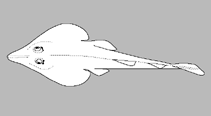 No image available for this species;
drawing shows typical species in Rhinobatidae.
Google afbeelding
drawing shows typical species in Rhinobatidae.
Classificatie / Namen Lokale namen | Synoniemen | Catalog of Fishes(Genus, Soort(en)) | ITIS | CoL | WoRMS | Cloffa
Elasmobranchii (haaien en roggen) (sharks and rays) > Rhinopristiformes (Shovelnose rays) > Rhinobatidae (Guitarfishes)
Etymology: Rhinobatos: Greek, rhinos = nose + Greek, batis, -idos = a ray (Raja sp.) (Ref. 45335); borneensis: Named for its type locality, Borneo.
Etymology: Rhinobatos: Greek, rhinos = nose + Greek, batis, -idos = a ray (Raja sp.) (Ref. 45335); borneensis: Named for its type locality, Borneo.
Milieu: milieu / Klimaatzone / Diepte / verspreidingsgebied Ecologie
marien benthopelagisch. Tropical; 8°N - 1°N, 108°E - 118°E (Ref. 114953)
Verspreiding Gebieden | FAO regio's | Ecosystemen | Voorkomen | Verspreidingskaart | Introducties | Faunafri
West Pacific: Malaysia (Borneo) and the Philippines.
Grootte / Gewicht / Leeftijd
Maturiteit: Lm ? range ? - 63 cm
Max length : 68.6 cm TL mannelijk / geslacht onbekend; (Ref. 108568); 90.0 cm TL (female)
Max length : 68.6 cm TL mannelijk / geslacht onbekend; (Ref. 108568); 90.0 cm TL (female)
Korte beschrijving Determinatiesleutels | Morfologie | Morfometrie
This species is distinguished by the following characters in adults: a wedge-shaped disc, its width 29-31% TL and length 1.30-1.42 times width; snout length 2.5-3.3 times the interspiracular distance, 3.8-5.6 times the interorbital width; medium-sized orbit, 1.5-2.2 times the spiracle length; nostrils weakly oblique, length 1.5-1.7 times internarial distance; preoral length 7.4-8.1 times the internarial distance; anterior nasal flaps are penetrating slightly into internarial space but well separated at their insertion (not reaching level of inner corner of nostril); posterior nasal flaps are broad; spiracular folds 2, the outermost fold distinctly taller than inner fold; ridges of rostral cartilage almost parallel, converging slightly anteriorly but not constricted medially; anterior cartilage sickle-shaped, pointed or blunt posteriorly; distance between fifth gill slits 2.7-3.3 times in ventral head length; prebranchial sensory pore patch obvious, extending to just behind first gill slit; postscapular sensory canal apparent with exposed lateral pores, grooved; thorn patches present on supraorbit, scapular region, and dorsal midline rudimentary, not evident; in males pelvic-fin inner margin subequal to its base, shorter in females; interdorsal distance 2.5-3.3 times first dorsal-fin base; dorsal caudal margin 1.9-2.3 times preventral margin; upper jaw with ca. 90 tooth rows; post-synarcual centra 176-180; nasal lamellae 50-53; dorsal fin usually with a large, often faint, central dusky blotches; in adults dorsal disc yellowish or brownish, often with diffuse pale yellowish blotches, without white spots; young with ocellate markings (Ref. 108568).
Body shape (shape guide): elongated; Cross section: flattened.
Body shape (shape guide): elongated; Cross section: flattened.
This species is probably benthic on continental shelf. Biology of the species is poorly known, but for finding a pregnant female with 6 pups (Ref. 108568). Matures at ca. 63 cm TL (Ref. 114953).
Levenscyclus en paargedrag Maturiteit | Voortplanting | Paaien | Eieren | Fecunditeit | Larven
Hoofdreferentie
Upload uw referenties | Referenties | Coördinator : McEachran, John | Medewerkers
Last, P.R., B. Séret and G.J.P. Naylor, 2016. A new species of guitarfish, Rhinobatos borneensis sp. nov. with a redefinition of the family-level classification in the order Rhinopristiformes (Chondrichthyes: Batoidea). Zootaxa 4117(4):451-475. (Ref. 108568)
Status op de Rode Lijst van het IUCN (Ref. 130435: Version 2025-2 (Global))
Bedreigd (EN) (A2d); Date assessed: 12 May 2020
Gevaar voor de mens
Harmless
Gebruik door de mens
FAO - Publication: search | FishSource |
Meer informatie
Trofische ecologie
Voedsel (prooien)
Dieetsamenstelling
Voedselconsumptie
Voedselrantsoenen
Predatoren
Voedsel (prooien)
Dieetsamenstelling
Voedselconsumptie
Voedselrantsoenen
Predatoren
Ecologie
Ecologie
Ecologie
Populatiedynamica
Groeiparameters
Max. leeftijden / maten
Lengte-gewicht rel.
Lengte-lengte rel.
Lengtefrequenties
Massaconversie
Rekrutering
Abundantie
Groeiparameters
Max. leeftijden / maten
Lengte-gewicht rel.
Lengte-lengte rel.
Lengtefrequenties
Massaconversie
Rekrutering
Abundantie
Levenscyclus
Voortplanting
Maturiteit
Rijpheid/kieuwen rel.
Fecunditeit
Paaien
Paaibestanden
Eieren
Ontwikkeling van de eieren
Larven
Larvale populatiedynamiek
Voortplanting
Maturiteit
Rijpheid/kieuwen rel.
Fecunditeit
Paaien
Paaibestanden
Eieren
Ontwikkeling van de eieren
Larven
Larvale populatiedynamiek
Anatomie
Kieuwoppervlak
Hersenen
Otoliet
Kieuwoppervlak
Hersenen
Otoliet
Fysiologie
Lichaamssamenstelling
Voedingsstoffen
Zuurstofverbruik
Type zwemmen
Zwemsnelheid
Visuele pigmenten
Vis geluid
Ziekten en parasieten
Toxiciteit (LC50)
Lichaamssamenstelling
Voedingsstoffen
Zuurstofverbruik
Type zwemmen
Zwemsnelheid
Visuele pigmenten
Vis geluid
Ziekten en parasieten
Toxiciteit (LC50)
Genetica
genoom
Genetica
Heterozygositeit
Erfelijkheid
Genetische diversiteit
genoom
Genetica
Heterozygositeit
Erfelijkheid
Genetische diversiteit
Menselijk gerelateerd
Aquacultuursystemen
Aquacultuurprofielen
Kweeklijnen
Ciguatera gevallen
Postzegels, munten, diversen.
Aquacultuursystemen
Aquacultuurprofielen
Kweeklijnen
Ciguatera gevallen
Postzegels, munten, diversen.
Tools
Speciale rapporten
Bekijk gegevens voor het houden in een aquarium | Bekijk Fact Sheets voor de soort | Bekijk Aquacultuur Fact Sheets
Download XML
Internetbronnen
AFORO (otoliths) | Aquatic Commons | BHL | Cloffa | Websites from users | Bekijk FishWatcher | CISTI | Catalog of Fishes: Genus, Soort(en) | DiscoverLife | ECOTOX | FAO - Publication: search | Faunafri | Fishipedia | Fishtrace | GloBI | Google Books | Google Scholar | Google | IGFA World Record | OneZoom | Open Tree of Life | Otolith Atlas of Taiwan Fishes | PubMed | Reef Life Survey | Socotra Atlas | TreeBase | Tree of Life | Wikipedia: ga naar, zoek | World Records Freshwater Fishing | Zoobank | Zoological Record
Schattingen op basis van modellen
Fylogenetische diversiteitsindex (Ref. 82804): PD50 = 0.5000 [Uniqueness, from 0.5 = low to 2.0 = high].
Bayesian length-weight: a=0.00295 (0.00150 - 0.00581), b=3.13 (2.96 - 3.30), in cm total length, based on LWR estimates for this (Sub)family-body shape (Ref. 93245).
Trofisch niveau (Ref. 69278): 3.7 ±0.4 se; based on size and trophs of closest relatives
Weerstandsvermogen (Ref. 120179): laag, minimale populatieverdubbelingstijd 4,5-14 jaar (Preliminary low fecundity).