



Rhinobatos borneensis Last, Séret & Naylor, 2016
Borneo guitarfish
Envoyez vos Photos et vidéos
Images Google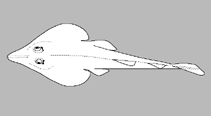 No image available for this species;
drawing shows typical species in Rhinobatidae.
Images Google
drawing shows typical species in Rhinobatidae.
Classification / Noms Noms communs | Synonymes | Catalog of Fishes(Genre, Espèce) | ITIS | CoL | WoRMS | Cloffa
Élasmobranches (requins et raies) (sharks and rays) > Rhinopristiformes (Shovelnose rays) > Rhinobatidae (Guitarfishes)
Etymology: Rhinobatos: Greek, rhinos = nose + Greek, batis, -idos = a ray (Raja sp.) (Ref. 45335); borneensis: Named for its type locality, Borneo.
Etymology: Rhinobatos: Greek, rhinos = nose + Greek, batis, -idos = a ray (Raja sp.) (Ref. 45335); borneensis: Named for its type locality, Borneo.
Environnement : milieu / zone climatique / profondeur / gamme de distribution Écologie
marin benthopélagique. Tropical; 8°N - 1°N, 108°E - 118°E (Ref. 114953)
Distribution Territoires | Zones FAO | Écosystèmes | Occurrences | Carte par point | Introductions | Faunafri
West Pacific: Malaysia (Borneo) and the Philippines.
Taille / Poids / Âge
Maturité: Lm ? range ? - 63 cm
Max length : 68.6 cm TL mâle / non sexé; (Ref. 108568); 90.0 cm TL (female)
Max length : 68.6 cm TL mâle / non sexé; (Ref. 108568); 90.0 cm TL (female)
Description synthétique Clés d'identification | Morphologie | Morphométrie
This species is distinguished by the following characters in adults: a wedge-shaped disc, its width 29-31% TL and length 1.30-1.42 times width; snout length 2.5-3.3 times the interspiracular distance, 3.8-5.6 times the interorbital width; medium-sized orbit, 1.5-2.2 times the spiracle length; nostrils weakly oblique, length 1.5-1.7 times internarial distance; preoral length 7.4-8.1 times the internarial distance; anterior nasal flaps are penetrating slightly into internarial space but well separated at their insertion (not reaching level of inner corner of nostril); posterior nasal flaps are broad; spiracular folds 2, the outermost fold distinctly taller than inner fold; ridges of rostral cartilage almost parallel, converging slightly anteriorly but not constricted medially; anterior cartilage sickle-shaped, pointed or blunt posteriorly; distance between fifth gill slits 2.7-3.3 times in ventral head length; prebranchial sensory pore patch obvious, extending to just behind first gill slit; postscapular sensory canal apparent with exposed lateral pores, grooved; thorn patches present on supraorbit, scapular region, and dorsal midline rudimentary, not evident; in males pelvic-fin inner margin subequal to its base, shorter in females; interdorsal distance 2.5-3.3 times first dorsal-fin base; dorsal caudal margin 1.9-2.3 times preventral margin; upper jaw with ca. 90 tooth rows; post-synarcual centra 176-180; nasal lamellae 50-53; dorsal fin usually with a large, often faint, central dusky blotches; in adults dorsal disc yellowish or brownish, often with diffuse pale yellowish blotches, without white spots; young with ocellate markings (Ref. 108568).
Body shape (shape guide): elongated; Cross section: flattened.
Body shape (shape guide): elongated; Cross section: flattened.
This species is probably benthic on continental shelf. Biology of the species is poorly known, but for finding a pregnant female with 6 pups (Ref. 108568). Matures at ca. 63 cm TL (Ref. 114953).
Cycle de vie et comportement reproducteur Maturité | Reproduction | Frai | Œufs | Fécondité | Larves
Référence principale
Téléchargez vos références | Références | Coordinateur : McEachran, John | Collaborateurs
Last, P.R., B. Séret and G.J.P. Naylor, 2016. A new species of guitarfish, Rhinobatos borneensis sp. nov. with a redefinition of the family-level classification in the order Rhinopristiformes (Chondrichthyes: Batoidea). Zootaxa 4117(4):451-475. (Ref. 108568)
Statut dans la liste rouge de l'IUCN (Ref. 130435: Version 2025-2 (Global))
Menacé (EN) (A2d); Date assessed: 12 May 2020
Menace pour l'homme
Harmless
Utilisations par l'homme
FAO - Publication: search | FishSource |
Plus d'informations
Écologie trophique
Aliments (proies)
Composition du régime alimentaire
Consommation alimentaire
Rations alimentaires
Prédateurs
Aliments (proies)
Composition du régime alimentaire
Consommation alimentaire
Rations alimentaires
Prédateurs
Écologie
Écologie
Écologie
Dynamique des populations
Paramètres de croissance
Âges / tailles maximales
Longueur-poids rel.
Rel. longueur-longueur.
Fréquences de longueurs
Conversion de masse
Recrutement
Abondance
Paramètres de croissance
Âges / tailles maximales
Longueur-poids rel.
Rel. longueur-longueur.
Fréquences de longueurs
Conversion de masse
Recrutement
Abondance
Cycle de vie
Reproduction
Maturité
Maturité/épines rel.
Fécondité
Frai
Agrégats de frai
Œufs
Développement de l'œuf
Larves
Dynamique des populations larvaires
Reproduction
Maturité
Maturité/épines rel.
Fécondité
Frai
Agrégats de frai
Œufs
Développement de l'œuf
Larves
Dynamique des populations larvaires
Anatomie
Surface branchiale
Cerveau
Otolithe
Surface branchiale
Cerveau
Otolithe
Physiologie
Composition corporelle
Nutriments
Consommation d'oxygène
Type de natation
Vitesse de nage
Pigments visuels
Son de poisson
Maladies et parasites
Toxicité (CL50)
Composition corporelle
Nutriments
Consommation d'oxygène
Type de natation
Vitesse de nage
Pigments visuels
Son de poisson
Maladies et parasites
Toxicité (CL50)
Génétique
génôme
Génétique
Hétérozygotie
Héritabilité
Diversité génétique
génôme
Génétique
Hétérozygotie
Héritabilité
Diversité génétique
Liées à l'homme
Systèmes d'aquaculture
Profils d'aquaculture
Souches
Cas de ciguatera
Timbres, pièces de monnaie, divers
Systèmes d'aquaculture
Profils d'aquaculture
Souches
Cas de ciguatera
Timbres, pièces de monnaie, divers
Outils
E-book | Guide de terrain | Générateur de fréquences de longueur | Outil de dynamique de population | Carte par point |
Capture-MSY |
Articles particuliers
Télécharger en XML
Sources Internet
AFORO (otoliths) | Aquatic Commons | BHL | Cloffa | Websites from users | FishWatcher | CISTI | Catalog of Fishes: Genre, Espèce | DiscoverLife | ECOTOX | FAO - Publication: search | Faunafri | Fishipedia | Fishtrace | GloBI | Google Books | Google Scholar | Google | IGFA World Record | OneZoom | Open Tree of Life | Otolith Atlas of Taiwan Fishes | PubMed | Reef Life Survey | Socotra Atlas | TreeBase | Arbre de Vie | Wikipedia: aller à, chercher | World Records Freshwater Fishing | Zoobank | Zoological Record
Estimations basées sur des modèles
Indice de diversité phylogénétique (Réf. 82804): PD50 = 0.5000 [Uniqueness, from 0.5 = low to 2.0 = high].
Bayesian length-weight: a=0.00295 (0.00150 - 0.00581), b=3.13 (2.96 - 3.30), in cm total length, based on LWR estimates for this (Sub)family-body shape (Ref. 93245).
Niveau trophique (Réf. 69278): 3.7 ±0.4 se; based on size and trophs of closest relatives
Résilience (Réf. 120179): Faible, temps minimum de doublement de population : 4,5 à 14 années (Preliminary low fecundity).