



Cottus gratzianowi Sideleva, Naseka & Zhidkov, 2015
Hochladen Photos und videos
Google Bild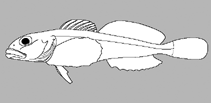 No image available for this species;
drawing shows typical species in Cottidae.
Google Bild
drawing shows typical species in Cottidae.
Klassifizierung / Names Namen | Synonyme | Catalog of Fishes(Gattung, Arten) | ITIS | CoL | WoRMS | Cloffa
> Perciformes/Cottoidei (Sculpins) > Cottidae (Sculpins)
Etymology: Cottus: Greek, kottos = a fish (Ref. 45335); gratzianowi: Named for Valerian Ivanovich Gratzianow [Gratsianov] (1876−1932), the author of the first taxonomic review of Russian fishes "Versuch einer Übersicht der Fische des Russischen Reiches in systematischer und geographischer Hinsicht" (Gratzianow 1907), who described Cottus koshewnikowi. The original latinised spelling of the surname (Gratzianow) was retained.
Eponymy: Valerian Ivanovich Gratzianow (Gratsianov) (1876–1932) was a Russian ichthyologist and zoologist. [...] (Ref. 128868), visit book page.
Etymology: Cottus: Greek, kottos = a fish (Ref. 45335); gratzianowi: Named for Valerian Ivanovich Gratzianow [Gratsianov] (1876−1932), the author of the first taxonomic review of Russian fishes "Versuch einer Übersicht der Fische des Russischen Reiches in systematischer und geographischer Hinsicht" (Gratzianow 1907), who described Cottus koshewnikowi. The original latinised spelling of the surname (Gratzianow) was retained.
Eponymy: Valerian Ivanovich Gratzianow (Gratsianov) (1876–1932) was a Russian ichthyologist and zoologist. [...] (Ref. 128868), visit book page.
Umwelt: Milieu / Klimazone / Tiefenbereich / Verbreitungsgebiet Ökologie
; süßwasser benthopelagisch. Temperate
Verbreitung Territorien | FAO Gebiete | Ökosysteme | Vorkommen | Punkt Karte | Einführungen | Faunafri
Europe: Ukhtomitsa River in the Onega River drainage, White Sea basin, Russia.
Größe / Gewicht / Alter
Kurzbeschreibung Bestimmungsschlüssel | Morphologie | Morphometrie
Rückenflossenstacheln (insgesamt) : 6 - 8; Rückenflossenweichstrahlen (insgesamt) : 15 - 17; Afterflossenweichstrahlen: 12 - 13; Wirbelzahl: 32 - 34. Cottus gratzianowi is distinguished from all congeners in Europe east of the Meuse (except C. koshewnikowi) in having the following combination of characters: no transverse dark bands on the pelvic fin; a single median chin canal pore; an incomplete lateral line not reaching behind the anal-fin insertion; and lateral line located considerably above the mid-line of the flank. It differs from C. koshewnikowi by a larger eye (horizontal diameter 23?28% HL, equal to or exceeding snout length vs. 16?25% HL, less than snout length), a rounded caudal fin (vs. commonly truncated), frequent presence of one to three branched rays in median part of the pectoral fin (vs. usual absence), an interrupted supratemporal canal commissure with 4 pores (vs. non-interrupted, with 3 pores), the pelvic fin extending to the anus in both sexes (vs. not reaching the anus), a short lateral-line canal extending to below the fifth to tenth ray of the second dorsal fin, with 15?24 pores, with few interruption (vs. commonly extending to below the 9th to 15th ray of the second dorsal fin, with modally 21?27 pores, with few to numerous interruptions), abdominal vertebrae commonly 10 (vs. 11), and contrasting black blotches on all fins including pelvic and anal fins (vs. no blotches on pelvic and anal fins) (Ref. 101366).
During summer, this species is found in a relatively cool small river with moderate to rapid current, gravel and cobble bottom, and not very dense submerged aquatic vegetation (Ref. 101366).
Lebenszyklus und Paarungsverhalten Geschlechtsreife | Fortpflanzung | Ablaichen | Eier | Fruchtbarkeit | Larven
Hauptreferenz
Laden Sie Ihre Referenzen hoch | Referenzen | Koordinator | Partner
Sideleva, V.G., A.M. Naseka and Z.V. Zhidkov, 2015. A new species of Cottus from the Onega River drainage, White Sea basin (Actinopterygii: Scorpaeniformes: Cottidae). Zootaxa 3949(3):419-430. (Ref. 101366)
IUCN Rote Liste Status (Ref. 130435: Version 2025-2 (Global))
nicht bedroht (LC) ; Date assessed: 21 July 2023
CITES
Not Evaluated
Bedrohung für Menschen
Harmless
Nutzung durch Menschen
Fischereien: nicht kommerziell
FAO - Publication: search | FishSource |
Mehr Information
Trophische Ökologie
Lebensmittel (Beutetiere)
Nahrungszusammensetzung
Nahrungsaufnahme
Lebensmittelrationen
Räuber
Lebensmittel (Beutetiere)
Nahrungszusammensetzung
Nahrungsaufnahme
Lebensmittelrationen
Räuber
Populationsdynamik
Wachstumsparameter
Max. Alter/Größen
Länge-Gewicht-Rel.
Länge-Länge-Verhältnis.
Längenhäufigkeiten
Massenkonvertierung
Rekrutierung
Dichte
Wachstumsparameter
Max. Alter/Größen
Länge-Gewicht-Rel.
Länge-Länge-Verhältnis.
Längenhäufigkeiten
Massenkonvertierung
Rekrutierung
Dichte
Lebenszyklus
Fortpflanzung
Geschlechtsreife
Reifung/Kiemen rel.
Fruchtbarkeit
Ablaichen
Laichaggregationen
Eier
Eientwicklung
Larven
Larven Pop.Dyn.
Fortpflanzung
Geschlechtsreife
Reifung/Kiemen rel.
Fruchtbarkeit
Ablaichen
Laichaggregationen
Eier
Eientwicklung
Larven
Larven Pop.Dyn.
Anatomie
Kiemenoberfläche
Gehirn
Otolith
Kiemenoberfläche
Gehirn
Otolith
Physiologie
Körperliche Zusammensetzung
Nährstoffe
Sauerstoffverbrauch
Schwimmart
Schwimmgeschwindigkeit
Visuelle Pigmente
Fischgeräusche
Krankheiten und Parasiten
Toxizität (LC50s)
Körperliche Zusammensetzung
Nährstoffe
Sauerstoffverbrauch
Schwimmart
Schwimmgeschwindigkeit
Visuelle Pigmente
Fischgeräusche
Krankheiten und Parasiten
Toxizität (LC50s)
Genetik
Genom
Genetik
Heterozygotie
Vererbbarkeit
Genetische Vielfalt
Genom
Genetik
Heterozygotie
Vererbbarkeit
Genetische Vielfalt
Menschenbezogen
Aquakultur-Systeme
Aquakultur Profile
Zuchtlinien
Ciguatera-Fälle
Briefmarken, Münzen, Verschiedenes.
Aquakultur-Systeme
Aquakultur Profile
Zuchtlinien
Ciguatera-Fälle
Briefmarken, Münzen, Verschiedenes.
Tools
Zusatzinformationen
Download XML
Zusammenfassung | Punktdaten | Namen | Photos
Internet Quellen
AFORO (otoliths) | Aquatic Commons | BHL | Cloffa | Websites from users | FishWatcher Einträge suchen | CISTI | Catalog of Fishes: Gattung, Arten | DiscoverLife | ECOTOX | FAO - Publication: search | Faunafri | Fishipedia | Fishtrace | GloBI | Google Books | Google Scholar | Google | IGFA World Record | OneZoom | Open Tree of Life | Otolith Atlas of Taiwan Fishes | PubMed | Reef Life Survey | Socotra Atlas | TreeBase | Tree of Life | Wikipedia: Gehe zu, Suchen | World Records Freshwater Fishing | Zoobank | Zoologischer Rekord
Schätzungen auf der Grundlage von Modellen
Phylogenetischer Diversitätsindex (Ref. 82804): PD50 = 0.5000 [Uniqueness, from 0.5 = low to 2.0 = high].
Bayesian length-weight: a=0.00832 (0.00345 - 0.02005), b=3.16 (2.98 - 3.34), in cm total length, based on LWR estimates for this Genus-body shape (Ref. 93245).
Trophische Ebene (Ref. 69278): 3.2 ±0.4 se; based on size and trophs of closest relatives
Widerstandsfähigkeit (Ref. 120179): hoch, Verdopplung der Population dauert weniger als 15 Monate. (Preliminary K or Fecundity.).