



Cottus gratzianowi Sideleva, Naseka & Zhidkov, 2015
Envoyez vos Photos et vidéos
Images Google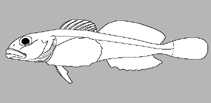 No image available for this species;
drawing shows typical species in Cottidae.
Images Google
drawing shows typical species in Cottidae.
Classification / Noms Noms communs | Synonymes | Catalog of Fishes(Genre, Espèce) | ITIS | CoL | WoRMS | Cloffa
> Perciformes/Cottoidei (Sculpins) > Cottidae (Sculpins)
Etymology: Cottus: Greek, kottos = a fish (Ref. 45335); gratzianowi: Named for Valerian Ivanovich Gratzianow [Gratsianov] (1876−1932), the author of the first taxonomic review of Russian fishes "Versuch einer Übersicht der Fische des Russischen Reiches in systematischer und geographischer Hinsicht" (Gratzianow 1907), who described Cottus koshewnikowi. The original latinised spelling of the surname (Gratzianow) was retained.
Eponymy: Valerian Ivanovich Gratzianow (Gratsianov) (1876–1932) was a Russian ichthyologist and zoologist. [...] (Ref. 128868), visit book page.
Etymology: Cottus: Greek, kottos = a fish (Ref. 45335); gratzianowi: Named for Valerian Ivanovich Gratzianow [Gratsianov] (1876−1932), the author of the first taxonomic review of Russian fishes "Versuch einer Übersicht der Fische des Russischen Reiches in systematischer und geographischer Hinsicht" (Gratzianow 1907), who described Cottus koshewnikowi. The original latinised spelling of the surname (Gratzianow) was retained.
Eponymy: Valerian Ivanovich Gratzianow (Gratsianov) (1876–1932) was a Russian ichthyologist and zoologist. [...] (Ref. 128868), visit book page.
Environnement : milieu / zone climatique / profondeur / gamme de distribution Écologie
; eau douce benthopélagique. Temperate
Distribution Territoires | Zones FAO | Écosystèmes | Occurrences | Carte par point | Introductions | Faunafri
Europe: Ukhtomitsa River in the Onega River drainage, White Sea basin, Russia.
Taille / Poids / Âge
Description synthétique Clés d'identification | Morphologie | Morphométrie
Épines dorsales (Total) : 6 - 8; Rayons mous dorsaux (Total) : 15 - 17; Rayons mous anaux: 12 - 13; Vertèbres: 32 - 34. Cottus gratzianowi is distinguished from all congeners in Europe east of the Meuse (except C. koshewnikowi) in having the following combination of characters: no transverse dark bands on the pelvic fin; a single median chin canal pore; an incomplete lateral line not reaching behind the anal-fin insertion; and lateral line located considerably above the mid-line of the flank. It differs from C. koshewnikowi by a larger eye (horizontal diameter 23?28% HL, equal to or exceeding snout length vs. 16?25% HL, less than snout length), a rounded caudal fin (vs. commonly truncated), frequent presence of one to three branched rays in median part of the pectoral fin (vs. usual absence), an interrupted supratemporal canal commissure with 4 pores (vs. non-interrupted, with 3 pores), the pelvic fin extending to the anus in both sexes (vs. not reaching the anus), a short lateral-line canal extending to below the fifth to tenth ray of the second dorsal fin, with 15?24 pores, with few interruption (vs. commonly extending to below the 9th to 15th ray of the second dorsal fin, with modally 21?27 pores, with few to numerous interruptions), abdominal vertebrae commonly 10 (vs. 11), and contrasting black blotches on all fins including pelvic and anal fins (vs. no blotches on pelvic and anal fins) (Ref. 101366).
During summer, this species is found in a relatively cool small river with moderate to rapid current, gravel and cobble bottom, and not very dense submerged aquatic vegetation (Ref. 101366).
Cycle de vie et comportement reproducteur Maturité | Reproduction | Frai | Œufs | Fécondité | Larves
Référence principale
Téléchargez vos références | Références | Coordinateur | Collaborateurs
Sideleva, V.G., A.M. Naseka and Z.V. Zhidkov, 2015. A new species of Cottus from the Onega River drainage, White Sea basin (Actinopterygii: Scorpaeniformes: Cottidae). Zootaxa 3949(3):419-430. (Ref. 101366)
Statut dans la liste rouge de l'IUCN (Ref. 130435: Version 2025-2 (Global))
Préoccupation mineure (LC) ; Date assessed: 21 July 2023
CITES
Not Evaluated
Menace pour l'homme
Harmless
Utilisations par l'homme
Pêcheries: sans intérêt
FAO - Publication: search | FishSource |
Plus d'informations
Écologie trophique
Aliments (proies)
Composition du régime alimentaire
Consommation alimentaire
Rations alimentaires
Prédateurs
Aliments (proies)
Composition du régime alimentaire
Consommation alimentaire
Rations alimentaires
Prédateurs
Dynamique des populations
Paramètres de croissance
Âges / tailles maximales
Longueur-poids rel.
Rel. longueur-longueur.
Fréquences de longueurs
Conversion de masse
Recrutement
Abondance
Paramètres de croissance
Âges / tailles maximales
Longueur-poids rel.
Rel. longueur-longueur.
Fréquences de longueurs
Conversion de masse
Recrutement
Abondance
Cycle de vie
Reproduction
Maturité
Maturité/épines rel.
Fécondité
Frai
Agrégats de frai
Œufs
Développement de l'œuf
Larves
Dynamique des populations larvaires
Reproduction
Maturité
Maturité/épines rel.
Fécondité
Frai
Agrégats de frai
Œufs
Développement de l'œuf
Larves
Dynamique des populations larvaires
Anatomie
Surface branchiale
Cerveau
Otolithe
Surface branchiale
Cerveau
Otolithe
Physiologie
Composition corporelle
Nutriments
Consommation d'oxygène
Type de natation
Vitesse de nage
Pigments visuels
Son de poisson
Maladies et parasites
Toxicité (CL50)
Composition corporelle
Nutriments
Consommation d'oxygène
Type de natation
Vitesse de nage
Pigments visuels
Son de poisson
Maladies et parasites
Toxicité (CL50)
Génétique
génôme
Génétique
Hétérozygotie
Héritabilité
Diversité génétique
génôme
Génétique
Hétérozygotie
Héritabilité
Diversité génétique
Liées à l'homme
Systèmes d'aquaculture
Profils d'aquaculture
Souches
Cas de ciguatera
Timbres, pièces de monnaie, divers
Systèmes d'aquaculture
Profils d'aquaculture
Souches
Cas de ciguatera
Timbres, pièces de monnaie, divers
Outils
E-book | Guide de terrain | Générateur de fréquences de longueur | Outil de dynamique de population | Carte par point |
Capture-MSY |
Articles particuliers
Télécharger en XML
Sources Internet
AFORO (otoliths) | Aquatic Commons | BHL | Cloffa | Websites from users | FishWatcher | CISTI | Catalog of Fishes: Genre, Espèce | DiscoverLife | ECOTOX | FAO - Publication: search | Faunafri | Fishipedia | Fishtrace | GloBI | Google Books | Google Scholar | Google | IGFA World Record | OneZoom | Open Tree of Life | Otolith Atlas of Taiwan Fishes | PubMed | Reef Life Survey | Socotra Atlas | TreeBase | Arbre de Vie | Wikipedia: aller à, chercher | World Records Freshwater Fishing | Zoobank | Zoological Record
Estimations basées sur des modèles
Indice de diversité phylogénétique (Réf. 82804): PD50 = 0.5000 [Uniqueness, from 0.5 = low to 2.0 = high].
Bayesian length-weight: a=0.00832 (0.00345 - 0.02005), b=3.16 (2.98 - 3.34), in cm total length, based on LWR estimates for this Genus-body shape (Ref. 93245).
Niveau trophique (Réf. 69278): 3.2 ±0.4 se; based on size and trophs of closest relatives
Résilience (Réf. 120179): Haut, temps minimum de doublement de population inférieur à 15 mois (Preliminary K or Fecundity.).