



Rhynchobatus immaculatus Last, ho & Chen, 2013
Taiwanese Wedgefish
Hochladen Photos und videos
Google Bild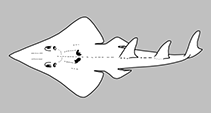 No image available for this species;
drawing shows typical species in Rhinidae.
Google Bild
drawing shows typical species in Rhinidae.
Klassifizierung / Names Namen | Synonyme | Catalog of Fishes(Gattung, Arten) | ITIS | CoL | WoRMS | Cloffa
Elasmobranchii (Haie und Rochen) (sharks and rays) > Rhinopristiformes (Shovelnose rays) > Rhinidae (Wedgefishes)
Etymology: Rhynchobatus: Greek, rhingchos = snout + Greek, batis, -idos = a sting ray (Raja sp.) (Ref. 45335); immaculatus: Name from Latin 'im' meaning not and 'macula' for spot, mark; based on the lack of a dark pectoral marking (rather than any white spots) which is otherwise present in small individuals of other nominal species of Rhynchobatus.
Etymology: Rhynchobatus: Greek, rhingchos = snout + Greek, batis, -idos = a sting ray (Raja sp.) (Ref. 45335); immaculatus: Name from Latin 'im' meaning not and 'macula' for spot, mark; based on the lack of a dark pectoral marking (rather than any white spots) which is otherwise present in small individuals of other nominal species of Rhynchobatus.
Umwelt: Milieu / Klimazone / Tiefenbereich / Verbreitungsgebiet Ökologie
seewasser pelagic-neritic. Subtropical; 23°N - 25°N, 120°E - 122°E (Ref. 114953)
Verbreitung Territorien | FAO Gebiete | Ökosysteme | Vorkommen | Punkt Karte | Einführungen | Faunafri
Northwest Pacific: confirmed from Taiwan; probably more widespread.
Größe / Gewicht / Alter
Kurzbeschreibung Bestimmungsschlüssel | Morphologie | Morphometrie
This medium-sized species is distinguished by the following set of characters: snout is broad, and wedge-shaped; preoral snout 19-21% TL; small eye, its length 4.1-4.5 in preorbital snout; interorbital space 2.6-2.9 in preorbital snout; about 48 tooth rows; no spines from snout; supraorbital spines are small, well differentiated, and extending from preorbit to beyond end of spiracle; predorsal spines are relatively well developed; 2 disjunct rows of 6-9 small scapular spines on each side of the disc; predorsal space 48-49% of total length; origin of the first dorsal fin is well behind origin of pelvic-fin bases; total pectoral-fin radials 65-68; vertebrae with 28-30 monospondylous precaudal centra, 124-131 precaudal free centra, 38-42 diplospondylous caudal (free) centra, 165-170 total free centra, 179-184 total centra (including synarcual centra). Colouration: dark greenish brown dorsally with a few white spots scattered on pectoral disc; no black pectoral marking; prominent row of white spots start just forward of a single white spot (above pelvic-fin origin) and coalescing posteriorly to form a white mid-lateral line on tail; orbital membrane is white with dark bar over eye; no alternating light and dark markings on the interorbital space (Ref. 94805).
Body shape (shape guide): other (see remarks); Cross section: flattened.
Body shape (shape guide): other (see remarks); Cross section: flattened.
A benthic species that was recently discovered and not well known, but apparently lives in shallow water on the continental shelf. Probably feeds on bottom-dwelling crustaceans and fishes (Ref. 114953). Specimens caught are all immature that most probably the maximum length of this medium-size wedgefish could be less than 150 cm TL (Ref. 94805).
Lebenszyklus und Paarungsverhalten Geschlechtsreife | Fortpflanzung | Ablaichen | Eier | Fruchtbarkeit | Larven
Hauptreferenz
Laden Sie Ihre Referenzen hoch | Referenzen | Koordinator | Partner
Last, P.R., H.-H. Ho and R.-R. Chen, 2013. A new species of wedgefish, Rhynchobatus immaculatus (Chondrichthyes: Rhynchobatidae), from Taiwan. Zootaxa 3752(1):185-198. (Ref. 94805)
IUCN Rote Liste Status (Ref. 130435: Version 2025-2 (Global))
vom Aussterben bedroht (CR) (A2bd); Date assessed: 03 December 2018
Bedrohung für Menschen
Harmless
Nutzung durch Menschen
FAO - Publication: search | FishSource |
Mehr Information
Trophische Ökologie
Lebensmittel (Beutetiere)
Nahrungszusammensetzung
Nahrungsaufnahme
Lebensmittelrationen
Räuber
Lebensmittel (Beutetiere)
Nahrungszusammensetzung
Nahrungsaufnahme
Lebensmittelrationen
Räuber
Ökologie
Ökologie
Ökologie
Populationsdynamik
Wachstumsparameter
Max. Alter/Größen
Länge-Gewicht-Rel.
Länge-Länge-Verhältnis.
Längenhäufigkeiten
Massenkonvertierung
Rekrutierung
Dichte
Wachstumsparameter
Max. Alter/Größen
Länge-Gewicht-Rel.
Länge-Länge-Verhältnis.
Längenhäufigkeiten
Massenkonvertierung
Rekrutierung
Dichte
Lebenszyklus
Fortpflanzung
Geschlechtsreife
Reifung/Kiemen rel.
Fruchtbarkeit
Ablaichen
Laichaggregationen
Eier
Eientwicklung
Larven
Larven Pop.Dyn.
Fortpflanzung
Geschlechtsreife
Reifung/Kiemen rel.
Fruchtbarkeit
Ablaichen
Laichaggregationen
Eier
Eientwicklung
Larven
Larven Pop.Dyn.
Anatomie
Kiemenoberfläche
Gehirn
Otolith
Kiemenoberfläche
Gehirn
Otolith
Physiologie
Körperliche Zusammensetzung
Nährstoffe
Sauerstoffverbrauch
Schwimmart
Schwimmgeschwindigkeit
Visuelle Pigmente
Fischgeräusche
Krankheiten und Parasiten
Toxizität (LC50s)
Körperliche Zusammensetzung
Nährstoffe
Sauerstoffverbrauch
Schwimmart
Schwimmgeschwindigkeit
Visuelle Pigmente
Fischgeräusche
Krankheiten und Parasiten
Toxizität (LC50s)
Genetik
Genom
Genetik
Heterozygotie
Vererbbarkeit
Genetische Vielfalt
Genom
Genetik
Heterozygotie
Vererbbarkeit
Genetische Vielfalt
Menschenbezogen
Aquakultur-Systeme
Aquakultur Profile
Zuchtlinien
Ciguatera-Fälle
Briefmarken, Münzen, Verschiedenes.
Aquakultur-Systeme
Aquakultur Profile
Zuchtlinien
Ciguatera-Fälle
Briefmarken, Münzen, Verschiedenes.
Tools
Zusatzinformationen
Download XML
Zusammenfassung | Punktdaten | Namen | Photos
Internet Quellen
AFORO (otoliths) | Aquatic Commons | BHL | Cloffa | Websites from users | FishWatcher Einträge suchen | CISTI | Catalog of Fishes: Gattung, Arten | DiscoverLife | ECOTOX | FAO - Publication: search | Faunafri | Fishipedia | Fishtrace | GloBI | Google Books | Google Scholar | Google | IGFA World Record | Nationale Datenbanken | OneZoom | Open Tree of Life | Otolith Atlas of Taiwan Fishes | PubMed | Reef Life Survey | Socotra Atlas | TreeBase | Tree of Life | Wikipedia: Gehe zu, Suchen | World Records Freshwater Fishing | Zoobank | Zoologischer Rekord
Schätzungen auf der Grundlage von Modellen
Phylogenetischer Diversitätsindex (Ref. 82804): PD50 = 0.5024 [Uniqueness, from 0.5 = low to 2.0 = high].
Bayesian length-weight: a=0.01000 (0.00244 - 0.04107), b=3.04 (2.81 - 3.27), in cm total length, based on all LWR estimates for this body shape (Ref. 93245).
Trophische Ebene (Ref. 69278): 3.5 ±0.6 se; based on size and trophs of closest relatives