



Rhynchobatus immaculatus Last, ho & Chen, 2013
Taiwanese Wedgefish
Uploaden van uw Foto's en video's
Google afbeelding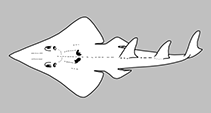 No image available for this species;
drawing shows typical species in Rhinidae.
Google afbeelding
drawing shows typical species in Rhinidae.
Classificatie / Namen Lokale namen | Synoniemen | Catalog of Fishes(Genus, Soort(en)) | ITIS | CoL | WoRMS | Cloffa
Elasmobranchii (haaien en roggen) (sharks and rays) > Rhinopristiformes (Shovelnose rays) > Rhinidae (Wedgefishes)
Etymology: Rhynchobatus: Greek, rhingchos = snout + Greek, batis, -idos = a sting ray (Raja sp.) (Ref. 45335); immaculatus: Name from Latin 'im' meaning not and 'macula' for spot, mark; based on the lack of a dark pectoral marking (rather than any white spots) which is otherwise present in small individuals of other nominal species of Rhynchobatus.
Etymology: Rhynchobatus: Greek, rhingchos = snout + Greek, batis, -idos = a sting ray (Raja sp.) (Ref. 45335); immaculatus: Name from Latin 'im' meaning not and 'macula' for spot, mark; based on the lack of a dark pectoral marking (rather than any white spots) which is otherwise present in small individuals of other nominal species of Rhynchobatus.
Milieu: milieu / Klimaatzone / Diepte / verspreidingsgebied Ecologie
marien pelagic-neritic. Subtropical; 23°N - 25°N, 120°E - 122°E (Ref. 114953)
Verspreiding Gebieden | FAO regio's | Ecosystemen | Voorkomen | Verspreidingskaart | Introducties | Faunafri
Northwest Pacific: confirmed from Taiwan; probably more widespread.
Grootte / Gewicht / Leeftijd
Korte beschrijving Determinatiesleutels | Morfologie | Morfometrie
This medium-sized species is distinguished by the following set of characters: snout is broad, and wedge-shaped; preoral snout 19-21% TL; small eye, its length 4.1-4.5 in preorbital snout; interorbital space 2.6-2.9 in preorbital snout; about 48 tooth rows; no spines from snout; supraorbital spines are small, well differentiated, and extending from preorbit to beyond end of spiracle; predorsal spines are relatively well developed; 2 disjunct rows of 6-9 small scapular spines on each side of the disc; predorsal space 48-49% of total length; origin of the first dorsal fin is well behind origin of pelvic-fin bases; total pectoral-fin radials 65-68; vertebrae with 28-30 monospondylous precaudal centra, 124-131 precaudal free centra, 38-42 diplospondylous caudal (free) centra, 165-170 total free centra, 179-184 total centra (including synarcual centra). Colouration: dark greenish brown dorsally with a few white spots scattered on pectoral disc; no black pectoral marking; prominent row of white spots start just forward of a single white spot (above pelvic-fin origin) and coalescing posteriorly to form a white mid-lateral line on tail; orbital membrane is white with dark bar over eye; no alternating light and dark markings on the interorbital space (Ref. 94805).
Body shape (shape guide): other (see remarks); Cross section: flattened.
Body shape (shape guide): other (see remarks); Cross section: flattened.
A benthic species that was recently discovered and not well known, but apparently lives in shallow water on the continental shelf. Probably feeds on bottom-dwelling crustaceans and fishes (Ref. 114953). Specimens caught are all immature that most probably the maximum length of this medium-size wedgefish could be less than 150 cm TL (Ref. 94805).
Levenscyclus en paargedrag Maturiteit | Voortplanting | Paaien | Eieren | Fecunditeit | Larven
Hoofdreferentie
Upload uw referenties | Referenties | Coördinator | Medewerkers
Last, P.R., H.-H. Ho and R.-R. Chen, 2013. A new species of wedgefish, Rhynchobatus immaculatus (Chondrichthyes: Rhynchobatidae), from Taiwan. Zootaxa 3752(1):185-198. (Ref. 94805)
Status op de Rode Lijst van het IUCN (Ref. 130435: Version 2025-2 (Global))
Ernstig bedreigd (CR) (A2bd); Date assessed: 03 December 2018
Gevaar voor de mens
Harmless
Gebruik door de mens
FAO - Publication: search | FishSource |
Meer informatie
Trofische ecologie
Voedsel (prooien)
Dieetsamenstelling
Voedselconsumptie
Voedselrantsoenen
Predatoren
Voedsel (prooien)
Dieetsamenstelling
Voedselconsumptie
Voedselrantsoenen
Predatoren
Ecologie
Ecologie
Ecologie
Populatiedynamica
Groeiparameters
Max. leeftijden / maten
Lengte-gewicht rel.
Lengte-lengte rel.
Lengtefrequenties
Massaconversie
Rekrutering
Abundantie
Groeiparameters
Max. leeftijden / maten
Lengte-gewicht rel.
Lengte-lengte rel.
Lengtefrequenties
Massaconversie
Rekrutering
Abundantie
Levenscyclus
Voortplanting
Maturiteit
Rijpheid/kieuwen rel.
Fecunditeit
Paaien
Paaibestanden
Eieren
Ontwikkeling van de eieren
Larven
Larvale populatiedynamiek
Voortplanting
Maturiteit
Rijpheid/kieuwen rel.
Fecunditeit
Paaien
Paaibestanden
Eieren
Ontwikkeling van de eieren
Larven
Larvale populatiedynamiek
Anatomie
Kieuwoppervlak
Hersenen
Otoliet
Kieuwoppervlak
Hersenen
Otoliet
Fysiologie
Lichaamssamenstelling
Voedingsstoffen
Zuurstofverbruik
Type zwemmen
Zwemsnelheid
Visuele pigmenten
Vis geluid
Ziekten en parasieten
Toxiciteit (LC50)
Lichaamssamenstelling
Voedingsstoffen
Zuurstofverbruik
Type zwemmen
Zwemsnelheid
Visuele pigmenten
Vis geluid
Ziekten en parasieten
Toxiciteit (LC50)
Genetica
genoom
Genetica
Heterozygositeit
Erfelijkheid
Genetische diversiteit
genoom
Genetica
Heterozygositeit
Erfelijkheid
Genetische diversiteit
Menselijk gerelateerd
Aquacultuursystemen
Aquacultuurprofielen
Kweeklijnen
Ciguatera gevallen
Postzegels, munten, diversen.
Aquacultuursystemen
Aquacultuurprofielen
Kweeklijnen
Ciguatera gevallen
Postzegels, munten, diversen.
Tools
Speciale rapporten
Bekijk gegevens voor het houden in een aquarium | Bekijk Fact Sheets voor de soort | Bekijk Aquacultuur Fact Sheets
Download XML
Internetbronnen
AFORO (otoliths) | Aquatic Commons | BHL | Cloffa | Websites from users | Bekijk FishWatcher | CISTI | Catalog of Fishes: Genus, Soort(en) | DiscoverLife | ECOTOX | FAO - Publication: search | Faunafri | Fishipedia | Fishtrace | GloBI | Google Books | Google Scholar | Google | IGFA World Record | Nationale databanken | OneZoom | Open Tree of Life | Otolith Atlas of Taiwan Fishes | PubMed | Reef Life Survey | Socotra Atlas | TreeBase | Tree of Life | Wikipedia: ga naar, zoek | World Records Freshwater Fishing | Zoobank | Zoological Record
Schattingen op basis van modellen
Fylogenetische diversiteitsindex (Ref. 82804): PD50 = 0.5024 [Uniqueness, from 0.5 = low to 2.0 = high].
Bayesian length-weight: a=0.01000 (0.00244 - 0.04107), b=3.04 (2.81 - 3.27), in cm total length, based on all LWR estimates for this body shape (Ref. 93245).
Trofisch niveau (Ref. 69278): 3.5 ±0.6 se; based on size and trophs of closest relatives