



Rhynchobatus immaculatus Last, ho & Chen, 2013
Taiwanese Wedgefish
muatnaik fotos/gambar dan video
imej Google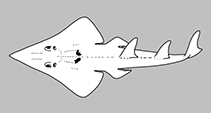 No image available for this species;
drawing shows typical species in Rhinidae.
imej Google
drawing shows typical species in Rhinidae.
klasifikasi / Nama Nama-nama umum | Sinonim (persamaan) | Catalog of Fishes(Marga, Jenis) | ITIS | CoL | WoRMS | Cloffa
Ikan bertulang rawan (sharks and rays) > Rhinopristiformes (Shovelnose rays) > Rhinidae (Wedgefishes)
Etymology: Rhynchobatus: Greek, rhingchos = snout + Greek, batis, -idos = a sting ray (Raja sp.) (Ref. 45335); immaculatus: Name from Latin 'im' meaning not and 'macula' for spot, mark; based on the lack of a dark pectoral marking (rather than any white spots) which is otherwise present in small individuals of other nominal species of Rhynchobatus.
Etymology: Rhynchobatus: Greek, rhingchos = snout + Greek, batis, -idos = a sting ray (Raja sp.) (Ref. 45335); immaculatus: Name from Latin 'im' meaning not and 'macula' for spot, mark; based on the lack of a dark pectoral marking (rather than any white spots) which is otherwise present in small individuals of other nominal species of Rhynchobatus.
Lingkungan: lingkungan / zona iklim / kisaran kedalaman / jangkauan distribusi Ekologi
laut pelagic-neritic. Subtropical; 23°N - 25°N, 120°E - 122°E (Ref. 114953)
Penyebaran Wilayah | Daerah-daerah FAO | Ekosistem | Kemunculan | peta titik | Introduksi | Faunafri
Northwest Pacific: confirmed from Taiwan; probably more widespread.
Ukuran / Berat / umur
deskripsi pendek Kunci identifiaksi (pengenalan) | Morfologi | Morfometrik
This medium-sized species is distinguished by the following set of characters: snout is broad, and wedge-shaped; preoral snout 19-21% TL; small eye, its length 4.1-4.5 in preorbital snout; interorbital space 2.6-2.9 in preorbital snout; about 48 tooth rows; no spines from snout; supraorbital spines are small, well differentiated, and extending from preorbit to beyond end of spiracle; predorsal spines are relatively well developed; 2 disjunct rows of 6-9 small scapular spines on each side of the disc; predorsal space 48-49% of total length; origin of the first dorsal fin is well behind origin of pelvic-fin bases; total pectoral-fin radials 65-68; vertebrae with 28-30 monospondylous precaudal centra, 124-131 precaudal free centra, 38-42 diplospondylous caudal (free) centra, 165-170 total free centra, 179-184 total centra (including synarcual centra). Colouration: dark greenish brown dorsally with a few white spots scattered on pectoral disc; no black pectoral marking; prominent row of white spots start just forward of a single white spot (above pelvic-fin origin) and coalescing posteriorly to form a white mid-lateral line on tail; orbital membrane is white with dark bar over eye; no alternating light and dark markings on the interorbital space (Ref. 94805).
Body shape (shape guide): other (see remarks); Cross section: flattened.
Body shape (shape guide): other (see remarks); Cross section: flattened.
A benthic species that was recently discovered and not well known, but apparently lives in shallow water on the continental shelf. Probably feeds on bottom-dwelling crustaceans and fishes (Ref. 114953). Specimens caught are all immature that most probably the maximum length of this medium-size wedgefish could be less than 150 cm TL (Ref. 94805).
Siklus hidup dan perilaku kawin Kematangan | Reproduksi, perkembang biakan | Pemijahan | telur-telur | Fekunditas | Larva
rujukan utama
Unggah referensi Anda | Acuan | Koordinator | mitra
Last, P.R., H.-H. Ho and R.-R. Chen, 2013. A new species of wedgefish, Rhynchobatus immaculatus (Chondrichthyes: Rhynchobatidae), from Taiwan. Zootaxa 3752(1):185-198. (Ref. 94805)
Status IUCN Red List (Ref. 130435: Version 2025-2 (Global))
sangat terancam (CR) (A2bd); Date assessed: 03 December 2018
ancaman kepada manusia
Harmless
penggunaan manusia
FAO - Publication: search | FishSource |
informasi lanjut
Ekologi trofik
Item makanan (mangsa)
Komposisi makanan
Konsumsi makanan
Ransum makanan
Pemangsa
Item makanan (mangsa)
Komposisi makanan
Konsumsi makanan
Ransum makanan
Pemangsa
Ekologi
Ekologi
Ekologi
Dinamika populasi
Parameter pertumbuhan
Maks. usia / ukuran
Panjang-berat rel.
Panjang-panjang rel.
ukuran frekuensi
Konversi massa
pemulihan
Kelimpahan
Parameter pertumbuhan
Maks. usia / ukuran
Panjang-berat rel.
Panjang-panjang rel.
ukuran frekuensi
Konversi massa
pemulihan
Kelimpahan
Siklus hidup
Reproduksi, perkembang biakan
Kematangan
Kedewasaan / insang rel.
Fekunditas
Pemijahan
Agregasi pemijahan
telur-telur
pekembangan telor
Larva
Dinamika larva
Reproduksi, perkembang biakan
Kematangan
Kedewasaan / insang rel.
Fekunditas
Pemijahan
Agregasi pemijahan
telur-telur
pekembangan telor
Larva
Dinamika larva
Anatomi
Area insang
Otak
Otolith
Area insang
Otak
Otolith
Fisiologi
Komposisi tubuh
Nutrisi
Konsumsi oksigen
Jenis renang
Kecepatan berenang
Pigmen visual
Suara ikan
Penyakit & Parasit
Toksisitas (LC50)
Komposisi tubuh
Nutrisi
Konsumsi oksigen
Jenis renang
Kecepatan berenang
Pigmen visual
Suara ikan
Penyakit & Parasit
Toksisitas (LC50)
Genetika
genom
Genetika
Heterozigositas
Diturunkan
Keanekaragaman Genetik
genom
Genetika
Heterozigositas
Diturunkan
Keanekaragaman Genetik
Yang berhubungan dengan manusia
Sistem akuakultur
profil budidaya air
Strain
Kasus Ciguatera
Perangko, koin, dll.
Sistem akuakultur
profil budidaya air
Strain
Kasus Ciguatera
Perangko, koin, dll.
Alat, peralatan
E-book | Penuntun lapangan | tanda freqkuenci panjang | peringkat sejarah hidup | peta titik |
Tangkap-MSY |
laporan khas
muat turun XML
Sumber internet
AFORO (otoliths) | Aquatic Commons | BHL | Cloffa | Websites from users | semak peneliti ikan | CISTI | Catalog of Fishes: Marga, Jenis | DiscoverLife | ECOTOX | FAO - Publication: search | Faunafri | Fishipedia | Fishtrace | GloBI | Google Books | Google Scholar | Google | IGFA World Record | Pangkalan data nasional | OneZoom | Open Tree of Life | Otolith Atlas of Taiwan Fishes | PubMed | Reef Life Survey | Socotra Atlas | TreeBase | Tree of Life | Wikipedia: pergi, Cari | World Records Freshwater Fishing | Zoobank | Catatan Zoologi
Estimasi berdasarkan model
Indeks keanekaragaman filogenetik (Acuan 82804): PD50 = 0.5024 [Uniqueness, from 0.5 = low to 2.0 = high].
Bayesian length-weight: a=0.01000 (0.00244 - 0.04107), b=3.04 (2.81 - 3.27), in cm total length, based on all LWR estimates for this body shape (Ref. 93245).
Tingkat Trofik (Acuan 69278): 3.5 ±0.6 se; based on size and trophs of closest relatives