



Uploaden van uw Foto's en video's
Google afbeelding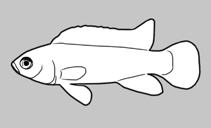 No image available for this species;
drawing shows typical species in Badidae.
Google afbeelding
drawing shows typical species in Badidae.
Classificatie / Namen Lokale namen | Synoniemen | Catalog of Fishes(Genus, Soort(en)) | ITIS | CoL | WoRMS | Cloffa
> Anabantiformes (Gouramies, snakeheads) > Badidae (Chameleonfishes)
Etymology: Badis: 'badis' is presumably a Bengali local name, possibly derived from 'bhedo' or 'bheda', but it lacks a proper reference. Probably incorrect etymology (J. Müller, pers. comm., April 2021, after information from native speakers); britzi: Named for Ralf Britz, Natural History Museum, London, for his contributions to the understanding of the systematics and evolution of badid fishes.
Eponymy: Dr Ralf Britz is a German zoologist and ichthyologist whose research foci are the anatomy, ontogeny and systematics of fish. [...] (Ref. 128868), visit book page.
Etymology: Badis: 'badis' is presumably a Bengali local name, possibly derived from 'bhedo' or 'bheda', but it lacks a proper reference. Probably incorrect etymology (J. Müller, pers. comm., April 2021, after information from native speakers); britzi: Named for Ralf Britz, Natural History Museum, London, for his contributions to the understanding of the systematics and evolution of badid fishes.
Eponymy: Dr Ralf Britz is a German zoologist and ichthyologist whose research foci are the anatomy, ontogeny and systematics of fish. [...] (Ref. 128868), visit book page.
Milieu: milieu / Klimaatzone / Diepte / verspreidingsgebied Ecologie
; zoet water benthopelagisch. Tropical
Verspreiding Gebieden | FAO regio's | Ecosystemen | Voorkomen | Verspreidingskaart | Introducties | Faunafri
Asia: Nagodi tributary of the west-flowing Sharavati River in Karnataka, India.
Grootte / Gewicht / Leeftijd
Korte beschrijving Determinatiesleutels | Morfologie | Morfometrie
Dorsale stekels (totaal) : 17; Dorsale zachte stralen (totaal) : 9; Anale stekels: 3; Anale zachte stralen: 7; Wervels: 28. Badis britzi can be diagnosed from all congeners by its color pattern. It differs from all members of the B. ruber group (that includes B. ruber, B. khwae and B. siamensis) by absence of cleithral and caudal-peduncular blotches, from all members of the B. assamensis group (that includes B. assamensis and B. blosyrus) by absence of an opercular blotch and of two parallel rows of dark blotches and alternating dark and light stripes along the body, from all members of the B. corycaeus group (that includes B. corycaeus, B pyema and B. kyar) by the absence of an ocellus on the caudal-fin base, from all members of the extended B. badis group (that includes B. badis, B. chittagongis, B. ferrarisi, B. dibruensis, B. tuivaiei and B. kanabos) by the absence of a cleithral blotch, and from B. singenensis by the absence of a conspicuous black blotch posterodorsally on the opercle, three distinct dark blotches on dorsal fin base and another distinct black blotch on the base of anal fin. It can be further distinguished by having a slender body (body depth less than 30% SL), which distinguishes it from all other congeners except B. pyema and B. kyar. Its color pattern is composed of 11 dark, clearly-defined bars, most closely resembles that of B. kyar and B. juergenschmidti, from which it is distinguished by a greater head length (32.3-35.0% SL vs. 26.8-31.4% in B. kyar and 28.8-29.6% in B. juergenschmidti), a longer snout (6.8-8.3% SL vs. 5.0-6.4% in B. kyar) and shorter dorsal-fin base (54.6-56.6% SL vs. 62.3-63.7% in B. juergenschmidti) (Ref. 101085).
Body shape (shape guide): elongated.
Body shape (shape guide): elongated.
Inhabits slow-moving clear stream with riparian cover and substrate composed mainly of gravel and pebbles. Found associated with marginal vegetation and submerged roots. Occurs syntopically with other fishes including Barilius sp., Devario malabaricus, Danio rerio, Schistura nagodiensis, Haludaria fasciata, Dawkinsia arulius, Pethia sp., Channa gachua and Mastacembelus armatus (Ref. 101085).
Levenscyclus en paargedrag Maturiteit | Voortplanting | Paaien | Eieren | Fecunditeit | Larven
Hoofdreferentie
Upload uw referenties | Referenties | Coördinator | Medewerkers
Dahanukar, N., P. Kumkar, U. Katwate and R. Raghavan, 2015. Badis britzi, a new percomorph fish (Teleostei: Badidae) from the Western Ghats of India. Zootaxa 3941(3):429-436. (Ref. 101085)
Status op de Rode Lijst van het IUCN (Ref. 130435: Version 2025-2 (Global))
Onvoldoende gegevens (DD) ; Date assessed: 22 June 2020
CITES
Not Evaluated
Gevaar voor de mens
Harmless
Gebruik door de mens
FAO - Publication: search | FishSource |
Meer informatie
Trofische ecologie
Voedsel (prooien)
Dieetsamenstelling
Voedselconsumptie
Voedselrantsoenen
Predatoren
Voedsel (prooien)
Dieetsamenstelling
Voedselconsumptie
Voedselrantsoenen
Predatoren
Populatiedynamica
Groeiparameters
Max. leeftijden / maten
Lengte-gewicht rel.
Lengte-lengte rel.
Lengtefrequenties
Massaconversie
Rekrutering
Abundantie
Groeiparameters
Max. leeftijden / maten
Lengte-gewicht rel.
Lengte-lengte rel.
Lengtefrequenties
Massaconversie
Rekrutering
Abundantie
Levenscyclus
Voortplanting
Maturiteit
Rijpheid/kieuwen rel.
Fecunditeit
Paaien
Paaibestanden
Eieren
Ontwikkeling van de eieren
Larven
Larvale populatiedynamiek
Voortplanting
Maturiteit
Rijpheid/kieuwen rel.
Fecunditeit
Paaien
Paaibestanden
Eieren
Ontwikkeling van de eieren
Larven
Larvale populatiedynamiek
Anatomie
Kieuwoppervlak
Hersenen
Otoliet
Kieuwoppervlak
Hersenen
Otoliet
Fysiologie
Lichaamssamenstelling
Voedingsstoffen
Zuurstofverbruik
Type zwemmen
Zwemsnelheid
Visuele pigmenten
Vis geluid
Ziekten en parasieten
Toxiciteit (LC50)
Lichaamssamenstelling
Voedingsstoffen
Zuurstofverbruik
Type zwemmen
Zwemsnelheid
Visuele pigmenten
Vis geluid
Ziekten en parasieten
Toxiciteit (LC50)
Genetica
genoom
Genetica
Heterozygositeit
Erfelijkheid
Genetische diversiteit
genoom
Genetica
Heterozygositeit
Erfelijkheid
Genetische diversiteit
Menselijk gerelateerd
Aquacultuursystemen
Aquacultuurprofielen
Kweeklijnen
Ciguatera gevallen
Postzegels, munten, diversen.
Aquacultuursystemen
Aquacultuurprofielen
Kweeklijnen
Ciguatera gevallen
Postzegels, munten, diversen.
Tools
Speciale rapporten
Bekijk gegevens voor het houden in een aquarium | Bekijk Fact Sheets voor de soort | Bekijk Aquacultuur Fact Sheets
Download XML
Internetbronnen
AFORO (otoliths) | Aquatic Commons | BHL | Cloffa | Websites from users | Bekijk FishWatcher | CISTI | Catalog of Fishes: Genus, Soort(en) | DiscoverLife | ECOTOX | FAO - Publication: search | Faunafri | Fishipedia | Fishtrace | GloBI | Google Books | Google Scholar | Google | IGFA World Record | OneZoom | Open Tree of Life | Otolith Atlas of Taiwan Fishes | PubMed | Reef Life Survey | Socotra Atlas | TreeBase | Tree of Life | Wikipedia: ga naar, zoek | World Records Freshwater Fishing | Zoobank | Zoological Record
Schattingen op basis van modellen
Fylogenetische diversiteitsindex (Ref. 82804): PD50 = 0.5000 [Uniqueness, from 0.5 = low to 2.0 = high].
Bayesian length-weight: a=0.01175 (0.00503 - 0.02745), b=2.93 (2.73 - 3.13), in cm total length, based on LWR estimates for this (Sub)family-body shape (Ref. 93245).
Trofisch niveau (Ref. 69278): 3.2 ±0.4 se; based on size and trophs of closest relatives