



muatnaik fotos/gambar dan video
imej Google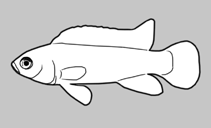 No image available for this species;
drawing shows typical species in Badidae.
imej Google
drawing shows typical species in Badidae.
klasifikasi / Nama Nama-nama umum | Sinonim (persamaan) | Catalog of Fishes(Marga, Jenis) | ITIS | CoL | WoRMS | Cloffa
> Anabantiformes (Gouramies, snakeheads) > Badidae (Chameleonfishes)
Etymology: Badis: 'badis' is presumably a Bengali local name, possibly derived from 'bhedo' or 'bheda', but it lacks a proper reference. Probably incorrect etymology (J. Müller, pers. comm., April 2021, after information from native speakers); britzi: Named for Ralf Britz, Natural History Museum, London, for his contributions to the understanding of the systematics and evolution of badid fishes.
Eponymy: Dr Ralf Britz is a German zoologist and ichthyologist whose research foci are the anatomy, ontogeny and systematics of fish. [...] (Ref. 128868), visit book page.
Etymology: Badis: 'badis' is presumably a Bengali local name, possibly derived from 'bhedo' or 'bheda', but it lacks a proper reference. Probably incorrect etymology (J. Müller, pers. comm., April 2021, after information from native speakers); britzi: Named for Ralf Britz, Natural History Museum, London, for his contributions to the understanding of the systematics and evolution of badid fishes.
Eponymy: Dr Ralf Britz is a German zoologist and ichthyologist whose research foci are the anatomy, ontogeny and systematics of fish. [...] (Ref. 128868), visit book page.
Lingkungan: lingkungan / zona iklim / kisaran kedalaman / jangkauan distribusi Ekologi
; air tawar bentopelagis. Tropical
Penyebaran Wilayah | Daerah-daerah FAO | Ekosistem | Kemunculan | peta titik | Introduksi | Faunafri
Asia: Nagodi tributary of the west-flowing Sharavati River in Karnataka, India.
Ukuran / Berat / umur
deskripsi pendek Kunci identifiaksi (pengenalan) | Morfologi | Morfometrik
Duri punggung (Keseluruhan (total)) : 17; duri punggung lunak (Keseluruhan (total)) : 9; Duri dubur: 3; Sirip dubur lunak: 7; vertebrata, bertulang belakang: 28. Badis britzi can be diagnosed from all congeners by its color pattern. It differs from all members of the B. ruber group (that includes B. ruber, B. khwae and B. siamensis) by absence of cleithral and caudal-peduncular blotches, from all members of the B. assamensis group (that includes B. assamensis and B. blosyrus) by absence of an opercular blotch and of two parallel rows of dark blotches and alternating dark and light stripes along the body, from all members of the B. corycaeus group (that includes B. corycaeus, B pyema and B. kyar) by the absence of an ocellus on the caudal-fin base, from all members of the extended B. badis group (that includes B. badis, B. chittagongis, B. ferrarisi, B. dibruensis, B. tuivaiei and B. kanabos) by the absence of a cleithral blotch, and from B. singenensis by the absence of a conspicuous black blotch posterodorsally on the opercle, three distinct dark blotches on dorsal fin base and another distinct black blotch on the base of anal fin. It can be further distinguished by having a slender body (body depth less than 30% SL), which distinguishes it from all other congeners except B. pyema and B. kyar. Its color pattern is composed of 11 dark, clearly-defined bars, most closely resembles that of B. kyar and B. juergenschmidti, from which it is distinguished by a greater head length (32.3-35.0% SL vs. 26.8-31.4% in B. kyar and 28.8-29.6% in B. juergenschmidti), a longer snout (6.8-8.3% SL vs. 5.0-6.4% in B. kyar) and shorter dorsal-fin base (54.6-56.6% SL vs. 62.3-63.7% in B. juergenschmidti) (Ref. 101085).
Body shape (shape guide): elongated.
Body shape (shape guide): elongated.
Inhabits slow-moving clear stream with riparian cover and substrate composed mainly of gravel and pebbles. Found associated with marginal vegetation and submerged roots. Occurs syntopically with other fishes including Barilius sp., Devario malabaricus, Danio rerio, Schistura nagodiensis, Haludaria fasciata, Dawkinsia arulius, Pethia sp., Channa gachua and Mastacembelus armatus (Ref. 101085).
Siklus hidup dan perilaku kawin Kematangan | Reproduksi, perkembang biakan | Pemijahan | telur-telur | Fekunditas | Larva
rujukan utama
Unggah referensi Anda | Acuan | Koordinator | mitra
Dahanukar, N., P. Kumkar, U. Katwate and R. Raghavan, 2015. Badis britzi, a new percomorph fish (Teleostei: Badidae) from the Western Ghats of India. Zootaxa 3941(3):429-436. (Ref. 101085)
Status IUCN Red List (Ref. 130435: Version 2025-2 (Global))
kekurangan data (DD) ; Date assessed: 22 June 2020
CITES
Not Evaluated
ancaman kepada manusia
Harmless
penggunaan manusia
FAO - Publication: search | FishSource |
informasi lanjut
Ekologi trofik
Item makanan (mangsa)
Komposisi makanan
Konsumsi makanan
Ransum makanan
Pemangsa
Item makanan (mangsa)
Komposisi makanan
Konsumsi makanan
Ransum makanan
Pemangsa
Dinamika populasi
Parameter pertumbuhan
Maks. usia / ukuran
Panjang-berat rel.
Panjang-panjang rel.
ukuran frekuensi
Konversi massa
pemulihan
Kelimpahan
Parameter pertumbuhan
Maks. usia / ukuran
Panjang-berat rel.
Panjang-panjang rel.
ukuran frekuensi
Konversi massa
pemulihan
Kelimpahan
Siklus hidup
Reproduksi, perkembang biakan
Kematangan
Kedewasaan / insang rel.
Fekunditas
Pemijahan
Agregasi pemijahan
telur-telur
pekembangan telor
Larva
Dinamika larva
Reproduksi, perkembang biakan
Kematangan
Kedewasaan / insang rel.
Fekunditas
Pemijahan
Agregasi pemijahan
telur-telur
pekembangan telor
Larva
Dinamika larva
Anatomi
Area insang
Otak
Otolith
Area insang
Otak
Otolith
Fisiologi
Komposisi tubuh
Nutrisi
Konsumsi oksigen
Jenis renang
Kecepatan berenang
Pigmen visual
Suara ikan
Penyakit & Parasit
Toksisitas (LC50)
Komposisi tubuh
Nutrisi
Konsumsi oksigen
Jenis renang
Kecepatan berenang
Pigmen visual
Suara ikan
Penyakit & Parasit
Toksisitas (LC50)
Genetika
genom
Genetika
Heterozigositas
Diturunkan
Keanekaragaman Genetik
genom
Genetika
Heterozigositas
Diturunkan
Keanekaragaman Genetik
Yang berhubungan dengan manusia
Sistem akuakultur
profil budidaya air
Strain
Kasus Ciguatera
Perangko, koin, dll.
Sistem akuakultur
profil budidaya air
Strain
Kasus Ciguatera
Perangko, koin, dll.
Alat, peralatan
E-book | Penuntun lapangan | tanda freqkuenci panjang | peringkat sejarah hidup | peta titik |
Tangkap-MSY |
laporan khas
muat turun XML
Sumber internet
AFORO (otoliths) | Aquatic Commons | BHL | Cloffa | Websites from users | semak peneliti ikan | CISTI | Catalog of Fishes: Marga, Jenis | DiscoverLife | ECOTOX | FAO - Publication: search | Faunafri | Fishipedia | Fishtrace | GloBI | Google Books | Google Scholar | Google | IGFA World Record | OneZoom | Open Tree of Life | Otolith Atlas of Taiwan Fishes | PubMed | Reef Life Survey | Socotra Atlas | TreeBase | Tree of Life | Wikipedia: pergi, Cari | World Records Freshwater Fishing | Zoobank | Catatan Zoologi
Estimasi berdasarkan model
Indeks keanekaragaman filogenetik (Acuan 82804): PD50 = 0.5000 [Uniqueness, from 0.5 = low to 2.0 = high].
Bayesian length-weight: a=0.01175 (0.00503 - 0.02745), b=2.93 (2.73 - 3.13), in cm total length, based on LWR estimates for this (Sub)family-body shape (Ref. 93245).
Tingkat Trofik (Acuan 69278): 3.2 ±0.4 se; based on size and trophs of closest relatives