



Percina brucethompsoni Robison, Cashner, Raley & Near, 2014
Adicionar o seu Fotografias e vídeos
Imagem do Google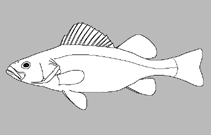 No image available for this species;
drawing shows typical species in Percidae.
Imagem do Google
drawing shows typical species in Percidae.
Classificação / Nomes Nomes comuns | Sinónimos | Catalog of Fishes(Género, Espécies) | ITIS | CoL | WoRMS | Cloffa
> Perciformes/Percoidei (Perchs) > Percidae (Perches) > Etheostomatinae
Etymology: Percina: Latin, diminutive of perch = perch (Ref. 45335).
Eponymy: Dr Bruce Alan Thompson (1946–2007) was, for nearly three decades, an Associate Professor at the Louisiana State University and researcher at the Coastal Fisheries Institute. [...] (Ref. 128868), visit book page.
Etymology: Percina: Latin, diminutive of perch = perch (Ref. 45335).
Eponymy: Dr Bruce Alan Thompson (1946–2007) was, for nearly three decades, an Associate Professor at the Louisiana State University and researcher at the Coastal Fisheries Institute. [...] (Ref. 128868), visit book page.
Ambiente: milieu / zona climática / intervalo de profundidade / gama de distribuição Ecologia
; Água doce bentopelágico. Temperate
Distribuição Territórios | Áreas FAO | Ecossistemas | Ocorrências | Mapa dos pontos | Introduções | Faunafri
North America: endemic to the Ouachita River system in the Ouachita Highlands Arkansas, USA.
Tamanho / Peso / Idade
Maturidade: Lm ? range ? - ? cm
Max length : 9.0 cm SL macho/indeterminado; (Ref. 102809); 8.2 cm SL (female)
Max length : 9.0 cm SL macho/indeterminado; (Ref. 102809); 8.2 cm SL (female)
Descrição breve Chaves de identificação | Morfologia | Morfometria
Espinhos dorsais (total) : 11 - 14; Raios dorsais moles (total) : 12 - 15; Espinhos anais: 2; Raios anais moles: 8 - 11; Vértebras: 39 - 41. A species of the subgenus Swainia but distinguished from all other species of Swainia by having the following combination of characters: snout depth is less than snout length; the ratio of snout length to SL is greater than 7.5%; more than 72 pored lateral line scales (mode 76-80); breast is unscaled or partially scaled in males and females; lateral pigmentation on body with 12 to 15 vertically elongated distinct blotches, with seven or more of these blotches between the insertion of the second dorsal fin and the hypural plate; and usually 12 branchiostegal rays (6 on each side).
Body shape (shape guide): elongated.
Body shape (shape guide): elongated.
Observed to seasonally occupy two different types of habitats. In spring season, breeding individuals typically occurs in gravelbottomed and cobble substrate riffle areas and swift chutes and runs of up to approximately 1 m deep. Inhabits deeper pool habitats for the remainder of the year. Also reported to inhabit deep, swift riffle areas with rocky substrates
and thick growths of Podostemon heterophyllum in spring. During fall, a single specimen was collected from a sluggish siltbottom pool at the confluence of the Ouachita River and Lake Ouachita. Also observed to have preference for a late-summer microhabitat of upstream edges of runs that invariably included slight surface agitation and a high
percentage of cobble substrate.
Ciclo de vida e comportamento de acasalamento Maturidade | Reprodução | Desova | Ovos | Fecundidade | Larvas
Referência principal
Carregar as suas referências | Referências | Coordenador | Colaboradores
Robison, H.W., R.C. Cashner, M.E. Raley and T.J. Near, 2014. A new species of darter from the Ouachita Highlands in Arkansas related to Percina nasuta (Percidae: Etheostomatinae). Bull. Peabody Mus. Nat. Hist. 55(2):237-252. (Ref. 102809)
CITES
Not Evaluated
Ameaça para o homem
Harmless
Utilização humana
Pescarias: sem interesse
FAO - Publication: search | FishSource |
Mais informação
Ecologia Trófica
Produtos alimentares (presas)
Composição da dieta
Consumo alimentar
Rações alimentares
Predadores
Produtos alimentares (presas)
Composição da dieta
Consumo alimentar
Rações alimentares
Predadores
Dinâmica das populações
Parâmetros de crescimento
Idades / tamanhos máximos
Comprimento-peso rel.
Comprimento-comprimento rel.
Frequência de comprimento
Conversão de massa
Recrutamento
Abundância
Parâmetros de crescimento
Idades / tamanhos máximos
Comprimento-peso rel.
Comprimento-comprimento rel.
Frequência de comprimento
Conversão de massa
Recrutamento
Abundância
Ciclo de vida
Reprodução
Maturidade
Maturidade/Rel. das guelras
Fecundidade
Desova
Agregações de desova
Ovos
Desenvolvimento dos ovos
Larvas
Dinâmica larvar
Reprodução
Maturidade
Maturidade/Rel. das guelras
Fecundidade
Desova
Agregações de desova
Ovos
Desenvolvimento dos ovos
Larvas
Dinâmica larvar
Anatomia
Área branquial
Cérebro
Otólitos
Área branquial
Cérebro
Otólitos
Fisiologia
Composição corporal
Nutrientes
Consumo de oxigénio
Tipo de natação
Velocidade de natação
Pigmentos visuais
Som de peixe
Doenças e Parasitas
Toxicidade (LC50s)
Composição corporal
Nutrientes
Consumo de oxigénio
Tipo de natação
Velocidade de natação
Pigmentos visuais
Som de peixe
Doenças e Parasitas
Toxicidade (LC50s)
Genética
genoma
Genética
Heterozigotia
Hereditariedade
Diversidade genética
genoma
Genética
Heterozigotia
Hereditariedade
Diversidade genética
Relacionado com o ser humano
Sistemas de aquacultura
Perfis para aquacultura
Estirpes
Casos de Ciguatera
Selos, moedas, diversos.
Sistemas de aquacultura
Perfis para aquacultura
Estirpes
Casos de Ciguatera
Selos, moedas, diversos.
Ferramentas
E-book | Guia de campo | Ferramenta auxiliar de frequências de comprimento | Ferramenta sobre a história de vida | Mapa dos pontos |
Captura-MSY |
Relatórios especiais
Descarregue XML
Fontes da internet
AFORO (otoliths) | Aquatic Commons | BHL | Cloffa | Websites from users | Consultar FishWatcher | CISTI | Catalog of Fishes: Género, Espécies | DiscoverLife | ECOTOX | FAO - Publication: search | Faunafri | Fishipedia | Fishtrace | GloBI | Google Books | Google Scholar | Google | IGFA World Record | OneZoom | Open Tree of Life | Otolith Atlas of Taiwan Fishes | PubMed | Reef Life Survey | Socotra Atlas | TreeBase | Árvore da vida | Wikipedia: ir para, procurar | World Records Freshwater Fishing | Zoobank | Registo zoológico
Estimativas baseadas em modelos
Índice de diversidade filogenética (Ref. 82804): PD50 = 0.5000 [Uniqueness, from 0.5 = low to 2.0 = high].
Bayesian length-weight: a=0.00575 (0.00268 - 0.01234), b=3.13 (2.95 - 3.31), in cm total length, based on LWR estimates for this (Sub)family-body shape (Ref. 93245).
Nível Trófico (Ref. 69278): 3.4 ±0.4 se; based on size and trophs of closest relatives
Resiliência (Ref. 120179): Elevada, tempo mínimo de duplicação da população menor que 15 meses (Preliminary K or Fecundity.).