



Percina brucethompsoni Robison, Cashner, Raley & Near, 2014
Hochladen Photos und videos
Google Bild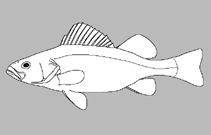 No image available for this species;
drawing shows typical species in Percidae.
Google Bild
drawing shows typical species in Percidae.
Klassifizierung / Names Namen | Synonyme | Catalog of Fishes(Gattung, Arten) | ITIS | CoL | WoRMS | Cloffa
> Perciformes/Percoidei (Perchs) > Percidae (Perches) > Etheostomatinae
Etymology: Percina: Latin, diminutive of perch = perch (Ref. 45335).
Eponymy: Dr Bruce Alan Thompson (1946–2007) was, for nearly three decades, an Associate Professor at the Louisiana State University and researcher at the Coastal Fisheries Institute. [...] (Ref. 128868), visit book page.
Etymology: Percina: Latin, diminutive of perch = perch (Ref. 45335).
Eponymy: Dr Bruce Alan Thompson (1946–2007) was, for nearly three decades, an Associate Professor at the Louisiana State University and researcher at the Coastal Fisheries Institute. [...] (Ref. 128868), visit book page.
Umwelt: Milieu / Klimazone / Tiefenbereich / Verbreitungsgebiet Ökologie
; süßwasser benthopelagisch. Temperate
Verbreitung Territorien | FAO Gebiete | Ökosysteme | Vorkommen | Punkt Karte | Einführungen | Faunafri
North America: endemic to the Ouachita River system in the Ouachita Highlands Arkansas, USA.
Größe / Gewicht / Alter
Geschlechtsreife: Lm ? range ? - ? cm
Max length : 9.0 cm SL Männchen/unbestimmt; (Ref. 102809); 8.2 cm SL (female)
Max length : 9.0 cm SL Männchen/unbestimmt; (Ref. 102809); 8.2 cm SL (female)
Kurzbeschreibung Bestimmungsschlüssel | Morphologie | Morphometrie
Rückenflossenstacheln (insgesamt) : 11 - 14; Rückenflossenweichstrahlen (insgesamt) : 12 - 15; Afterflossenstacheln: 2; Afterflossenweichstrahlen: 8 - 11; Wirbelzahl: 39 - 41. A species of the subgenus Swainia but distinguished from all other species of Swainia by having the following combination of characters: snout depth is less than snout length; the ratio of snout length to SL is greater than 7.5%; more than 72 pored lateral line scales (mode 76-80); breast is unscaled or partially scaled in males and females; lateral pigmentation on body with 12 to 15 vertically elongated distinct blotches, with seven or more of these blotches between the insertion of the second dorsal fin and the hypural plate; and usually 12 branchiostegal rays (6 on each side).
Body shape (shape guide): elongated.
Body shape (shape guide): elongated.
Observed to seasonally occupy two different types of habitats. In spring season, breeding individuals typically occurs in gravelbottomed and cobble substrate riffle areas and swift chutes and runs of up to approximately 1 m deep. Inhabits deeper pool habitats for the remainder of the year. Also reported to inhabit deep, swift riffle areas with rocky substrates
and thick growths of Podostemon heterophyllum in spring. During fall, a single specimen was collected from a sluggish siltbottom pool at the confluence of the Ouachita River and Lake Ouachita. Also observed to have preference for a late-summer microhabitat of upstream edges of runs that invariably included slight surface agitation and a high
percentage of cobble substrate.
Lebenszyklus und Paarungsverhalten Geschlechtsreife | Fortpflanzung | Ablaichen | Eier | Fruchtbarkeit | Larven
Hauptreferenz
Laden Sie Ihre Referenzen hoch | Referenzen | Koordinator | Partner
Robison, H.W., R.C. Cashner, M.E. Raley and T.J. Near, 2014. A new species of darter from the Ouachita Highlands in Arkansas related to Percina nasuta (Percidae: Etheostomatinae). Bull. Peabody Mus. Nat. Hist. 55(2):237-252. (Ref. 102809)
CITES
Not Evaluated
Bedrohung für Menschen
Harmless
Nutzung durch Menschen
Fischereien: nicht kommerziell
FAO - Publication: search | FishSource |
Mehr Information
Trophische Ökologie
Lebensmittel (Beutetiere)
Nahrungszusammensetzung
Nahrungsaufnahme
Lebensmittelrationen
Räuber
Lebensmittel (Beutetiere)
Nahrungszusammensetzung
Nahrungsaufnahme
Lebensmittelrationen
Räuber
Populationsdynamik
Wachstumsparameter
Max. Alter/Größen
Länge-Gewicht-Rel.
Länge-Länge-Verhältnis.
Längenhäufigkeiten
Massenkonvertierung
Rekrutierung
Dichte
Wachstumsparameter
Max. Alter/Größen
Länge-Gewicht-Rel.
Länge-Länge-Verhältnis.
Längenhäufigkeiten
Massenkonvertierung
Rekrutierung
Dichte
Lebenszyklus
Fortpflanzung
Geschlechtsreife
Reifung/Kiemen rel.
Fruchtbarkeit
Ablaichen
Laichaggregationen
Eier
Eientwicklung
Larven
Larven Pop.Dyn.
Fortpflanzung
Geschlechtsreife
Reifung/Kiemen rel.
Fruchtbarkeit
Ablaichen
Laichaggregationen
Eier
Eientwicklung
Larven
Larven Pop.Dyn.
Anatomie
Kiemenoberfläche
Gehirn
Otolith
Kiemenoberfläche
Gehirn
Otolith
Physiologie
Körperliche Zusammensetzung
Nährstoffe
Sauerstoffverbrauch
Schwimmart
Schwimmgeschwindigkeit
Visuelle Pigmente
Fischgeräusche
Krankheiten und Parasiten
Toxizität (LC50s)
Körperliche Zusammensetzung
Nährstoffe
Sauerstoffverbrauch
Schwimmart
Schwimmgeschwindigkeit
Visuelle Pigmente
Fischgeräusche
Krankheiten und Parasiten
Toxizität (LC50s)
Genetik
Genom
Genetik
Heterozygotie
Vererbbarkeit
Genetische Vielfalt
Genom
Genetik
Heterozygotie
Vererbbarkeit
Genetische Vielfalt
Menschenbezogen
Aquakultur-Systeme
Aquakultur Profile
Zuchtlinien
Ciguatera-Fälle
Briefmarken, Münzen, Verschiedenes.
Aquakultur-Systeme
Aquakultur Profile
Zuchtlinien
Ciguatera-Fälle
Briefmarken, Münzen, Verschiedenes.
Tools
Zusatzinformationen
Download XML
Zusammenfassung | Punktdaten | Namen | Photos
Internet Quellen
AFORO (otoliths) | Aquatic Commons | BHL | Cloffa | Websites from users | FishWatcher Einträge suchen | CISTI | Catalog of Fishes: Gattung, Arten | DiscoverLife | ECOTOX | FAO - Publication: search | Faunafri | Fishipedia | Fishtrace | GloBI | Google Books | Google Scholar | Google | IGFA World Record | OneZoom | Open Tree of Life | Otolith Atlas of Taiwan Fishes | PubMed | Reef Life Survey | Socotra Atlas | TreeBase | Tree of Life | Wikipedia: Gehe zu, Suchen | World Records Freshwater Fishing | Zoobank | Zoologischer Rekord
Schätzungen auf der Grundlage von Modellen
Phylogenetischer Diversitätsindex (Ref. 82804): PD50 = 0.5000 [Uniqueness, from 0.5 = low to 2.0 = high].
Bayesian length-weight: a=0.00575 (0.00268 - 0.01234), b=3.13 (2.95 - 3.31), in cm total length, based on LWR estimates for this (Sub)family-body shape (Ref. 93245).
Trophische Ebene (Ref. 69278): 3.4 ±0.4 se; based on size and trophs of closest relatives
Widerstandsfähigkeit (Ref. 120179): hoch, Verdopplung der Population dauert weniger als 15 Monate. (Preliminary K or Fecundity.).