



Petrocephalus arnegardi Lavoué & Sullivan, 2014
Ladda upp din foton och Videor
Google image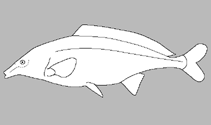 No image available for this species;
drawing shows typical species in Mormyridae.
Google image
drawing shows typical species in Mormyridae.
Klassificering / Namn Populärnamn | synonymer | Catalog of Fishes(Släkte, Arter) | ITIS | CoL | WoRMS | Cloffa
> Osteoglossiformes (Bony tongues) > Mormyridae (Elephantfishes)
Etymology: Petrocephalus: Latin, petra = stone + Greek, kephale = head (Ref. 45335); arnegardi: This species is dedicated to Matthew E. Arnegard, in recognition of his contributions to study of mormyrid evolution and diversification; Matthew Arnegard is additionally a member of the “Mintotom Team”: researchers associated with the Carl D. Hopkins Laboratory at Cornell University who have conducted field studies on African weakly electric fishes for more than 15 years ("Mintotom" is the plural form of the word for mormyrid fish in the Fang language of West Central Africa) (Ref. 96601).
Eponymy: Dr Matthew Arnegard (d: 1967) is an evolutionary biologist who was a member of the ‘Mintotom Team’ of researchers in the laboratory of Professor Carl Hopkins, Cornell University (N. [...] (Ref. 128868), visit book page.
Etymology: Petrocephalus: Latin, petra = stone + Greek, kephale = head (Ref. 45335); arnegardi: This species is dedicated to Matthew E. Arnegard, in recognition of his contributions to study of mormyrid evolution and diversification; Matthew Arnegard is additionally a member of the “Mintotom Team”: researchers associated with the Carl D. Hopkins Laboratory at Cornell University who have conducted field studies on African weakly electric fishes for more than 15 years ("Mintotom" is the plural form of the word for mormyrid fish in the Fang language of West Central Africa) (Ref. 96601).
Eponymy: Dr Matthew Arnegard (d: 1967) is an evolutionary biologist who was a member of the ‘Mintotom Team’ of researchers in the laboratory of Professor Carl Hopkins, Cornell University (N. [...] (Ref. 128868), visit book page.
Miljö: miljö / Klimatzon / djupintervall / distributionsområde Ekologi
; sötvatten bottenlevande. Tropical
Utbredning Territorier | FAO områden | Ekosystem | Förekomster | Prickkarta | Utplanteringar | Faunafri
Africa: various tributaries of the Likouala drainage (middle Congo River tributary) in Republic of Congo, and the middle Congo River near Yangambi in Democratic Republic of the Congo (Ref. 96601).
Storlek / Vikt / Ålder
Kort beskrivning Bestämningsnycklar | Morfologi | Morfometri
Diagnosis: Petrocephalus arnegardi is distinguished from all other Petrocephalus species of Central Africa by the following combination of characteristics: pigmentation pattern comprising three well-defined, bilateral black patches, one usually distinct round/ovoid subdorsal black mark situated slightly anterior to dorsal, one black mark at the base of each pectoral fin, and one ovoid black mark centered at the base of caudal fin; dorsal fin at least one third shorter than anal fin; dorsal fin with at least 20 branched rays but no more than 22; anal fin with at least 30 branched rays; 16 teeth or fewer in upper jaw, 25 teeth or fewer in lower jaw; eye relatively large, ration head length and eye-diameter less than 4.7; mouth subterminal; ration of head length to mouth position between 4.2 and 5.6; mouth small, ration head length and mouth width more than 4.1; and EOD of normal polarity, mainly biphasic with sometimes the presence of a small-amplitude positive third phase (Ref. 96601).
Body shape (shape guide): fusiform / normal.
Body shape (shape guide): fusiform / normal.
Livscykel och parningsbeteende Könsmognad | Reproduktion | Lek | Ägg | Fekunditet | Larver
Huvudreferens
Ladda upp dina referenser | referenser | Koordinator | Medarbetare
Lavoué, S. and J.P. Sullivan, 2014. Petrocephalus boboto and Petrocephalus arnegardi, two new species of African electric fish (Osteoglossomorpha, Mormyridae) from the Congo River basin. ZooKeys 400:43-65. (Ref. 96601)
CITES
Not Evaluated
Hot mot människor
Harmless
Mänskliga användningsområden
FAO - Publication: search | FishSource |
Ytterligare information
Trofisk ekologi
Livsmedelsartiklar (preys)
Födosammansättning
Födointag
Matransoner
Predatorer
Livsmedelsartiklar (preys)
Födosammansättning
Födointag
Matransoner
Predatorer
Ekologi
Ekologi
Ekologi
Populationsdynamik
Tillväxtparametrar
Max. åldrar / storlekar
Längd-vikt rel.
Längd-längd rel.
Längd-frekvenser
Massakonvertering
Rekrytering
Abundans
Tillväxtparametrar
Max. åldrar / storlekar
Längd-vikt rel.
Längd-längd rel.
Längd-frekvenser
Massakonvertering
Rekrytering
Abundans
Livscykel
Reproduktion
Könsmognad
Mognad/Gills rel.
Fekunditet
Lek
Lekande aggregat
Ägg
Utveckling av ägg
Larver
Larvdynamik
Reproduktion
Könsmognad
Mognad/Gills rel.
Fekunditet
Lek
Lekande aggregat
Ägg
Utveckling av ägg
Larver
Larvdynamik
Anatomi
Gälyta
Hjärna
Otolit
Gälyta
Hjärna
Otolit
Fysiologi
Kroppssammansättning
Näringsämnen
Syreförbrukning
Typ av simning
Simhastighet
Visuella pigment
Ljud från fisk
Sjukdomar & Parasiter
Toxicitet (LC50)
Kroppssammansättning
Näringsämnen
Syreförbrukning
Typ av simning
Simhastighet
Visuella pigment
Ljud från fisk
Sjukdomar & Parasiter
Toxicitet (LC50)
Genetik
Genom
Genetik
Heterozygositet
Ärftlighet
Genetisk mångfald
Genom
Genetik
Heterozygositet
Ärftlighet
Genetisk mångfald
Människorelaterad
Vattenbrukssystem
Vattenbruksprofiler
Avelslinjer
Ciguatera-fall
Frimärken, mynt, diverse.
Vattenbrukssystem
Vattenbruksprofiler
Avelslinjer
Ciguatera-fall
Frimärken, mynt, diverse.
Verktyg
E-bok | Fälthandbok | Bestämningsnycklar | Längdfördelnings-verktyg | Livshistorie-verktyg | Prickkarta |
Fångst-MSY |
Särskilda rapporter
Kontrollera för underhåll av akvarium | Kontrollera om det finns faktablad om arter | Kontrollera om det finns faktablad om vattenbruk
Ladda ner XML
Internet-källor
AFORO (otoliths) | Aquatic Commons | BHL | Cloffa | Websites from users | Check FishWatcher | CISTI | Catalog of Fishes: Släkte, Arter | DiscoverLife | ECOTOX | FAO - Publication: search | Faunafri | Fishipedia | Fishtrace | GloBI | Google Books | Google Scholar | Google | IGFA World Record | OneZoom | Open Tree of Life | Otolith Atlas of Taiwan Fishes | PubMed | Reef Life Survey | Socotra Atlas | TreeBase | Tree of Life | Wikipedia: Go, sök | World Records Freshwater Fishing | Zoobank | Zoologiskt register
Uppskattningar baserade på modeller
Index för fylogenetisk mångfald (Ref. 82804): PD50 = 0.5000 [Uniqueness, from 0.5 = low to 2.0 = high].
Bayesian length-weight: a=0.01549 (0.00672 - 0.03569), b=2.87 (2.69 - 3.05), in cm total length, based on LWR estimates for this Genus-body shape (Ref. 93245).
Trofisk nivå (Ref. 69278): 3.2 ±0.4 se; based on size and trophs of closest relatives
Resiliens (Ref. 120179): Hög, lägsta populationsfördubblingstid mindre än 15 månader (Preliminary K or Fecundity.).