



Petrocephalus arnegardi Lavoué & Sullivan, 2014
Загрузить свой Фото и Видео
Изображение на Google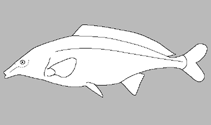 No image available for this species;
drawing shows typical species in Mormyridae.
Изображение на Google
drawing shows typical species in Mormyridae.
Классификация / Имена народные названия | синонимы | Catalog of Fishes(род, виды) | ITIS | CoL | WoRMS | Cloffa
> Osteoglossiformes (Bony tongues) > Mormyridae (Elephantfishes)
Etymology: Petrocephalus: Latin, petra = stone + Greek, kephale = head (Ref. 45335); arnegardi: This species is dedicated to Matthew E. Arnegard, in recognition of his contributions to study of mormyrid evolution and diversification; Matthew Arnegard is additionally a member of the “Mintotom Team”: researchers associated with the Carl D. Hopkins Laboratory at Cornell University who have conducted field studies on African weakly electric fishes for more than 15 years ("Mintotom" is the plural form of the word for mormyrid fish in the Fang language of West Central Africa) (Ref. 96601).
Eponymy: Dr Matthew Arnegard (d: 1967) is an evolutionary biologist who was a member of the ‘Mintotom Team’ of researchers in the laboratory of Professor Carl Hopkins, Cornell University (N. [...] (Ref. 128868), visit book page.
Etymology: Petrocephalus: Latin, petra = stone + Greek, kephale = head (Ref. 45335); arnegardi: This species is dedicated to Matthew E. Arnegard, in recognition of his contributions to study of mormyrid evolution and diversification; Matthew Arnegard is additionally a member of the “Mintotom Team”: researchers associated with the Carl D. Hopkins Laboratory at Cornell University who have conducted field studies on African weakly electric fishes for more than 15 years ("Mintotom" is the plural form of the word for mormyrid fish in the Fang language of West Central Africa) (Ref. 96601).
Eponymy: Dr Matthew Arnegard (d: 1967) is an evolutionary biologist who was a member of the ‘Mintotom Team’ of researchers in the laboratory of Professor Carl Hopkins, Cornell University (N. [...] (Ref. 128868), visit book page.
Окружающая среда: среда / климатическая зона / пределы глубины / диапазон распространения экология
; пресноводный демерсальный. Tropical
распространение Территории | регионы FAO | Экосистемы | места находок | карта точек | интродукции | Faunafri
Africa: various tributaries of the Likouala drainage (middle Congo River tributary) in Republic of Congo, and the middle Congo River near Yangambi in Democratic Republic of the Congo (Ref. 96601).
Размер / Вес / Возраст
Краткое описание определительные ключи | морфология | морфометрия
Diagnosis: Petrocephalus arnegardi is distinguished from all other Petrocephalus species of Central Africa by the following combination of characteristics: pigmentation pattern comprising three well-defined, bilateral black patches, one usually distinct round/ovoid subdorsal black mark situated slightly anterior to dorsal, one black mark at the base of each pectoral fin, and one ovoid black mark centered at the base of caudal fin; dorsal fin at least one third shorter than anal fin; dorsal fin with at least 20 branched rays but no more than 22; anal fin with at least 30 branched rays; 16 teeth or fewer in upper jaw, 25 teeth or fewer in lower jaw; eye relatively large, ration head length and eye-diameter less than 4.7; mouth subterminal; ration of head length to mouth position between 4.2 and 5.6; mouth small, ration head length and mouth width more than 4.1; and EOD of normal polarity, mainly biphasic with sometimes the presence of a small-amplitude positive third phase (Ref. 96601).
Body shape (shape guide): fusiform / normal.
Body shape (shape guide): fusiform / normal.
Жизненный цикл и брачное поведение половая зрелость | размножение | нерест | икра | Плодовитость | личинки
Основная ссылка
Загрузите свои рекомендации | ссылки | координатор | соавторы
Lavoué, S. and J.P. Sullivan, 2014. Petrocephalus boboto and Petrocephalus arnegardi, two new species of African electric fish (Osteoglossomorpha, Mormyridae) from the Congo River basin. ZooKeys 400:43-65. (Ref. 96601)
CITES
Not Evaluated
Угроза для людей
Harmless
Использование человеком
FAO - Publication: search | FishSource |
дополнительная информация
Трофическая экология
Пищевые предметы (добыча)
состав пищи
потребление пищи
Продовольственные пайки
хищники
Пищевые предметы (добыча)
состав пищи
потребление пищи
Продовольственные пайки
хищники
экология
экология
экология
Динамика численности населения
Параметры роста
Макс. возраст / размер
Отношение длины к весу.
Отношение длины к длине.
Размерный состав
Преобразование массы
пополнение
численность
Параметры роста
Макс. возраст / размер
Отношение длины к весу.
Отношение длины к длине.
Размерный состав
Преобразование массы
пополнение
численность
Жизненный цикл
размножение
половая зрелость
Зрелость/Жиры относительно.
Плодовитость
нерест
Нерестовые скопления
икра
Развитие икры
личинки
динамика численности личинок
размножение
половая зрелость
Зрелость/Жиры относительно.
Плодовитость
нерест
Нерестовые скопления
икра
Развитие икры
личинки
динамика численности личинок
Анатомия
жаберная область
Мозг
Отолит
жаберная область
Мозг
Отолит
Физиология
Состав тела
Питательные вещества
Потребление кислорода
Тип плавания
Скорость плавания
Зрительные пигменты
Звук рыбы
Болезни и паразиты
Токсичность (LC50s)
Состав тела
Питательные вещества
Потребление кислорода
Тип плавания
Скорость плавания
Зрительные пигменты
Звук рыбы
Болезни и паразиты
Токсичность (LC50s)
генетика
Геном
генетика
Гетерозиготность
наследуемость
Генетическое разнообразие
Геном
генетика
Гетерозиготность
наследуемость
Генетическое разнообразие
Связанные с человеком
Системы аквакультуры
особенности рыбоводства
степень растяжения
Случаи заболевания сигуатерой
Марки, монеты и прочее.
Системы аквакультуры
особенности рыбоводства
степень растяжения
Случаи заболевания сигуатерой
Марки, монеты и прочее.
инструменты
Электронная книга | полевой определитель | определительные ключи | Длина-Частота | онтогенез | карта точек |
Catch-MSY |
Специальные отчеты
Проверить содержание в аквариумах | Проверить опубликованные видовые данные | Проверить опубликованные данные по аквакультуре
Скачать в формате XML
ресурсы в Интернет
AFORO (otoliths) | Aquatic Commons | BHL | Cloffa | Websites from users | Проверить FishWatcher | CISTI | Catalog of Fishes: род, виды | DiscoverLife | ECOTOX | FAO - Publication: search | Faunafri | Fishipedia | Fishtrace | GloBI | Google Books | Google Scholar | Google | IGFA World Record | OneZoom | Open Tree of Life | Otolith Atlas of Taiwan Fishes | PubMed | Reef Life Survey | Socotra Atlas | TreeBase | Tree of Life | Wikipedia: Вперёд, поиск | World Records Freshwater Fishing | Zoobank | Зоологическая летопись
Оценки, основанные на моделях
Индекс филогенетического разнообразия (ссылка 82804): PD50 = 0.5000 [Uniqueness, from 0.5 = low to 2.0 = high].
Bayesian length-weight: a=0.01549 (0.00672 - 0.03569), b=2.87 (2.69 - 3.05), in cm total length, based on LWR estimates for this Genus-body shape (Ref. 93245).
Трофический уровень (ссылка 69278): 3.2 ±0.4 se; based on size and trophs of closest relatives
устойчивость к внешним воздействиям (ссылка 120179): высокий, минимальное время удвоения популяции до 15 месяцев (Preliminary K or Fecundity.).