



Petrocephalus arnegardi Lavoué & Sullivan, 2014
Envoyez vos Photos et vidéos
Images Google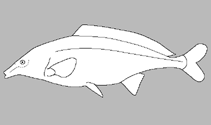 No image available for this species;
drawing shows typical species in Mormyridae.
Images Google
drawing shows typical species in Mormyridae.
Classification / Noms Noms communs | Synonymes | Catalog of Fishes(Genre, Espèce) | ITIS | CoL | WoRMS | Cloffa
> Osteoglossiformes (Bony tongues) > Mormyridae (Elephantfishes)
Etymology: Petrocephalus: Latin, petra = stone + Greek, kephale = head (Ref. 45335); arnegardi: This species is dedicated to Matthew E. Arnegard, in recognition of his contributions to study of mormyrid evolution and diversification; Matthew Arnegard is additionally a member of the “Mintotom Team”: researchers associated with the Carl D. Hopkins Laboratory at Cornell University who have conducted field studies on African weakly electric fishes for more than 15 years ("Mintotom" is the plural form of the word for mormyrid fish in the Fang language of West Central Africa) (Ref. 96601).
Eponymy: Dr Matthew Arnegard (d: 1967) is an evolutionary biologist who was a member of the ‘Mintotom Team’ of researchers in the laboratory of Professor Carl Hopkins, Cornell University (N. [...] (Ref. 128868), visit book page.
Etymology: Petrocephalus: Latin, petra = stone + Greek, kephale = head (Ref. 45335); arnegardi: This species is dedicated to Matthew E. Arnegard, in recognition of his contributions to study of mormyrid evolution and diversification; Matthew Arnegard is additionally a member of the “Mintotom Team”: researchers associated with the Carl D. Hopkins Laboratory at Cornell University who have conducted field studies on African weakly electric fishes for more than 15 years ("Mintotom" is the plural form of the word for mormyrid fish in the Fang language of West Central Africa) (Ref. 96601).
Eponymy: Dr Matthew Arnegard (d: 1967) is an evolutionary biologist who was a member of the ‘Mintotom Team’ of researchers in the laboratory of Professor Carl Hopkins, Cornell University (N. [...] (Ref. 128868), visit book page.
Environnement : milieu / zone climatique / profondeur / gamme de distribution Écologie
; eau douce démersal. Tropical
Distribution Territoires | Zones FAO | Écosystèmes | Occurrences | Carte par point | Introductions | Faunafri
Africa: various tributaries of the Likouala drainage (middle Congo River tributary) in Republic of Congo, and the middle Congo River near Yangambi in Democratic Republic of the Congo (Ref. 96601).
Taille / Poids / Âge
Description synthétique Clés d'identification | Morphologie | Morphométrie
Diagnosis: Petrocephalus arnegardi is distinguished from all other Petrocephalus species of Central Africa by the following combination of characteristics: pigmentation pattern comprising three well-defined, bilateral black patches, one usually distinct round/ovoid subdorsal black mark situated slightly anterior to dorsal, one black mark at the base of each pectoral fin, and one ovoid black mark centered at the base of caudal fin; dorsal fin at least one third shorter than anal fin; dorsal fin with at least 20 branched rays but no more than 22; anal fin with at least 30 branched rays; 16 teeth or fewer in upper jaw, 25 teeth or fewer in lower jaw; eye relatively large, ration head length and eye-diameter less than 4.7; mouth subterminal; ration of head length to mouth position between 4.2 and 5.6; mouth small, ration head length and mouth width more than 4.1; and EOD of normal polarity, mainly biphasic with sometimes the presence of a small-amplitude positive third phase (Ref. 96601).
Body shape (shape guide): fusiform / normal.
Body shape (shape guide): fusiform / normal.
Cycle de vie et comportement reproducteur Maturité | Reproduction | Frai | Œufs | Fécondité | Larves
Référence principale
Téléchargez vos références | Références | Coordinateur | Collaborateurs
Lavoué, S. and J.P. Sullivan, 2014. Petrocephalus boboto and Petrocephalus arnegardi, two new species of African electric fish (Osteoglossomorpha, Mormyridae) from the Congo River basin. ZooKeys 400:43-65. (Ref. 96601)
CITES
Not Evaluated
Menace pour l'homme
Harmless
Utilisations par l'homme
FAO - Publication: search | FishSource |
Plus d'informations
Écologie trophique
Aliments (proies)
Composition du régime alimentaire
Consommation alimentaire
Rations alimentaires
Prédateurs
Aliments (proies)
Composition du régime alimentaire
Consommation alimentaire
Rations alimentaires
Prédateurs
Écologie
Écologie
Écologie
Dynamique des populations
Paramètres de croissance
Âges / tailles maximales
Longueur-poids rel.
Rel. longueur-longueur.
Fréquences de longueurs
Conversion de masse
Recrutement
Abondance
Paramètres de croissance
Âges / tailles maximales
Longueur-poids rel.
Rel. longueur-longueur.
Fréquences de longueurs
Conversion de masse
Recrutement
Abondance
Cycle de vie
Reproduction
Maturité
Maturité/épines rel.
Fécondité
Frai
Agrégats de frai
Œufs
Développement de l'œuf
Larves
Dynamique des populations larvaires
Reproduction
Maturité
Maturité/épines rel.
Fécondité
Frai
Agrégats de frai
Œufs
Développement de l'œuf
Larves
Dynamique des populations larvaires
Anatomie
Surface branchiale
Cerveau
Otolithe
Surface branchiale
Cerveau
Otolithe
Physiologie
Composition corporelle
Nutriments
Consommation d'oxygène
Type de natation
Vitesse de nage
Pigments visuels
Son de poisson
Maladies et parasites
Toxicité (CL50)
Composition corporelle
Nutriments
Consommation d'oxygène
Type de natation
Vitesse de nage
Pigments visuels
Son de poisson
Maladies et parasites
Toxicité (CL50)
Génétique
génôme
Génétique
Hétérozygotie
Héritabilité
Diversité génétique
génôme
Génétique
Hétérozygotie
Héritabilité
Diversité génétique
Liées à l'homme
Systèmes d'aquaculture
Profils d'aquaculture
Souches
Cas de ciguatera
Timbres, pièces de monnaie, divers
Systèmes d'aquaculture
Profils d'aquaculture
Souches
Cas de ciguatera
Timbres, pièces de monnaie, divers
Outils
E-book | Guide de terrain | Clés d'identification | Générateur de fréquences de longueur | Outil de dynamique de population | Carte par point |
Capture-MSY |
Articles particuliers
Télécharger en XML
Sources Internet
AFORO (otoliths) | Aquatic Commons | BHL | Cloffa | Websites from users | FishWatcher | CISTI | Catalog of Fishes: Genre, Espèce | DiscoverLife | ECOTOX | FAO - Publication: search | Faunafri | Fishipedia | Fishtrace | GloBI | Google Books | Google Scholar | Google | IGFA World Record | OneZoom | Open Tree of Life | Otolith Atlas of Taiwan Fishes | PubMed | Reef Life Survey | Socotra Atlas | TreeBase | Arbre de Vie | Wikipedia: aller à, chercher | World Records Freshwater Fishing | Zoobank | Zoological Record
Estimations basées sur des modèles
Indice de diversité phylogénétique (Réf. 82804): PD50 = 0.5000 [Uniqueness, from 0.5 = low to 2.0 = high].
Bayesian length-weight: a=0.01549 (0.00672 - 0.03569), b=2.87 (2.69 - 3.05), in cm total length, based on LWR estimates for this Genus-body shape (Ref. 93245).
Niveau trophique (Réf. 69278): 3.2 ±0.4 se; based on size and trophs of closest relatives
Résilience (Réf. 120179): Haut, temps minimum de doublement de population inférieur à 15 mois (Preliminary K or Fecundity.).