



Heteropneustes nani Hossain, Sarker, Sharifuzzaman & Chowdhury, 2013
Ladda upp din foton och Videor
Bilder | Google image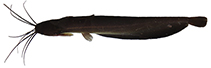 Heteropneustes nani
Male Bild av Hossain, M.S.
Bilder | Google image
Male Bild av Hossain, M.S.
Klassificering / Namn Populärnamn | synonymer | Catalog of Fishes(Släkte, Arter) | ITIS | CoL | WoRMS | Cloffa
> Siluriformes (Catfishes) > Heteropneustidae (Airsac catfishes)
Etymology: Heteropneustes: Greek, heteros = other + Greek, pneo = to breath (Ref. 45335); nani: Named for Professor Dr Nani Gopal Das.
Eponymy: Dr Nani Gopal Das (d: 1944) is a fisheries and aquaculture scientist. [...] (Ref. 128868), visit book page.
Etymology: Heteropneustes: Greek, heteros = other + Greek, pneo = to breath (Ref. 45335); nani: Named for Professor Dr Nani Gopal Das.
Eponymy: Dr Nani Gopal Das (d: 1944) is a fisheries and aquaculture scientist. [...] (Ref. 128868), visit book page.
Miljö: miljö / Klimatzon / djupintervall / distributionsområde Ekologi
; sötvatten bentopelagisk; djupintervall 1 - 2 m (Ref. 94657). Tropical
Utbredning Territorier | FAO områden | Ekosystem | Förekomster | Prickkarta | Utplanteringar | Faunafri
Asia: Bangladesh.
Storlek / Vikt / Ålder
Kort beskrivning Bestämningsnycklar | Morfologi | Morfometri
This species is distinguished from its congeners by the following: smallest in size; head length greater than the depth of body; small terminal mouth bearing nearly equal jaws and fleshy lips; united anal-caudal fin; pectoral spines completely separated from rays with 9-10 antrorse serrae along inner edge and 13-15 in outer edge; body colour blackish with two indistinct lateral bands on flank, with the ventral surface lighter (Ref. 94657).
Body shape (shape guide): elongated; Cross section: compressed.
Body shape (shape guide): elongated; Cross section: compressed.
Facultative air-breathing (Ref. 126274); This species is found in ponds, ditches, canals, flooded rice fields, swamps, marshes, waterlogged areas and rivers. Its air-breathing apparatus enables it to survive in low water depth, even in turbid and oxygen deficit conditions. During the winter season the fish can live in semi-liquid mud and when the mud dries up they burrow to the bottom of fissures and crevices formed by the cracking mud. Recorded physicochemical parameters during the study period are the following: water temperature 18-28°C; pH 6.5-7.5; dissolved oxygen 4.5-5.0 mg/l; water transparency 45-60 cm at 1.0-1.8 m depth. This fish is able to deliver a stinging protein (known as poison) emanated from the venom glands around the pectoral spine, and is reported to be neurotoxic and hemolytic (i.e. destruction of red blood cells) in humans, causing local numbness, inflammation and severe painful physical conditions on the affected limb (warm water bath, application of lukewarm turmeric paste, ejection of blood, and traditional herbal medicine are commonly used for healing). Still, its flesh is of good table quality and nutritional value. rich in iron and low fat, and a valuable source of protein (Ref. 94657).
Livscykel och parningsbeteende Könsmognad | Reproduktion | Lek | Ägg | Fekunditet | Larver
Huvudreferens
Ladda upp dina referenser | referenser | Koordinator | Medarbetare
Hossain, M.S., S. Sarker, S.M. Sharifuzzaman and S.R. Chowdhury, 2013. New species of stinging catfish Heteropneustes nani (Siluriformes: Heteropneustidae) from Noakhali, Bangladesh. Vert. Zool. 63(3):259-267. (Ref. 94657)
CITES
Not Evaluated
Hot mot människor
Traumatogenic
Mänskliga användningsområden
Fiskeri: kommersiell
FAO - Publication: search | FishSource |
Ytterligare information
Trofisk ekologi
Livsmedelsartiklar (preys)
Födosammansättning
Födointag
Matransoner
Predatorer
Livsmedelsartiklar (preys)
Födosammansättning
Födointag
Matransoner
Predatorer
Populationsdynamik
Tillväxtparametrar
Max. åldrar / storlekar
Längd-vikt rel.
Längd-längd rel.
Längd-frekvenser
Massakonvertering
Rekrytering
Abundans
Tillväxtparametrar
Max. åldrar / storlekar
Längd-vikt rel.
Längd-längd rel.
Längd-frekvenser
Massakonvertering
Rekrytering
Abundans
Livscykel
Reproduktion
Könsmognad
Mognad/Gills rel.
Fekunditet
Lek
Lekande aggregat
Ägg
Utveckling av ägg
Larver
Larvdynamik
Reproduktion
Könsmognad
Mognad/Gills rel.
Fekunditet
Lek
Lekande aggregat
Ägg
Utveckling av ägg
Larver
Larvdynamik
Anatomi
Gälyta
Hjärna
Otolit
Gälyta
Hjärna
Otolit
Fysiologi
Kroppssammansättning
Näringsämnen
Syreförbrukning
Typ av simning
Simhastighet
Visuella pigment
Ljud från fisk
Sjukdomar & Parasiter
Toxicitet (LC50)
Kroppssammansättning
Näringsämnen
Syreförbrukning
Typ av simning
Simhastighet
Visuella pigment
Ljud från fisk
Sjukdomar & Parasiter
Toxicitet (LC50)
Genetik
Genom
Genetik
Heterozygositet
Ärftlighet
Genetisk mångfald
Genom
Genetik
Heterozygositet
Ärftlighet
Genetisk mångfald
Människorelaterad
Vattenbrukssystem
Vattenbruksprofiler
Avelslinjer
Ciguatera-fall
Frimärken, mynt, diverse.
Vattenbrukssystem
Vattenbruksprofiler
Avelslinjer
Ciguatera-fall
Frimärken, mynt, diverse.
Verktyg
Särskilda rapporter
Kontrollera för underhåll av akvarium | Kontrollera om det finns faktablad om arter | Kontrollera om det finns faktablad om vattenbruk
Ladda ner XML
Internet-källor
AFORO (otoliths) | Aquatic Commons | BHL | Cloffa | Websites from users | Check FishWatcher | CISTI | Catalog of Fishes: Släkte, Arter | DiscoverLife | ECOTOX | FAO - Publication: search | Faunafri | Fishipedia | Fishtrace | GloBI | Google Books | Google Scholar | Google | IGFA World Record | OneZoom | Open Tree of Life | Otolith Atlas of Taiwan Fishes | PubMed | Reef Life Survey | Socotra Atlas | TreeBase | Tree of Life | Wikipedia: Go, sök | World Records Freshwater Fishing | Zoobank | Zoologiskt register
Uppskattningar baserade på modeller
Index för fylogenetisk mångfald (Ref. 82804): PD50 = 0.5312 [Uniqueness, from 0.5 = low to 2.0 = high].
Bayesian length-weight: a=0.00437 (0.00193 - 0.00988), b=3.09 (2.88 - 3.30), in cm total length, based on LWR estimates for this (Sub)family-body shape (Ref. 93245).
Trofisk nivå (Ref. 69278): 3.3 ±0.5 se; based on size and trophs of closest relatives
Resiliens (Ref. 120179): Hög, lägsta populationsfördubblingstid mindre än 15 månader (Preliminary K or Fecundity.).