



Bythaelurus giddingsi McCosker, Long & Baldwin, 2012
Galápagos catshark
Lägg till din observation i Fish Watcher
| Native range | All suitable habitat | Point map | Year 2050 |

|
| This map was computer-generated and has not yet been reviewed. |
| Bythaelurus giddingsi AquaMaps Data sources: GBIF OBIS |
Ladda upp din foton och Videor
Google image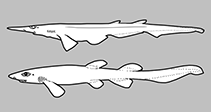 No image available for this species;
drawing shows typical species in Pentanchidae.
Google image
drawing shows typical species in Pentanchidae.
Klassificering / Namn Populärnamn | synonymer | Catalog of Fishes(Släkte, Arter) | ITIS | CoL | WoRMS | Cloffa
Elasmobranchii (hajar och rockor) (sharks and rays) > Carcharhiniformes (Ground sharks) > Pentanchidae (Deepwater catsharks)
Etymology: Bythaelurus: bythos (Gr.), depths of the sea, referring to its deepwater habitat; ailouros (Gr.), cat, probably an allusion to the vernacular “catshark,” so named for its cat-like eyes (See ETYFish); giddingsi: In honor of Al Giddings (b. 1937), American underwater filmmaker, naturalist, and friend (See ETYFish).
Eponymy: Al Giddings is an underwater filmmaker and naturalist. He has also been active in the commercial film business as the cameraman for: The Deep (1977) and as co-producer of: Titanic (1997). Moreover, he is a friend of the senior author. (Ref. 128868), visit book page.
More on authors: McCosker, Long & Baldwin.
Etymology: Bythaelurus: bythos (Gr.), depths of the sea, referring to its deepwater habitat; ailouros (Gr.), cat, probably an allusion to the vernacular “catshark,” so named for its cat-like eyes (See ETYFish); giddingsi: In honor of Al Giddings (b. 1937), American underwater filmmaker, naturalist, and friend (See ETYFish).
Eponymy: Al Giddings is an underwater filmmaker and naturalist. He has also been active in the commercial film business as the cameraman for: The Deep (1977) and as co-producer of: Titanic (1997). Moreover, he is a friend of the senior author. (Ref. 128868), visit book page.
More on authors: McCosker, Long & Baldwin.
Miljö: miljö / Klimatzon / djupintervall / distributionsområde Ekologi
marina batypelagisk; djupintervall 428 - 562 m (Ref. 89625). Tropical
Utbredning Territorier | FAO områden | Ekosystem | Förekomster | Prickkarta | Utplanteringar | Faunafri
Pacific Ocean: presumed to be endemic to the Galápagos Islands.
Storlek / Vikt / Ålder
Kort beskrivning Bestämningsnycklar | Morfologi | Morfometri
This species is moderately sized and have the following characters: snout bluntly rounded;
preoral length 4.7-6.8% TL; short head, length about equal to pectoral-pelvic space, 21-24% TL; precaudal length 73-80% TL; dorsal and anal fins are subequal; length of anal-fin base about equal to length of interdorsal space; 81-85 (mean = 82.6) precaudal vertebrae; color chocolate brown dorsally, paler on ventral surface from snout to anus; body, flanks, caudal and median fins are overlain with pale spots about equal in size to eye, becoming smaller below lateral midline, and showing a bilaterally asymmetrical pattern. It differs from its congeners in its coloration, the length of its anal-fin base, and in other morphological characters (Ref. 89625).
Body shape (shape guide): elongated.
Body shape (shape guide): elongated.
This species were observed living on the bottom above sand or sand and mud substrates,
in the vicinity of lava boulders, either over flat bottoms or along slopes to 45° (Ref. 89625).
Livscykel och parningsbeteende Könsmognad | Reproduktion | Lek | Ägg | Fekunditet | Larver
Huvudreferens
Ladda upp dina referenser | referenser | Koordinator | Medarbetare
McCosker, J.E., D.J. Long and C.C. Baldwin, 2012. Description of a new species of deepwater catshark, Bythaelurus giddingsi sp. nov., from the Galápagos Islands (Chondrichthyes: Carcharhiniformes: Scyliorhinidae). Zootaxa 3221:48-59. (Ref. 89625)
Status på IUCN:s rödlista (Ref. 130435: Version 2025-2 (Global))
Least Concern (LC) ; Date assessed: 08 February 2019
CITES
Not Evaluated
Hot mot människor
Harmless
Mänskliga användningsområden
FAO - Publication: search | FishSource |
Ytterligare information
Trofisk ekologi
Livsmedelsartiklar (preys)
Födosammansättning
Födointag
Matransoner
Predatorer
Livsmedelsartiklar (preys)
Födosammansättning
Födointag
Matransoner
Predatorer
Ekologi
Ekologi
Ekologi
Populationsdynamik
Tillväxtparametrar
Max. åldrar / storlekar
Längd-vikt rel.
Längd-längd rel.
Längd-frekvenser
Massakonvertering
Rekrytering
Abundans
Tillväxtparametrar
Max. åldrar / storlekar
Längd-vikt rel.
Längd-längd rel.
Längd-frekvenser
Massakonvertering
Rekrytering
Abundans
Livscykel
Reproduktion
Könsmognad
Mognad/Gills rel.
Fekunditet
Lek
Lekande aggregat
Ägg
Utveckling av ägg
Larver
Larvdynamik
Reproduktion
Könsmognad
Mognad/Gills rel.
Fekunditet
Lek
Lekande aggregat
Ägg
Utveckling av ägg
Larver
Larvdynamik
Anatomi
Gälyta
Hjärna
Otolit
Gälyta
Hjärna
Otolit
Fysiologi
Kroppssammansättning
Näringsämnen
Syreförbrukning
Typ av simning
Simhastighet
Visuella pigment
Ljud från fisk
Sjukdomar & Parasiter
Toxicitet (LC50)
Kroppssammansättning
Näringsämnen
Syreförbrukning
Typ av simning
Simhastighet
Visuella pigment
Ljud från fisk
Sjukdomar & Parasiter
Toxicitet (LC50)
Genetik
Genom
Genetik
Heterozygositet
Ärftlighet
Genetisk mångfald
Genom
Genetik
Heterozygositet
Ärftlighet
Genetisk mångfald
Människorelaterad
Vattenbrukssystem
Vattenbruksprofiler
Avelslinjer
Ciguatera-fall
Frimärken, mynt, diverse.
Vattenbrukssystem
Vattenbruksprofiler
Avelslinjer
Ciguatera-fall
Frimärken, mynt, diverse.
Verktyg
Särskilda rapporter
Kontrollera för underhåll av akvarium | Kontrollera om det finns faktablad om arter | Kontrollera om det finns faktablad om vattenbruk
Ladda ner XML
Internet-källor
AFORO (otoliths) | Aquatic Commons | BHL | Cloffa | Websites from users | Check FishWatcher | CISTI | Catalog of Fishes: Släkte, Arter | DiscoverLife | ECOTOX | FAO - Publication: search | Faunafri | Fishipedia | Fishtrace | GloBI | Google Books | Google Scholar | Google | IGFA World Record | OneZoom | Open Tree of Life | Otolith Atlas of Taiwan Fishes | PubMed | Reef Life Survey | Socotra Atlas | TreeBase | Tree of Life | Wikipedia: Go, sök | World Records Freshwater Fishing | Zoobank | Zoologiskt register
Uppskattningar baserade på modeller
Önskad temperatur (Ref. 123201): 2.6 - 3.3, mean 3.1 °C (based on 9 cells).
Index för fylogenetisk mångfald (Ref. 82804): PD50 = 0.5001 [Uniqueness, from 0.5 = low to 2.0 = high].
Bayesian length-weight: a=0.00347 (0.00172 - 0.00698), b=3.08 (2.90 - 3.26), in cm total length, based on LWR estimates for this (Sub)family-body shape (Ref. 93245).
Trofisk nivå (Ref. 69278): 4.3 ±0.5 se; based on size and trophs of closest relatives