



Bythaelurus giddingsi McCosker, Long & Baldwin, 2012
Galápagos catshark
Beobachtung melden im Fish Watcher
| Native range | All suitable habitat | Point map | Year 2050 |

|
| This map was computer-generated and has not yet been reviewed. |
| Bythaelurus giddingsi AquaMaps Data sources: GBIF OBIS |
Hochladen Photos und videos
Google Bild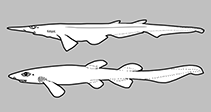 No image available for this species;
drawing shows typical species in Pentanchidae.
Google Bild
drawing shows typical species in Pentanchidae.
Klassifizierung / Names Namen | Synonyme | Catalog of Fishes(Gattung, Arten) | ITIS | CoL | WoRMS | Cloffa
Elasmobranchii (Haie und Rochen) (sharks and rays) > Carcharhiniformes (Ground sharks) > Pentanchidae (Deepwater catsharks)
Etymology: Bythaelurus: bythos (Gr.), depths of the sea, referring to its deepwater habitat; ailouros (Gr.), cat, probably an allusion to the vernacular “catshark,” so named for its cat-like eyes (See ETYFish); giddingsi: In honor of Al Giddings (b. 1937), American underwater filmmaker, naturalist, and friend (See ETYFish).
Eponymy: Al Giddings is an underwater filmmaker and naturalist. He has also been active in the commercial film business as the cameraman for: The Deep (1977) and as co-producer of: Titanic (1997). Moreover, he is a friend of the senior author. (Ref. 128868), visit book page.
More on authors: McCosker, Long & Baldwin.
Etymology: Bythaelurus: bythos (Gr.), depths of the sea, referring to its deepwater habitat; ailouros (Gr.), cat, probably an allusion to the vernacular “catshark,” so named for its cat-like eyes (See ETYFish); giddingsi: In honor of Al Giddings (b. 1937), American underwater filmmaker, naturalist, and friend (See ETYFish).
Eponymy: Al Giddings is an underwater filmmaker and naturalist. He has also been active in the commercial film business as the cameraman for: The Deep (1977) and as co-producer of: Titanic (1997). Moreover, he is a friend of the senior author. (Ref. 128868), visit book page.
More on authors: McCosker, Long & Baldwin.
Umwelt: Milieu / Klimazone / Tiefenbereich / Verbreitungsgebiet Ökologie
seewasser bathypelagisch; tiefenbereich 428 - 562 m (Ref. 89625). Tropical
Verbreitung Territorien | FAO Gebiete | Ökosysteme | Vorkommen | Punkt Karte | Einführungen | Faunafri
Pacific Ocean: presumed to be endemic to the Galápagos Islands.
Größe / Gewicht / Alter
Kurzbeschreibung Bestimmungsschlüssel | Morphologie | Morphometrie
This species is moderately sized and have the following characters: snout bluntly rounded;
preoral length 4.7-6.8% TL; short head, length about equal to pectoral-pelvic space, 21-24% TL; precaudal length 73-80% TL; dorsal and anal fins are subequal; length of anal-fin base about equal to length of interdorsal space; 81-85 (mean = 82.6) precaudal vertebrae; color chocolate brown dorsally, paler on ventral surface from snout to anus; body, flanks, caudal and median fins are overlain with pale spots about equal in size to eye, becoming smaller below lateral midline, and showing a bilaterally asymmetrical pattern. It differs from its congeners in its coloration, the length of its anal-fin base, and in other morphological characters (Ref. 89625).
Body shape (shape guide): elongated.
Body shape (shape guide): elongated.
This species were observed living on the bottom above sand or sand and mud substrates,
in the vicinity of lava boulders, either over flat bottoms or along slopes to 45° (Ref. 89625).
Lebenszyklus und Paarungsverhalten Geschlechtsreife | Fortpflanzung | Ablaichen | Eier | Fruchtbarkeit | Larven
Hauptreferenz
Laden Sie Ihre Referenzen hoch | Referenzen | Koordinator | Partner
McCosker, J.E., D.J. Long and C.C. Baldwin, 2012. Description of a new species of deepwater catshark, Bythaelurus giddingsi sp. nov., from the Galápagos Islands (Chondrichthyes: Carcharhiniformes: Scyliorhinidae). Zootaxa 3221:48-59. (Ref. 89625)
IUCN Rote Liste Status (Ref. 130435: Version 2025-2 (Global))
nicht bedroht (LC) ; Date assessed: 08 February 2019
CITES
Not Evaluated
Bedrohung für Menschen
Harmless
Nutzung durch Menschen
FAO - Publication: search | FishSource |
Mehr Information
Trophische Ökologie
Lebensmittel (Beutetiere)
Nahrungszusammensetzung
Nahrungsaufnahme
Lebensmittelrationen
Räuber
Lebensmittel (Beutetiere)
Nahrungszusammensetzung
Nahrungsaufnahme
Lebensmittelrationen
Räuber
Ökologie
Ökologie
Ökologie
Populationsdynamik
Wachstumsparameter
Max. Alter/Größen
Länge-Gewicht-Rel.
Länge-Länge-Verhältnis.
Längenhäufigkeiten
Massenkonvertierung
Rekrutierung
Dichte
Wachstumsparameter
Max. Alter/Größen
Länge-Gewicht-Rel.
Länge-Länge-Verhältnis.
Längenhäufigkeiten
Massenkonvertierung
Rekrutierung
Dichte
Lebenszyklus
Fortpflanzung
Geschlechtsreife
Reifung/Kiemen rel.
Fruchtbarkeit
Ablaichen
Laichaggregationen
Eier
Eientwicklung
Larven
Larven Pop.Dyn.
Fortpflanzung
Geschlechtsreife
Reifung/Kiemen rel.
Fruchtbarkeit
Ablaichen
Laichaggregationen
Eier
Eientwicklung
Larven
Larven Pop.Dyn.
Anatomie
Kiemenoberfläche
Gehirn
Otolith
Kiemenoberfläche
Gehirn
Otolith
Physiologie
Körperliche Zusammensetzung
Nährstoffe
Sauerstoffverbrauch
Schwimmart
Schwimmgeschwindigkeit
Visuelle Pigmente
Fischgeräusche
Krankheiten und Parasiten
Toxizität (LC50s)
Körperliche Zusammensetzung
Nährstoffe
Sauerstoffverbrauch
Schwimmart
Schwimmgeschwindigkeit
Visuelle Pigmente
Fischgeräusche
Krankheiten und Parasiten
Toxizität (LC50s)
Genetik
Genom
Genetik
Heterozygotie
Vererbbarkeit
Genetische Vielfalt
Genom
Genetik
Heterozygotie
Vererbbarkeit
Genetische Vielfalt
Menschenbezogen
Aquakultur-Systeme
Aquakultur Profile
Zuchtlinien
Ciguatera-Fälle
Briefmarken, Münzen, Verschiedenes.
Aquakultur-Systeme
Aquakultur Profile
Zuchtlinien
Ciguatera-Fälle
Briefmarken, Münzen, Verschiedenes.
Tools
Zusatzinformationen
Download XML
Zusammenfassung | Punktdaten | Namen | Photos
Internet Quellen
AFORO (otoliths) | Aquatic Commons | BHL | Cloffa | Websites from users | FishWatcher Einträge suchen | CISTI | Catalog of Fishes: Gattung, Arten | DiscoverLife | ECOTOX | FAO - Publication: search | Faunafri | Fishipedia | Fishtrace | GloBI | Google Books | Google Scholar | Google | IGFA World Record | OneZoom | Open Tree of Life | Otolith Atlas of Taiwan Fishes | PubMed | Reef Life Survey | Socotra Atlas | TreeBase | Tree of Life | Wikipedia: Gehe zu, Suchen | | Zoobank | Zoologischer Rekord
Schätzungen auf der Grundlage von Modellen
|
Phylogenetischer Diversitätsindex (Ref. 82804) |
PD50 = 0.5001 [Uniqueness, from 0.5 = low to 2.0 = high]. |
| Bayesian length-weight | a=0.00347 (0.00171 - 0.00701), b=3.09 (2.91 - 3.27), in cm total length, based on LWR estimates for this (Sub)family-body shape (Ref. 93245). |
|
Trophische Ebene (Ref. 69278) |
4.3 ±0.5 se; based on size and trophs of closest relatives |
|
Anfälligkeit der Fischerei (Ref. 59153) |
Low to moderate vulnerability (25 of 100). 🛈 |