



Chiloglanis igamba Friel & Vigliotta, 2011
Sube tu fotos y Vídeos
Google image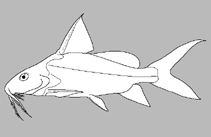 No image available for this species;
drawing shows typical species in Mochokidae.
Google image
drawing shows typical species in Mochokidae.
Clasificación / Nombres Nombres comunes | Sinónimos | Catalog of Fishes(Género, Especie) | ITIS | CoL | WoRMS | Cloffa
> Siluriformes (Catfishes) > Mochokidae (Squeakers or upside-down catfishes) > Chiloglanidinae
Etymology: Chiloglanis: Greek, cheilos = lip + Greek, glanis = a fish that can eat the bait without touching the hook; a cat fish (Ref. 45335); igamba: The specific name refers to the type locality of this species, Igamba Falls on the Malagarasi River; this is the first major series of waterfalls encountered while navigating upriver from Lake Tanganyika, and is a potential site for a hydroelectric dam; used as a noun in apposition (Ref. 87986).
Etymology: Chiloglanis: Greek, cheilos = lip + Greek, glanis = a fish that can eat the bait without touching the hook; a cat fish (Ref. 45335); igamba: The specific name refers to the type locality of this species, Igamba Falls on the Malagarasi River; this is the first major series of waterfalls encountered while navigating upriver from Lake Tanganyika, and is a potential site for a hydroelectric dam; used as a noun in apposition (Ref. 87986).
Entorno: milieu / zona climática / rango de profundidad / gama de distribución Ecología
; agua dulce bentopelágico. Tropical; 5°S - 6°S, 29°E - 31°E
Distribución Territorios | Áreas FAO | Ecosistemas | Ocurrencias, apariciones | Mapa de puntos | Introducciones | Faunafri
Africa: lower Malagarasi River, Tanzania (Ref. 87986).
Tamaño / Peso / Edad
Descripción breve Claves de identificación | Morfología | Morfometría
Espinas dorsales (total) : 2; Radios blandos dorsales (total) : 5 - 6; Espinas anales: 0; Radios blandos anales: 9 - 11; Vértebra: 33. Diagnosis: Chiloglanis igamba is a sexually dimorphic species in which the caudal fin of adult males is relatively truncate, but with the middlemost rays moderately elongated; females and juvenile males of this species in contrast exhibit a gently forked caudal fin; sexual dimorphism of the caudal fin is also apparent in several other species of Chiloglanis, including the following from various tributaries flowing into Lake Tanganyika: C. trilobatus, C. kalambo, C. productus and C. asymetricaudalis, but the particular shape of the caudal fin in C. igamba is unique among all congeners (Ref. 87986). The most similar sexually dimorphic caudal fins are found in males of C. trilobatus and C. kalambo, where the middle most rays form a third lobe; the trilobate caudal-fin shape in these species can be distinguished from the shape in C. igamba by the areas between upper, middle and lower lobes, which are notably recessed; in C. igamba these recessed areas are absent and clearly trilobate shape is not evident; Chiloglanis igamba is further distinguished from C. trilobatus and C. kalambo by a shorter adipose-fin length, 10.3-16.3% of standard length vs. 16.4-22.3% in C. trilobatus and 16.5-23.4% in C. kalambo; a shorter depth at dorsal fin insertion, 14.5-18.4% of standard length vs. 20.0-24.0% in C. trilobatus and 18.2-23.5% in C. kalambo; a shorter caudal peduncle depth, 8.7-12.6% of standard length vs. 11.9-14.5% in C. trilobatus and 11.3-15.4% in C. kalambo; a longer snout length, 20.3-26.2% of standard length vs. mean of 19.9% in C. trilobatus and mean of 18.4% in C. kalambo; a shorter maxillary barbel, 5.0-7.5% of standard length vs. a mean of 10.6% in C. trilobatus and mean of 9.3% in C. kalambo; a wider oral disc, 20.4-26.8% of standard length vs. mean of 19.0% in C. trilobatus and mean of 19.7% in C. kalambo; a wider set of premaxillary tooth plates, 15.6-19.8% of standard length vs. mean of 14.0% in C. trilobatus and mean of 13.7% in C. kalambo; 27-45 primary teeth on each premaxilla, vs. 18-31 in C. trilobatus and 7-21 in C. kalambo; 6 soft rays in the dorsal fin, rarely 5, vs. 5 rays in C. trilobatus and C. kalambo (Ref. 87986). Caudal-fin shape in males of C. igamba is also fairly similar to the shape found in males of C. productus; but in C. productus all caudal-fin rays, especially the middle rays, are elongated and the fin is diamond shaped; Chiloglanis igamba is also easily distinguished from C. productus by its pigmentation, which consists of cream-coloured splotches on a light brown background; in contrast, the pigmentation of C. productus is medium to dark brown with a pale midlateral stripe along the lateral line; Chiloglanis igamba is further distinguished from C. productus by a shorter pectoral spine, 9.9-15.1% of standard length vs. 15.2-18.5%; a shorter pectoral-fin longest ray, 15.2-18.8% of standard length vs. 19.1-23.9%; and a shorter adipose-fin base, 10.3-16.3% of standard length vs. 22.5-26.2% (Ref. 87986). Finally, in Chiloglanis asymetricaudalis the caudal fin of adult males is forked, but with an elongate upper lobe; in addition to caudal fin shape, C. igamba is easily distinguished from C. asymetricaudalis by a shorter pectoral spine, 9.9-15.1% of standard length vs. 16.4-19.7%; a shorter dorsal spine, 8.2-12.7% of standard length vs. 13.0-15.7%; a shorter anal fin, 11.7-15.9% of standard length vs. 22.6-28.0%; a shorter caudal peduncle, 15.0-17.7% of standard length vs. 18.4-20.9%; and a markedly different pigment pattern (Ref. 87986).
Body shape (shape guide): elongated.
Body shape (shape guide): elongated.
This species is most abundant within the Igamba Falls area and associated large rapids, and is much less common in smaller rapids both above and below these falls (Ref. 87986).
Ciclo vital y comportamiento de apareamiento Madurez | Reproducción | Puesta | Huevos | Fecundidad | Larva
Referencia principal
Suba sus referencias | Referencias | Coordinador | Colaboradores
Friel, J.P. and T.R. Vigliotta, 2011. Three new species of African suckermouth catfishes, genus Chiloglanis (Siluriformes: Mochokidae), from the lower Malagarasi and Luiche rivers of western Tanzania. Zootaxa 3063:1-21. (Ref. 87986)
CITES
Not Evaluated
Amenaza para el ser humano
Harmless
Usos humanos
Pesquerías: sin interés
FAO - Publication: search | FishSource |
Más información
Ecología Trófica
Alimentos (presas)
Composición de la dieta
consumo de alimento
Raciones de comida
Despredadores
Alimentos (presas)
Composición de la dieta
consumo de alimento
Raciones de comida
Despredadores
Dinámica de la población
Coeficiente del crecimiento para
Edades / tallas máximas
Longitud-peso rel.
Longitud-longitud rel.
Longitud-frecuencias
Conversión de masas
Reclutamiento
Abundancia
Coeficiente del crecimiento para
Edades / tallas máximas
Longitud-peso rel.
Longitud-longitud rel.
Longitud-frecuencias
Conversión de masas
Reclutamiento
Abundancia
Ciclo de vida
Reproducción
Madurez
Madurez/Gills rel.
Fecundidad
Puesta
Agregaciones de desove
Huevos
Desarrollo de los huevos
Larva
Dinámica larvaria
Reproducción
Madurez
Madurez/Gills rel.
Fecundidad
Puesta
Agregaciones de desove
Huevos
Desarrollo de los huevos
Larva
Dinámica larvaria
Distribución
Territorios
Áreas FAO
Ecosistemas
Ocurrencias, apariciones
Introducciones
BRUVS - Vídeos
Territorios
Áreas FAO
Ecosistemas
Ocurrencias, apariciones
Introducciones
BRUVS - Vídeos
Anatomía
Superficie branquial
Cerebro
Otolito
Superficie branquial
Cerebro
Otolito
Fisiología
Composición corporal
Nutrientes
Consumo del oxígeno
Tipo de natación
Velocidad de natación
Pigmentos visuales
Sonido de peces
Enfermedades y parásitos
Toxicidad (CL50)
Composición corporal
Nutrientes
Consumo del oxígeno
Tipo de natación
Velocidad de natación
Pigmentos visuales
Sonido de peces
Enfermedades y parásitos
Toxicidad (CL50)
Genética
Genoma
Genética
Heterocigosidad
heritabilidad
Diversidad genética
Genoma
Genética
Heterocigosidad
heritabilidad
Diversidad genética
Relacionados con el ser humano
Sistemas de acuicultura
Perfiles de acuicultura
Razas
Ciguatera cases
Sellos, monedas, varios
Sistemas de acuicultura
Perfiles de acuicultura
Razas
Ciguatera cases
Sellos, monedas, varios
Herramientas
Libro electrónico | Guía de campo | Asistente para frecuencias de tallas | Herramienta de ciclo de vida | Mapa de puntos |
Catch-MSY |
Informes especiales
Comprobar el mantenimiento del acuario | Buscar fichas sobre especies | Consulte las hojas informativas sobre acuicultura
Descargar XML
Fuentes de Internet
AFORO (otoliths) | Aquatic Commons | BHL | Cloffa | Websites from users | Check FishWatcher | CISTI | Catalog of Fishes: Género, Especie | DiscoverLife | ECOTOX | FAO - Publication: search | Faunafri | Fishipedia | Fishtrace | GloBI | Google Books | Google Scholar | Google | IGFA World Record | OneZoom | Open Tree of Life | Otolith Atlas of Taiwan Fishes | PubMed | Reef Life Survey | Socotra Atlas | TreeBase | Árbol de la vida | Wikipedia: Go, búsqueda | World Records Freshwater Fishing | Zoobank | Expediente Zoológico
Estimaciones basadas en modelos
Índice de diversidad filogenética (Referencia 82804): PD50 = 0.5000 [Uniqueness, from 0.5 = low to 2.0 = high].
Bayesian length-weight: a=0.00389 (0.00180 - 0.00842), b=3.12 (2.94 - 3.30), in cm total length, based on all LWR estimates for this body shape (Ref. 93245).
Nivel trófico (Referencia 69278): 3.2 ±0.4 se; based on size and trophs of closest relatives