



Chiloglanis igamba Friel & Vigliotta, 2011
分類 / 名稱 俗名 | 同種異名 | Catalog of Fishes(屬, 種) | ITIS | CoL | WoRMS | Cloffa
Teleostei > Siluriformes (Catfishes) 鯰形目 (Catfishes) > Mochokidae (Squeakers or upside-down catfishes) 倒立鯰科 (Squeakers or upside-down catfishes) > Chiloglanidinae
Etymology: Chiloglanis: Greek, cheilos = lip + Greek, glanis = a fish that can eat the bait without touching the hook; a cat fish (Ref. 45335); igamba: The specific name refers to the type locality of this species, Igamba Falls on the Malagarasi River; this is the first major series of waterfalls encountered while navigating upriver from Lake Tanganyika, and is a potential site for a hydroelectric dam; used as a noun in apposition (Ref. 87986).
Etymology: Chiloglanis: Greek, cheilos = lip + Greek, glanis = a fish that can eat the bait without touching the hook; a cat fish (Ref. 45335); igamba: The specific name refers to the type locality of this species, Igamba Falls on the Malagarasi River; this is the first major series of waterfalls encountered while navigating upriver from Lake Tanganyika, and is a potential site for a hydroelectric dam; used as a noun in apposition (Ref. 87986).
環境: 環境 / 氣候帶 / 深度上下限 / 配送範圍 生態學
; 淡水 底中水層性. ; 5°S - 6°S, 29°E - 31°E
分布 領土 | FAO區域 | 生態系 | 發現紀錄 | 分布圖 | 簡介 | Faunafri
Africa: lower Malagarasi River, Tanzania (Ref. 87986).
大小 / 重量 / 年齡
簡短描述 檢索表 | 型態特徵 | 形態測量圖
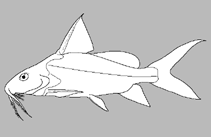
背棘 (總數) : 2; 背的軟條 (總數) : 5 - 6; 臀棘: 0; 臀鰭軟條: 9 - 11; 脊椎骨: 33. Diagnosis: Chiloglanis igamba is a sexually dimorphic species in which the caudal fin of adult males is relatively truncate, but with the middlemost rays moderately elongated; females and juvenile males of this species in contrast exhibit a gently forked caudal fin; sexual dimorphism of the caudal fin is also apparent in several other species of Chiloglanis, including the following from various tributaries flowing into Lake Tanganyika: C. trilobatus, C. kalambo, C. productus and C. asymetricaudalis, but the particular shape of the caudal fin in C. igamba is unique among all congeners (Ref. 87986). The most similar sexually dimorphic caudal fins are found in males of C. trilobatus and C. kalambo, where the middle most rays form a third lobe; the trilobate caudal-fin shape in these species can be distinguished from the shape in C. igamba by the areas between upper, middle and lower lobes, which are notably recessed; in C. igamba these recessed areas are absent and clearly trilobate shape is not evident; Chiloglanis igamba is further distinguished from C. trilobatus and C. kalambo by a shorter adipose-fin length, 10.3-16.3% of standard length vs. 16.4-22.3% in C. trilobatus and 16.5-23.4% in C. kalambo; a shorter depth at dorsal fin insertion, 14.5-18.4% of standard length vs. 20.0-24.0% in C. trilobatus and 18.2-23.5% in C. kalambo; a shorter caudal peduncle depth, 8.7-12.6% of standard length vs. 11.9-14.5% in C. trilobatus and 11.3-15.4% in C. kalambo; a longer snout length, 20.3-26.2% of standard length vs. mean of 19.9% in C. trilobatus and mean of 18.4% in C. kalambo; a shorter maxillary barbel, 5.0-7.5% of standard length vs. a mean of 10.6% in C. trilobatus and mean of 9.3% in C. kalambo; a wider oral disc, 20.4-26.8% of standard length vs. mean of 19.0% in C. trilobatus and mean of 19.7% in C. kalambo; a wider set of premaxillary tooth plates, 15.6-19.8% of standard length vs. mean of 14.0% in C. trilobatus and mean of 13.7% in C. kalambo; 27-45 primary teeth on each premaxilla, vs. 18-31 in C. trilobatus and 7-21 in C. kalambo; 6 soft rays in the dorsal fin, rarely 5, vs. 5 rays in C. trilobatus and C. kalambo (Ref. 87986). Caudal-fin shape in males of C. igamba is also fairly similar to the shape found in males of C. productus; but in C. productus all caudal-fin rays, especially the middle rays, are elongated and the fin is diamond shaped; Chiloglanis igamba is also easily distinguished from C. productus by its pigmentation, which consists of cream-coloured splotches on a light brown background; in contrast, the pigmentation of C. productus is medium to dark brown with a pale midlateral stripe along the lateral line; Chiloglanis igamba is further distinguished from C. productus by a shorter pectoral spine, 9.9-15.1% of standard length vs. 15.2-18.5%; a shorter pectoral-fin longest ray, 15.2-18.8% of standard length vs. 19.1-23.9%; and a shorter adipose-fin base, 10.3-16.3% of standard length vs. 22.5-26.2% (Ref. 87986). Finally, in Chiloglanis asymetricaudalis the caudal fin of adult males is forked, but with an elongate upper lobe; in addition to caudal fin shape, C. igamba is easily distinguished from C. asymetricaudalis by a shorter pectoral spine, 9.9-15.1% of standard length vs. 16.4-19.7%; a shorter dorsal spine, 8.2-12.7% of standard length vs. 13.0-15.7%; a shorter anal fin, 11.7-15.9% of standard length vs. 22.6-28.0%; a shorter caudal peduncle, 15.0-17.7% of standard length vs. 18.4-20.9%; and a markedly different pigment pattern (Ref. 87986).
Body shape (shape guide): elongated.
Body shape (shape guide): elongated.
This species is most abundant within the Igamba Falls area and associated large rapids, and is much less common in smaller rapids both above and below these falls (Ref. 87986).
生命週期和交配行為 成熟度 | 繁殖 | 產卵場 | 卵 | 孕卵數 | 仔魚
主要參考資料
上傳您的推薦信 | 參考文獻 | 合作者 | 合作者
Friel, J.P. and T.R. Vigliotta, 2011. Three new species of African suckermouth catfishes, genus Chiloglanis (Siluriformes: Mochokidae), from the lower Malagarasi and Luiche rivers of western Tanzania. Zootaxa 3063:1-21. (Ref. 87986)
CITES
Not Evaluated
對人類具威脅
人類使用
漁業: 沒有興趣
FAO - Publication: search | FishSource |
更多資訊
解剖學
鰓區
腦部
耳石
鰓區
腦部
耳石
生理學
身體成分
營養素
耗氧量
游泳類型
游泳速度
視覺色素
魚聲
疾病與寄生蟲
毒性 (LC50s)
身體成分
營養素
耗氧量
游泳類型
游泳速度
視覺色素
魚聲
疾病與寄生蟲
毒性 (LC50s)
遺傳學
基因組
遺傳學
異種性
遺傳率
遺傳多樣性
基因組
遺傳學
異種性
遺傳率
遺傳多樣性
工具
特別的報告
下載 XML
網路資源
AFORO (otoliths) | Aquatic Commons | BHL | Cloffa | Websites from users | 檢查 FishWatcher | CISTI | Catalog of Fishes: 屬, 種 | DiscoverLife | ECOTOX | FAO - Publication: search | Faunafri | Fishipedia | Fishtrace | GloBI | Google Books | Google Scholar | Google | IGFA World Record | OneZoom | Open Tree of Life | Otolith Atlas of Taiwan Fishes | PubMed | Reef Life Survey | Socotra Atlas | TreeBase | 樹狀分類階層 | Wikipedia: 去, 搜尋 | World Records Freshwater Fishing | Zoobank | 動物學的記錄
基於模型的估計
系統發育多樣性指數 (參考文獻 82804): PD50 = 0.5000 [Uniqueness, from 0.5 = low to 2.0 = high].
Bayesian length-weight: a=0.00389 (0.00180 - 0.00842), b=3.12 (2.94 - 3.30), in cm total length, based on all LWR estimates for this body shape (Ref. 93245).
營養階層 (參考文獻 69278): 3.2 ±0.4 se; based on size and trophs of closest relatives