



Haplochromis katunzii ter Huurne & Witte, 2010
Uploaden van uw Foto's en video's
Google afbeelding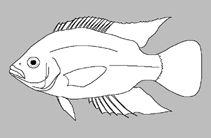 No image available for this species;
drawing shows typical species in Cichlidae.
Google afbeelding
drawing shows typical species in Cichlidae.
Classificatie / Namen Lokale namen | Synoniemen | Catalog of Fishes(Genus, Soort(en)) | ITIS | CoL | WoRMS | Cloffa
> Cichliformes (Cichlids, convict blennies) > Cichlidae (Cichlids) > Pseudocrenilabrinae
Etymology: Haplochromis: Greek, Haploos = single + Greek, chromis = a fish, perhaps a perch (Ref. 45335); katunzii: This species is named in honour of Mr. Egid F.B. Katunzi, the Director of the Mwanza Centre of the Tanzania Fisheries Research Institute (TAFIRI); Mr. Katunzi has collaborated with the Haplochromis Ecology Survey Team (HEST) of Leiden University since 1979, when he did his MSc. study on food preferences of four haplochromine species from the Mwanza Gulf; Mr. Katunzi published several papers on Lake Victoria haplochromines; during the past thirty years he has continuously supported the fieldwork of HEST (Ref. 85523).
Eponymy: Egid F B Katunzi is Director of the Mwanza Centre of the Tanzania Fisheries Research Institute. [...] (Ref. 128868), visit book page.
Etymology: Haplochromis: Greek, Haploos = single + Greek, chromis = a fish, perhaps a perch (Ref. 45335); katunzii: This species is named in honour of Mr. Egid F.B. Katunzi, the Director of the Mwanza Centre of the Tanzania Fisheries Research Institute (TAFIRI); Mr. Katunzi has collaborated with the Haplochromis Ecology Survey Team (HEST) of Leiden University since 1979, when he did his MSc. study on food preferences of four haplochromine species from the Mwanza Gulf; Mr. Katunzi published several papers on Lake Victoria haplochromines; during the past thirty years he has continuously supported the fieldwork of HEST (Ref. 85523).
Eponymy: Egid F B Katunzi is Director of the Mwanza Centre of the Tanzania Fisheries Research Institute. [...] (Ref. 128868), visit book page.
Milieu: milieu / Klimaatzone / Diepte / verspreidingsgebied Ecologie
; zoet water demersaal; diepte 2 - 15 m (Ref. 85523). Tropical
Verspreiding Gebieden | FAO regio's | Ecosystemen | Voorkomen | Verspreidingskaart | Introducties | Faunafri
Africa: Lake Victoria (Ref. 85523).
Grootte / Gewicht / Leeftijd
Korte beschrijving Determinatiesleutels | Morfologie | Morfometrie
Wervels: 28 - 31. Diagnosis: Haplochromis katunzii belongs to an assemblage of small sized (less than 9 cm standard length), relatively deep-bodied (body depth larger than 35% of standard length) micrognathic species with a moderately curved to straight dorsal head profile; the fish in this group have relatively small, mainly bicuspid, teeth in the oral jaws (Ref. 85523). It can be distinguished from Haplochromis paropius, Haplochromis cinctus and Haplochromis antleter by live colouration of sexually active males: Haplochromis katunzii is sandy-brown, and has rather distinct vertical bars; H. antleter is dusky coloured, has faint vertical bars and no or a faint lachrymal stripe; H. cinctus has a red dorsum, an orange to yellowish flank and dark vertical bars; H. paropius has a red dorsum, a greenish flank and is the only species of the assemblage that often has a mid-lateral band (Ref. 85523). Haplochromis katunzii has a larger cheek depth, 18.6-24.6% of head length, than H. antleter, 16.1-21.1% of head length, as well as a more pronounced mental prominence on the lower jaw; and it has a smaller interorbital width, 19.2-24.1% of head length, than H. cinctus, 24.3-27.2% of head length (Ref. 85523).
Body shape (shape guide): fusiform / normal.
Body shape (shape guide): fusiform / normal.
A benthic species found in sub-littoral areas of the Mwanza Gulf, mainly over mud bottoms; the depth range is 2-15 m (Ref. 85523). Before the ecological changes in Lake Victoria, this species fed mainly on detritus, but also included phytoplankton, insect larvae and copepods in its diet (Ref. 85523). Based on the egg dummies on the anal fin it is supposed to be a female mouth brooder (Ref. 85523).
Levenscyclus en paargedrag Maturiteit | Voortplanting | Paaien | Eieren | Fecunditeit | Larven
Based on the egg dummies on the anal fin it is supposed to be a female mouth brooder (Ref. 85523).
Hoofdreferentie
Upload uw referenties | Referenties | Coördinator : Kullander, Sven O. | Medewerkers
de Zeeuw, M.P., M. Mietes, P. Niemantsverdriet, S. ter Huurne and F. Witte, 2010. Seven new species of detritivorous and phytoplanktivorous haplochromines from Lake Victoria. Zool. Meded. Leiden 84:201-250. (Ref. 85523)
Status op de Rode Lijst van het IUCN (Ref. 130435: Version 2025-2 (Global))
Ernstig bedreigd (CR) (C2a(ii)); Date assessed: 31 March 2010
CITES
Not Evaluated
Gevaar voor de mens
Harmless
Gebruik door de mens
FAO - Publication: search | FishSource |
Meer informatie
Trofische ecologie
Voedsel (prooien)
Dieetsamenstelling
Voedselconsumptie
Voedselrantsoenen
Predatoren
Voedsel (prooien)
Dieetsamenstelling
Voedselconsumptie
Voedselrantsoenen
Predatoren
Populatiedynamica
Groeiparameters
Max. leeftijden / maten
Lengte-gewicht rel.
Lengte-lengte rel.
Lengtefrequenties
Massaconversie
Rekrutering
Abundantie
Groeiparameters
Max. leeftijden / maten
Lengte-gewicht rel.
Lengte-lengte rel.
Lengtefrequenties
Massaconversie
Rekrutering
Abundantie
Levenscyclus
Voortplanting
Maturiteit
Rijpheid/kieuwen rel.
Fecunditeit
Paaien
Paaibestanden
Eieren
Ontwikkeling van de eieren
Larven
Larvale populatiedynamiek
Voortplanting
Maturiteit
Rijpheid/kieuwen rel.
Fecunditeit
Paaien
Paaibestanden
Eieren
Ontwikkeling van de eieren
Larven
Larvale populatiedynamiek
Anatomie
Kieuwoppervlak
Hersenen
Otoliet
Kieuwoppervlak
Hersenen
Otoliet
Fysiologie
Lichaamssamenstelling
Voedingsstoffen
Zuurstofverbruik
Type zwemmen
Zwemsnelheid
Visuele pigmenten
Vis geluid
Ziekten en parasieten
Toxiciteit (LC50)
Lichaamssamenstelling
Voedingsstoffen
Zuurstofverbruik
Type zwemmen
Zwemsnelheid
Visuele pigmenten
Vis geluid
Ziekten en parasieten
Toxiciteit (LC50)
Genetica
genoom
Genetica
Heterozygositeit
Erfelijkheid
Genetische diversiteit
genoom
Genetica
Heterozygositeit
Erfelijkheid
Genetische diversiteit
Menselijk gerelateerd
Aquacultuursystemen
Aquacultuurprofielen
Kweeklijnen
Ciguatera gevallen
Postzegels, munten, diversen.
Aquacultuursystemen
Aquacultuurprofielen
Kweeklijnen
Ciguatera gevallen
Postzegels, munten, diversen.
Tools
Speciale rapporten
Bekijk gegevens voor het houden in een aquarium | Bekijk Fact Sheets voor de soort | Bekijk Aquacultuur Fact Sheets
Download XML
Internetbronnen
AFORO (otoliths) | Aquatic Commons | BHL | Cloffa | Websites from users | Bekijk FishWatcher | CISTI | Catalog of Fishes: Genus, Soort(en) | DiscoverLife | ECOTOX | FAO - Publication: search | Faunafri | Fishipedia | Fishtrace | GloBI | Google Books | Google Scholar | Google | IGFA World Record | OneZoom | Open Tree of Life | Otolith Atlas of Taiwan Fishes | PubMed | Reef Life Survey | Socotra Atlas | TreeBase | Tree of Life | Wikipedia: ga naar, zoek | World Records Freshwater Fishing | Zoobank | Zoological Record
Schattingen op basis van modellen
Fylogenetische diversiteitsindex (Ref. 82804): PD50 = 0.5000 [Uniqueness, from 0.5 = low to 2.0 = high].
Bayesian length-weight: a=0.01445 (0.00671 - 0.03113), b=2.99 (2.82 - 3.16), in cm total length, based on LWR estimates for this (Sub)family-body shape (Ref. 93245).
Trofisch niveau (Ref. 69278): 3.3 ±0.4 se; based on size and trophs of closest relatives