



Haplochromis katunzii ter Huurne & Witte, 2010
muatnaik fotos/gambar dan video
imej Google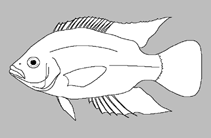 No image available for this species;
drawing shows typical species in Cichlidae.
imej Google
drawing shows typical species in Cichlidae.
klasifikasi / Nama Nama-nama umum | Sinonim (persamaan) | Catalog of Fishes(Marga, Jenis) | ITIS | CoL | WoRMS | Cloffa
> Cichliformes (Cichlids, convict blennies) > Cichlidae (Cichlids) > Pseudocrenilabrinae
Etymology: Haplochromis: Greek, Haploos = single + Greek, chromis = a fish, perhaps a perch (Ref. 45335); katunzii: This species is named in honour of Mr. Egid F.B. Katunzi, the Director of the Mwanza Centre of the Tanzania Fisheries Research Institute (TAFIRI); Mr. Katunzi has collaborated with the Haplochromis Ecology Survey Team (HEST) of Leiden University since 1979, when he did his MSc. study on food preferences of four haplochromine species from the Mwanza Gulf; Mr. Katunzi published several papers on Lake Victoria haplochromines; during the past thirty years he has continuously supported the fieldwork of HEST (Ref. 85523).
Eponymy: Egid F B Katunzi is Director of the Mwanza Centre of the Tanzania Fisheries Research Institute. [...] (Ref. 128868), visit book page.
Etymology: Haplochromis: Greek, Haploos = single + Greek, chromis = a fish, perhaps a perch (Ref. 45335); katunzii: This species is named in honour of Mr. Egid F.B. Katunzi, the Director of the Mwanza Centre of the Tanzania Fisheries Research Institute (TAFIRI); Mr. Katunzi has collaborated with the Haplochromis Ecology Survey Team (HEST) of Leiden University since 1979, when he did his MSc. study on food preferences of four haplochromine species from the Mwanza Gulf; Mr. Katunzi published several papers on Lake Victoria haplochromines; during the past thirty years he has continuously supported the fieldwork of HEST (Ref. 85523).
Eponymy: Egid F B Katunzi is Director of the Mwanza Centre of the Tanzania Fisheries Research Institute. [...] (Ref. 128868), visit book page.
Lingkungan: lingkungan / zona iklim / kisaran kedalaman / jangkauan distribusi Ekologi
; air tawar dasar (demersal); kisaran kedalaman 2 - 15 m (Ref. 85523). Tropical
Penyebaran Wilayah | Daerah-daerah FAO | Ekosistem | Kemunculan | peta titik | Introduksi | Faunafri
Africa: Lake Victoria (Ref. 85523).
Ukuran / Berat / umur
deskripsi pendek Kunci identifiaksi (pengenalan) | Morfologi | Morfometrik
vertebrata, bertulang belakang: 28 - 31. Diagnosis: Haplochromis katunzii belongs to an assemblage of small sized (less than 9 cm standard length), relatively deep-bodied (body depth larger than 35% of standard length) micrognathic species with a moderately curved to straight dorsal head profile; the fish in this group have relatively small, mainly bicuspid, teeth in the oral jaws (Ref. 85523). It can be distinguished from Haplochromis paropius, Haplochromis cinctus and Haplochromis antleter by live colouration of sexually active males: Haplochromis katunzii is sandy-brown, and has rather distinct vertical bars; H. antleter is dusky coloured, has faint vertical bars and no or a faint lachrymal stripe; H. cinctus has a red dorsum, an orange to yellowish flank and dark vertical bars; H. paropius has a red dorsum, a greenish flank and is the only species of the assemblage that often has a mid-lateral band (Ref. 85523). Haplochromis katunzii has a larger cheek depth, 18.6-24.6% of head length, than H. antleter, 16.1-21.1% of head length, as well as a more pronounced mental prominence on the lower jaw; and it has a smaller interorbital width, 19.2-24.1% of head length, than H. cinctus, 24.3-27.2% of head length (Ref. 85523).
Body shape (shape guide): fusiform / normal.
Body shape (shape guide): fusiform / normal.
A benthic species found in sub-littoral areas of the Mwanza Gulf, mainly over mud bottoms; the depth range is 2-15 m (Ref. 85523). Before the ecological changes in Lake Victoria, this species fed mainly on detritus, but also included phytoplankton, insect larvae and copepods in its diet (Ref. 85523). Based on the egg dummies on the anal fin it is supposed to be a female mouth brooder (Ref. 85523).
Siklus hidup dan perilaku kawin Kematangan | Reproduksi, perkembang biakan | Pemijahan | telur-telur | Fekunditas | Larva
Based on the egg dummies on the anal fin it is supposed to be a female mouth brooder (Ref. 85523).
rujukan utama
Unggah referensi Anda | Acuan | Koordinator : Kullander, Sven O. | mitra
de Zeeuw, M.P., M. Mietes, P. Niemantsverdriet, S. ter Huurne and F. Witte, 2010. Seven new species of detritivorous and phytoplanktivorous haplochromines from Lake Victoria. Zool. Meded. Leiden 84:201-250. (Ref. 85523)
Status IUCN Red List (Ref. 130435: Version 2025-2 (Global))
sangat terancam (CR) (C2a(ii)); Date assessed: 31 March 2010
CITES
Not Evaluated
ancaman kepada manusia
Harmless
penggunaan manusia
FAO - Publication: search | FishSource |
informasi lanjut
Dinamika populasi
Parameter pertumbuhan
Maks. usia / ukuran
Panjang-berat rel.
Panjang-panjang rel.
ukuran frekuensi
Konversi massa
pemulihan
Kelimpahan
Parameter pertumbuhan
Maks. usia / ukuran
Panjang-berat rel.
Panjang-panjang rel.
ukuran frekuensi
Konversi massa
pemulihan
Kelimpahan
Siklus hidup
Reproduksi, perkembang biakan
Kematangan
Kedewasaan / insang rel.
Fekunditas
Pemijahan
Agregasi pemijahan
telur-telur
pekembangan telor
Larva
Dinamika larva
Reproduksi, perkembang biakan
Kematangan
Kedewasaan / insang rel.
Fekunditas
Pemijahan
Agregasi pemijahan
telur-telur
pekembangan telor
Larva
Dinamika larva
Anatomi
Area insang
Otak
Otolith
Area insang
Otak
Otolith
Fisiologi
Komposisi tubuh
Nutrisi
Konsumsi oksigen
Jenis renang
Kecepatan berenang
Pigmen visual
Suara ikan
Penyakit & Parasit
Toksisitas (LC50)
Komposisi tubuh
Nutrisi
Konsumsi oksigen
Jenis renang
Kecepatan berenang
Pigmen visual
Suara ikan
Penyakit & Parasit
Toksisitas (LC50)
Genetika
genom
Genetika
Heterozigositas
Diturunkan
Keanekaragaman Genetik
genom
Genetika
Heterozigositas
Diturunkan
Keanekaragaman Genetik
Yang berhubungan dengan manusia
Sistem akuakultur
profil budidaya air
Strain
Kasus Ciguatera
Perangko, koin, dll.
Sistem akuakultur
profil budidaya air
Strain
Kasus Ciguatera
Perangko, koin, dll.
Alat, peralatan
E-book | Penuntun lapangan | tanda freqkuenci panjang | peringkat sejarah hidup | peta titik |
Tangkap-MSY |
laporan khas
muat turun XML
Sumber internet
AFORO (otoliths) | Aquatic Commons | BHL | Cloffa | Websites from users | semak peneliti ikan | CISTI | Catalog of Fishes: Marga, Jenis | DiscoverLife | ECOTOX | FAO - Publication: search | Faunafri | Fishipedia | Fishtrace | GloBI | Google Books | Google Scholar | Google | IGFA World Record | OneZoom | Open Tree of Life | Otolith Atlas of Taiwan Fishes | PubMed | Reef Life Survey | Socotra Atlas | TreeBase | Tree of Life | Wikipedia: pergi, Cari | World Records Freshwater Fishing | Zoobank | Catatan Zoologi
Estimasi berdasarkan model
Indeks keanekaragaman filogenetik (Acuan 82804): PD50 = 0.5000 [Uniqueness, from 0.5 = low to 2.0 = high].
Bayesian length-weight: a=0.01445 (0.00671 - 0.03113), b=2.99 (2.82 - 3.16), in cm total length, based on LWR estimates for this (Sub)family-body shape (Ref. 93245).
Tingkat Trofik (Acuan 69278): 3.3 ±0.4 se; based on size and trophs of closest relatives