



Centrophorus harrissoni McCulloch, 1915
Dumb gulper shark
Thêm quan sát của bạn vào Fish Watcher
| Native range | All suitable habitat | Point map | Year 2050 |

|
| This map was computer-generated and has not yet been reviewed. |
| Centrophorus harrissoni AquaMaps Data sources: GBIF OBIS |
Tải lên của bạn hình ảnh Và Video
Các tranh (Ảnh) | Google image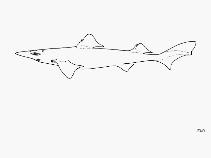 Centrophorus harrissoni
Hình ảnh của FAO
Các tranh (Ảnh) | Google image
Hình ảnh của FAO
Phân loại / Tên Tên thường gặp | Các synonym ( Các tên trùng) | Catalog of Fishes(Giống, Các loài) | ITIS | CoL | WoRMS | Cloffa
Lớp phụ Cá sụn (cá mập và cá đuối) (sharks and rays) > Squaliformes (Sleeper and dogfish sharks) > Centrophoridae (Gulper sharks)
Etymology: Centrophorus: centr[um] (L.), prickle or sharp point; phorus, from phoreus (Gr.), bearer or carrier, referring to grooved spines on dorsal fins (See ETYFish); harrissoni: In honor of biologist Charles Turnbull Harrisson (1869-1914), responsible for collecting and preserving many of the “more interesting” fishes during the “fishing experiments” of FIS Endeavour off the coast of Australia, 1909-1914 [he disappeared along with his ship and all hands in December 1914; no distress message had been given and no trace of the ship has been found] (See ETYFish).
Eponymy: Charles Turnbull Harrisson (1866*–1914) was a biologist from Tasmania who took part in the Mawson Antarctic Expedition (1911–1914) and was responsible for collecting many interesting fish species. [...] (Ref. 128868), visit book page.
Etymology: Centrophorus: centr[um] (L.), prickle or sharp point; phorus, from phoreus (Gr.), bearer or carrier, referring to grooved spines on dorsal fins (See ETYFish); harrissoni: In honor of biologist Charles Turnbull Harrisson (1869-1914), responsible for collecting and preserving many of the “more interesting” fishes during the “fishing experiments” of FIS Endeavour off the coast of Australia, 1909-1914 [he disappeared along with his ship and all hands in December 1914; no distress message had been given and no trace of the ship has been found] (See ETYFish).
Eponymy: Charles Turnbull Harrisson (1866*–1914) was a biologist from Tasmania who took part in the Mawson Antarctic Expedition (1911–1914) and was responsible for collecting many interesting fish species. [...] (Ref. 128868), visit book page.
Môi trường: môi trường / vùng khí hậu / Mức độ sâu / phạm vi phân phối Sinh thái học
biển tầng đáy biển sâu; mức độ sâu 250 - 790 m (Ref. 6871). Temperate; 26°S - 45°S, 111°E - 155°E
Sự phân bố Lãnh thổ | Các khu vực của FAO | Các hệ sinh thái | Những lần xuất hiện | Bản đồ điểm | Những chỉ dẫn | Faunafri
Eastern Indian Ocean: Western Australia. Southwest Pacific: New South Wales to Tasmania. Recorded in Norfolk Ridge, Three Kings Ridge amd Kermadec Ridge, extending the species eastern range (Ref. 89942). Record from Taiwan uncertain. This species is very close to Centrophorus uyato and may be a junior synonym of that species (Ref. 247).
Chiều dài lúc trưởng thành đầu tiên / Bộ gần gũi / Khối lượng (Trọng lượng) / Tuổi
Chín muồi sinh dục: Lm 99.0 range ? - ? cm
Max length : 111 cm TL con đực/không giới tính; (Ref. 76933)
Max length : 111 cm TL con đực/không giới tính; (Ref. 76933)
Mô tả ngắn gọn Khóa để định loại | Hình thái học | Sinh trắc học
A moderate-sized species distinguished by the following set of adult characters: length of pre-second dorsal 61.9-63.2% TL, 6.6-8.4 times the dorsal-caudal space; length of pre-first dorsal 30.4-32.0% TL; interdorsal space 18.2-20.6% TL, 2.2-2.6 times dorsal-caudal space; dorsal-caudal space 7.5-9.4% TL, 3.2-4.0 in pectoral-pelvic space; long and robust head, its length 22.4-24.6% TL, 2.7-3.0 times mouth width, its width 13.2-14.0% TL, 4.5-4.8 in pre-second dorsal length; width at anterior of nostrils 7.7-7.9% TL; long snout, its preoral length 11.4-12.4% TL, 2.0-2.2 times head height at anterior of mouth, 1.3-1.5 times mouth width, the horizontal preorbital length 7.1-8.2% TL, the horizontal prenarial length 4.4-5.4% TL; large mouth, its width 7.8-8.5% TL; moderately large pectoral fin, its anterior margin 11.9-12.4% TL, 2.3-2.4 times base length; large caudal fin, the dorsal caudal margin 19.1-19.5% TL; 2.1-2.5 times dorsal-caudal space; moderately large and tall first dorsal fin, its height 6.2-7.0% TL, with moderately robust spine, the base width 0.9-1.0% TL. The dorsal fins of juveniles have a distinct blackish oblique blotch anteriorly and a white blotch on the upper posterior margin; in adults a less distinct dark blotch, often apparent in fresh specimens and with a white blotch restricted to a narrow white posterior margin (occasionally indistinct in largest specimens). Adults with flank denticles flat, block-like, not overlapping, and crenulate. Females and immature males with upper teeth that are strongly oblique, similar in shape, but much smaller than lower teeth; in mature males upper teeth are erect, upright, becoming only slightly oblique laterally. 37-39/30 or 31 (n=3) tooth row count; 117-126 (mean 121.6, n=20) total vertebral centra; 53-59 (56.4, n=21) monospondylous precaudal centra; 29-37 (32.7, n=21) diplospondylous precaudal centra; 85-94 (89.1, n=21) precaudal centra (Ref. 76933).
Body shape (shape guide): elongated.
Body shape (shape guide): elongated.
Found on the continental slope (Ref. 6871, 75154).
Presumably ovoviviparous (Ref. 6871). Smallest mature male
recorded at 82.5 cm TL (Ref. 76933). Longevity assumed to be
high similar to close relative C. zeehaani with
estimated longevity exceeding 46 yrs (Ref. 107026).
Vòng đời và hành vi giao phối Chín muồi sinh dục | Sự tái sinh sản | Đẻ trứng | Các trứng | Sự sinh sản | Ấu trùng
Tài liệu tham khảo chính
Tải lên tài liệu tham khảo của bạn | Các tài liệu tham khảo | Người điều phối : Compagno, Leonard J.V. | Người cộng tác
Compagno, L.J.V., 1984. FAO Species Catalogue. Vol. 4. Sharks of the world. An annotated and illustrated catalogue of shark species known to date. Part 1 - Hexanchiformes to Lamniformes. FAO Fish. Synop. 125(4/1):1-249. Rome, FAO. (Ref. 247)
Tình trạng Sách đỏ IUCN (Ref. 130435: Version 2025-2 (Global))
Endangered (EN) (A2bd); Date assessed: 21 November 2019
CITES
Not Evaluated
Mối đe dọa đối với con người
Harmless
Sử dụng của con người
Các nghề cá: không ích lợi (thú vị)
FAO - Các nghề cá: hồ sơ loài; Publication: search | FishSource |
Thêm thông tin
Sinh thái dinh dưỡng
Thức ăn (con mồi)
Thành phần thức ăn
Thành phần thức ăn
Khẩu phần ăn
Các động vật ăn mồi
Thức ăn (con mồi)
Thành phần thức ăn
Thành phần thức ăn
Khẩu phần ăn
Các động vật ăn mồi
Sinh thái học
Sinh thái học
Sinh thái học
Biến động dân số
Các thông số tăng trưởng
Độ tuổi / kích thước tối đa
Chiều dài-trọng lượng tương đối
Chiều dài-chiều dài tương đối.
Chiều dài-tần số
Chuyển đổi khối lượng
Bổ xung
Sự phong phú
Các thông số tăng trưởng
Độ tuổi / kích thước tối đa
Chiều dài-trọng lượng tương đối
Chiều dài-chiều dài tương đối.
Chiều dài-tần số
Chuyển đổi khối lượng
Bổ xung
Sự phong phú
Vòng đời
Sự tái sinh sản
Chín muồi sinh dục
Độ trưởng thành/Mang liên quan
Sự sinh sản
Đẻ trứng
Tập hợp sinh sản
Các trứng
Sự phát triển của trứng
Ấu trùng
Sự biến động ấu trùng
Sự tái sinh sản
Chín muồi sinh dục
Độ trưởng thành/Mang liên quan
Sự sinh sản
Đẻ trứng
Tập hợp sinh sản
Các trứng
Sự phát triển của trứng
Ấu trùng
Sự biến động ấu trùng
Sự phân bố
Lãnh thổ
Các khu vực của FAO
Các hệ sinh thái
Những lần xuất hiện
Những chỉ dẫn
BRUVS - Video
Lãnh thổ
Các khu vực của FAO
Các hệ sinh thái
Những lần xuất hiện
Những chỉ dẫn
BRUVS - Video
Sinh lý học
Thành phần cơ thể
Chất dinh dưỡng
Thành phần ô-xy
Kiểu bơi
Tốc độ bơi
Sắc tố thị giác
Tiếng cá
Bệnh tật & Ký sinh trùng
Độc tính (LC50)
Thành phần cơ thể
Chất dinh dưỡng
Thành phần ô-xy
Kiểu bơi
Tốc độ bơi
Sắc tố thị giác
Tiếng cá
Bệnh tật & Ký sinh trùng
Độc tính (LC50)
Liên quan đến con người
Hệ thống nuôi trồng thủy sản
Các tổng quan nuôi trồng thủy sản
Các giống
Các trường hợp ngộ độc Ciguatera
Tem, tiền xu, v.v.
Hệ thống nuôi trồng thủy sản
Các tổng quan nuôi trồng thủy sản
Các giống
Các trường hợp ngộ độc Ciguatera
Tem, tiền xu, v.v.
Các công cụ
Sách điện tử | Hướng dẫn hiện trường | Tần suất chiều dài Wizard | Công cụ của vòng đời | Bản đồ điểm |
Bắt-MSY |
Báo cáo đặc biệt
Kiểm tra bảo trì bể cá | Kiểm tra các tờ thông tin về loài | Kiểm tra các tờ thông tin về nuôi trồng thủy sản
Tải xuống XML
Các nguồn internet
AFORO (otoliths) | Aquatic Commons | BHL | Cloffa | Websites from users | Check FishWatcher | CISTI | Catalog of Fishes: Giống, Các loài | DiscoverLife | ECOTOX | FAO - Các nghề cá: hồ sơ loài; Publication: search | Faunafri | Fishipedia | Fishtrace | GloBI | Google Books | Google Scholar | Google | IGFA World Record | OneZoom | Open Tree of Life | Otolith Atlas of Taiwan Fishes | PubMed | Reef Life Survey | Socotra Atlas | TreeBase | Cây Đời sống | Wikipedia: Go, tìm | World Records Freshwater Fishing | Zoobank | Tạp chí Zoological Record
Ước tính dựa trên mô hình
Nhiệt độ ưa thích (Tài liệu tham khảo 123201): 9.5 - 13.3, mean 10.4 °C (based on 22 cells).
Chỉ số đa dạng phát sinh loài (Tài liệu tham khảo 82804): PD50 = 0.5001 [Uniqueness, from 0.5 = low to 2.0 = high].
Bayesian length-weight: a=0.00251 (0.00120 - 0.00527), b=3.19 (3.01 - 3.37), in cm total length, based on LWR estimates for this (Sub)family-body shape (Ref. 93245).
Mức dinh dưỡng (Tài liệu tham khảo 69278): 4.3 ±0.3 se; based on size and trophs of closest relatives
Thích nghi nhanh (Tài liệu tham khảo 120179): thấp, thời gian nhân đôi của chủng quần tối thiểu là 4.5 - 14 năm (Fec assumed to be <100).
Chất dinh dưỡng (Ref. 124155): Calcium = 6.99 [1.35, 36.31] mg/100g; Iron = 0.217 [0.055, 0.667] mg/100g; Protein = 20.1 [17.7, 22.4] %; Omega3 = 0.463 [0.170, 1.408] g/100g; Selenium = 15.9 [4.6, 55.0] μg/100g; VitaminA = 22.4 [4.7, 111.5] μg/100g; Zinc = 0.444 [0.206, 0.839] mg/100g (wet weight);