



Centrophorus harrissoni McCulloch, 1915
Dumb gulper shark
Lägg till din observation i Fish Watcher
| Native range | All suitable habitat | Point map | Year 2050 |

|
| This map was computer-generated and has not yet been reviewed. |
| Centrophorus harrissoni AquaMaps Data sources: GBIF OBIS |
Ladda upp din foton och Videor
Bilder | Google image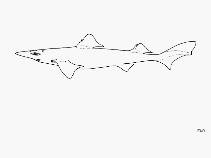 Centrophorus harrissoni
Bild av FAO
Bilder | Google image
Bild av FAO
Klassificering / Namn Populärnamn | synonymer | Catalog of Fishes(Släkte, Arter) | ITIS | CoL | WoRMS | Cloffa
Elasmobranchii (hajar och rockor) (sharks and rays) > Squaliformes (Sleeper and dogfish sharks) > Centrophoridae (Gulper sharks)
Etymology: Centrophorus: centr[um] (L.), prickle or sharp point; phorus, from phoreus (Gr.), bearer or carrier, referring to grooved spines on dorsal fins (See ETYFish); harrissoni: In honor of biologist Charles Turnbull Harrisson (1869-1914), responsible for collecting and preserving many of the “more interesting” fishes during the “fishing experiments” of FIS Endeavour off the coast of Australia, 1909-1914 [he disappeared along with his ship and all hands in December 1914; no distress message had been given and no trace of the ship has been found] (See ETYFish).
Eponymy: Charles Turnbull Harrisson (1866*–1914) was a biologist from Tasmania who took part in the Mawson Antarctic Expedition (1911–1914) and was responsible for collecting many interesting fish species. [...] (Ref. 128868), visit book page.
Etymology: Centrophorus: centr[um] (L.), prickle or sharp point; phorus, from phoreus (Gr.), bearer or carrier, referring to grooved spines on dorsal fins (See ETYFish); harrissoni: In honor of biologist Charles Turnbull Harrisson (1869-1914), responsible for collecting and preserving many of the “more interesting” fishes during the “fishing experiments” of FIS Endeavour off the coast of Australia, 1909-1914 [he disappeared along with his ship and all hands in December 1914; no distress message had been given and no trace of the ship has been found] (See ETYFish).
Eponymy: Charles Turnbull Harrisson (1866*–1914) was a biologist from Tasmania who took part in the Mawson Antarctic Expedition (1911–1914) and was responsible for collecting many interesting fish species. [...] (Ref. 128868), visit book page.
Miljö: miljö / Klimatzon / djupintervall / distributionsområde Ekologi
marina djupbottenlevande; djupintervall 250 - 790 m (Ref. 6871). Temperate; 26°S - 45°S, 111°E - 155°E
Utbredning Territorier | FAO områden | Ekosystem | Förekomster | Prickkarta | Utplanteringar | Faunafri
Eastern Indian Ocean: Western Australia. Southwest Pacific: New South Wales to Tasmania. Recorded in Norfolk Ridge, Three Kings Ridge amd Kermadec Ridge, extending the species eastern range (Ref. 89942). Record from Taiwan uncertain. This species is very close to Centrophorus uyato and may be a junior synonym of that species (Ref. 247).
Längd vid första mognad / Storlek / Vikt / Ålder
Kort beskrivning Bestämningsnycklar | Morfologi | Morfometri
A moderate-sized species distinguished by the following set of adult characters: length of pre-second dorsal 61.9-63.2% TL, 6.6-8.4 times the dorsal-caudal space; length of pre-first dorsal 30.4-32.0% TL; interdorsal space 18.2-20.6% TL, 2.2-2.6 times dorsal-caudal space; dorsal-caudal space 7.5-9.4% TL, 3.2-4.0 in pectoral-pelvic space; long and robust head, its length 22.4-24.6% TL, 2.7-3.0 times mouth width, its width 13.2-14.0% TL, 4.5-4.8 in pre-second dorsal length; width at anterior of nostrils 7.7-7.9% TL; long snout, its preoral length 11.4-12.4% TL, 2.0-2.2 times head height at anterior of mouth, 1.3-1.5 times mouth width, the horizontal preorbital length 7.1-8.2% TL, the horizontal prenarial length 4.4-5.4% TL; large mouth, its width 7.8-8.5% TL; moderately large pectoral fin, its anterior margin 11.9-12.4% TL, 2.3-2.4 times base length; large caudal fin, the dorsal caudal margin 19.1-19.5% TL; 2.1-2.5 times dorsal-caudal space; moderately large and tall first dorsal fin, its height 6.2-7.0% TL, with moderately robust spine, the base width 0.9-1.0% TL. The dorsal fins of juveniles have a distinct blackish oblique blotch anteriorly and a white blotch on the upper posterior margin; in adults a less distinct dark blotch, often apparent in fresh specimens and with a white blotch restricted to a narrow white posterior margin (occasionally indistinct in largest specimens). Adults with flank denticles flat, block-like, not overlapping, and crenulate. Females and immature males with upper teeth that are strongly oblique, similar in shape, but much smaller than lower teeth; in mature males upper teeth are erect, upright, becoming only slightly oblique laterally. 37-39/30 or 31 (n=3) tooth row count; 117-126 (mean 121.6, n=20) total vertebral centra; 53-59 (56.4, n=21) monospondylous precaudal centra; 29-37 (32.7, n=21) diplospondylous precaudal centra; 85-94 (89.1, n=21) precaudal centra (Ref. 76933).
Body shape (shape guide): elongated.
Body shape (shape guide): elongated.
Found on the continental slope (Ref. 6871, 75154).
Presumably ovoviviparous (Ref. 6871). Smallest mature male
recorded at 82.5 cm TL (Ref. 76933). Longevity assumed to be
high similar to close relative C. zeehaani with
estimated longevity exceeding 46 yrs (Ref. 107026).
Livscykel och parningsbeteende Könsmognad | Reproduktion | Lek | Ägg | Fekunditet | Larver
Huvudreferens
Ladda upp dina referenser | referenser | Koordinator : Compagno, Leonard J.V. | Medarbetare
Compagno, L.J.V., 1984. FAO Species Catalogue. Vol. 4. Sharks of the world. An annotated and illustrated catalogue of shark species known to date. Part 1 - Hexanchiformes to Lamniformes. FAO Fish. Synop. 125(4/1):1-249. Rome, FAO. (Ref. 247)
Status på IUCN:s rödlista (Ref. 130435: Version 2025-2 (Global))
Endangered (EN) (A2bd); Date assessed: 21 November 2019
CITES
Not Evaluated
Hot mot människor
Harmless
Mänskliga användningsområden
Fiskeri: saknar intresse
FAO - fiskeri: artprofil; Publication: search | FishSource |
Ytterligare information
Trofisk ekologi
Livsmedelsartiklar (preys)
Födosammansättning
Födointag
Matransoner
Predatorer
Livsmedelsartiklar (preys)
Födosammansättning
Födointag
Matransoner
Predatorer
Ekologi
Ekologi
Ekologi
Populationsdynamik
Tillväxtparametrar
Max. åldrar / storlekar
Längd-vikt rel.
Längd-längd rel.
Längd-frekvenser
Massakonvertering
Rekrytering
Abundans
Tillväxtparametrar
Max. åldrar / storlekar
Längd-vikt rel.
Längd-längd rel.
Längd-frekvenser
Massakonvertering
Rekrytering
Abundans
Livscykel
Reproduktion
Könsmognad
Mognad/Gills rel.
Fekunditet
Lek
Lekande aggregat
Ägg
Utveckling av ägg
Larver
Larvdynamik
Reproduktion
Könsmognad
Mognad/Gills rel.
Fekunditet
Lek
Lekande aggregat
Ägg
Utveckling av ägg
Larver
Larvdynamik
Fysiologi
Kroppssammansättning
Näringsämnen
Syreförbrukning
Typ av simning
Simhastighet
Visuella pigment
Ljud från fisk
Sjukdomar & Parasiter
Toxicitet (LC50)
Kroppssammansättning
Näringsämnen
Syreförbrukning
Typ av simning
Simhastighet
Visuella pigment
Ljud från fisk
Sjukdomar & Parasiter
Toxicitet (LC50)
Människorelaterad
Vattenbrukssystem
Vattenbruksprofiler
Avelslinjer
Ciguatera-fall
Frimärken, mynt, diverse.
Vattenbrukssystem
Vattenbruksprofiler
Avelslinjer
Ciguatera-fall
Frimärken, mynt, diverse.
Verktyg
Särskilda rapporter
Kontrollera för underhåll av akvarium | Kontrollera om det finns faktablad om arter | Kontrollera om det finns faktablad om vattenbruk
Ladda ner XML
Internet-källor
AFORO (otoliths) | Aquatic Commons | BHL | Cloffa | Websites from users | Check FishWatcher | CISTI | Catalog of Fishes: Släkte, Arter | DiscoverLife | ECOTOX | FAO - fiskeri: artprofil; Publication: search | Faunafri | Fishipedia | Fishtrace | GloBI | Google Books | Google Scholar | Google | IGFA World Record | OneZoom | Open Tree of Life | Otolith Atlas of Taiwan Fishes | PubMed | Reef Life Survey | Socotra Atlas | TreeBase | Tree of Life | Wikipedia: Go, sök | World Records Freshwater Fishing | Zoobank | Zoologiskt register
Uppskattningar baserade på modeller
Önskad temperatur (Ref. 123201): 9.5 - 13.3, mean 10.4 °C (based on 22 cells).
Index för fylogenetisk mångfald (Ref. 82804): PD50 = 0.5001 [Uniqueness, from 0.5 = low to 2.0 = high].
Bayesian length-weight: a=0.00251 (0.00120 - 0.00527), b=3.19 (3.01 - 3.37), in cm total length, based on LWR estimates for this (Sub)family-body shape (Ref. 93245).
Trofisk nivå (Ref. 69278): 4.3 ±0.3 se; based on size and trophs of closest relatives
Resiliens (Ref. 120179): Låg, lägsta populationsfördubblingstid 4,5-14 år (Fec assumed to be <100).
Näringsämnen (Ref. 124155): Calcium = 6.99 [1.35, 36.31] mg/100g; Iron = 0.217 [0.055, 0.667] mg/100g; Protein = 20.1 [17.7, 22.4] %; Omega3 = 0.463 [0.170, 1.408] g/100g; Selenium = 15.9 [4.6, 55.0] μg/100g; VitaminA = 22.4 [4.7, 111.5] μg/100g; Zinc = 0.444 [0.206, 0.839] mg/100g (wet weight);