



Centrophorus harrissoni McCulloch, 1915
Dumb gulper shark
Waarneming toevoegen in Fish Watcher
| Native range | All suitable habitat | Point map | Year 2050 |

|
| This map was computer-generated and has not yet been reviewed. |
| Centrophorus harrissoni AquaMaps Data sources: GBIF OBIS |
Uploaden van uw Foto's en video's
Afbeeldingen | Google afbeelding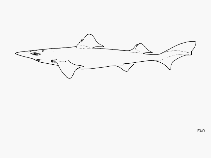 Centrophorus harrissoni
Afbeelding van FAO
Afbeeldingen | Google afbeelding
Afbeelding van FAO
Classificatie / Namen Lokale namen | Synoniemen | Catalog of Fishes(Genus, Soort(en)) | ITIS | CoL | WoRMS | Cloffa
Elasmobranchii (haaien en roggen) (sharks and rays) > Squaliformes (Sleeper and dogfish sharks) > Centrophoridae (Gulper sharks)
Etymology: Centrophorus: centr[um] (L.), prickle or sharp point; phorus, from phoreus (Gr.), bearer or carrier, referring to grooved spines on dorsal fins (See ETYFish); harrissoni: In honor of biologist Charles Turnbull Harrisson (1869-1914), responsible for collecting and preserving many of the “more interesting” fishes during the “fishing experiments” of FIS Endeavour off the coast of Australia, 1909-1914 [he disappeared along with his ship and all hands in December 1914; no distress message had been given and no trace of the ship has been found] (See ETYFish).
Eponymy: Charles Turnbull Harrisson (1866*–1914) was a biologist from Tasmania who took part in the Mawson Antarctic Expedition (1911–1914) and was responsible for collecting many interesting fish species. [...] (Ref. 128868), visit book page.
Etymology: Centrophorus: centr[um] (L.), prickle or sharp point; phorus, from phoreus (Gr.), bearer or carrier, referring to grooved spines on dorsal fins (See ETYFish); harrissoni: In honor of biologist Charles Turnbull Harrisson (1869-1914), responsible for collecting and preserving many of the “more interesting” fishes during the “fishing experiments” of FIS Endeavour off the coast of Australia, 1909-1914 [he disappeared along with his ship and all hands in December 1914; no distress message had been given and no trace of the ship has been found] (See ETYFish).
Eponymy: Charles Turnbull Harrisson (1866*–1914) was a biologist from Tasmania who took part in the Mawson Antarctic Expedition (1911–1914) and was responsible for collecting many interesting fish species. [...] (Ref. 128868), visit book page.
Milieu: milieu / Klimaatzone / Diepte / verspreidingsgebied Ecologie
marien bathydemersaal; diepte 250 - 790 m (Ref. 6871). Temperate; 26°S - 45°S, 111°E - 155°E
Verspreiding Gebieden | FAO regio's | Ecosystemen | Voorkomen | Verspreidingskaart | Introducties | Faunafri
Eastern Indian Ocean: Western Australia. Southwest Pacific: New South Wales to Tasmania. Recorded in Norfolk Ridge, Three Kings Ridge amd Kermadec Ridge, extending the species eastern range (Ref. 89942). Record from Taiwan uncertain. This species is very close to Centrophorus uyato and may be a junior synonym of that species (Ref. 247).
Lengte bij maturiteit / Grootte / Gewicht / Leeftijd
Maturiteit: Lm 99.0 range ? - ? cm
Max length : 111 cm TL mannelijk / geslacht onbekend; (Ref. 76933)
Max length : 111 cm TL mannelijk / geslacht onbekend; (Ref. 76933)
Korte beschrijving Determinatiesleutels | Morfologie | Morfometrie
A moderate-sized species distinguished by the following set of adult characters: length of pre-second dorsal 61.9-63.2% TL, 6.6-8.4 times the dorsal-caudal space; length of pre-first dorsal 30.4-32.0% TL; interdorsal space 18.2-20.6% TL, 2.2-2.6 times dorsal-caudal space; dorsal-caudal space 7.5-9.4% TL, 3.2-4.0 in pectoral-pelvic space; long and robust head, its length 22.4-24.6% TL, 2.7-3.0 times mouth width, its width 13.2-14.0% TL, 4.5-4.8 in pre-second dorsal length; width at anterior of nostrils 7.7-7.9% TL; long snout, its preoral length 11.4-12.4% TL, 2.0-2.2 times head height at anterior of mouth, 1.3-1.5 times mouth width, the horizontal preorbital length 7.1-8.2% TL, the horizontal prenarial length 4.4-5.4% TL; large mouth, its width 7.8-8.5% TL; moderately large pectoral fin, its anterior margin 11.9-12.4% TL, 2.3-2.4 times base length; large caudal fin, the dorsal caudal margin 19.1-19.5% TL; 2.1-2.5 times dorsal-caudal space; moderately large and tall first dorsal fin, its height 6.2-7.0% TL, with moderately robust spine, the base width 0.9-1.0% TL. The dorsal fins of juveniles have a distinct blackish oblique blotch anteriorly and a white blotch on the upper posterior margin; in adults a less distinct dark blotch, often apparent in fresh specimens and with a white blotch restricted to a narrow white posterior margin (occasionally indistinct in largest specimens). Adults with flank denticles flat, block-like, not overlapping, and crenulate. Females and immature males with upper teeth that are strongly oblique, similar in shape, but much smaller than lower teeth; in mature males upper teeth are erect, upright, becoming only slightly oblique laterally. 37-39/30 or 31 (n=3) tooth row count; 117-126 (mean 121.6, n=20) total vertebral centra; 53-59 (56.4, n=21) monospondylous precaudal centra; 29-37 (32.7, n=21) diplospondylous precaudal centra; 85-94 (89.1, n=21) precaudal centra (Ref. 76933).
Body shape (shape guide): elongated.
Body shape (shape guide): elongated.
Found on the continental slope (Ref. 6871, 75154).
Presumably ovoviviparous (Ref. 6871). Smallest mature male
recorded at 82.5 cm TL (Ref. 76933). Longevity assumed to be
high similar to close relative C. zeehaani with
estimated longevity exceeding 46 yrs (Ref. 107026).
Levenscyclus en paargedrag Maturiteit | Voortplanting | Paaien | Eieren | Fecunditeit | Larven
Hoofdreferentie
Upload uw referenties | Referenties | Coördinator : Compagno, Leonard J.V. | Medewerkers
Compagno, L.J.V., 1984. FAO Species Catalogue. Vol. 4. Sharks of the world. An annotated and illustrated catalogue of shark species known to date. Part 1 - Hexanchiformes to Lamniformes. FAO Fish. Synop. 125(4/1):1-249. Rome, FAO. (Ref. 247)
Status op de Rode Lijst van het IUCN (Ref. 130435: Version 2025-2 (Global))
Bedreigd (EN) (A2bd); Date assessed: 21 November 2019
CITES
Not Evaluated
Gevaar voor de mens
Harmless
Gebruik door de mens
Visserij: van geen belang
FAO - visserij: soortsprofiel; Publication: search | FishSource |
Meer informatie
Trofische ecologie
Voedsel (prooien)
Dieetsamenstelling
Voedselconsumptie
Voedselrantsoenen
Predatoren
Voedsel (prooien)
Dieetsamenstelling
Voedselconsumptie
Voedselrantsoenen
Predatoren
Ecologie
Ecologie
Ecologie
Populatiedynamica
Groeiparameters
Max. leeftijden / maten
Lengte-gewicht rel.
Lengte-lengte rel.
Lengtefrequenties
Massaconversie
Rekrutering
Abundantie
Groeiparameters
Max. leeftijden / maten
Lengte-gewicht rel.
Lengte-lengte rel.
Lengtefrequenties
Massaconversie
Rekrutering
Abundantie
Levenscyclus
Voortplanting
Maturiteit
Rijpheid/kieuwen rel.
Fecunditeit
Paaien
Paaibestanden
Eieren
Ontwikkeling van de eieren
Larven
Larvale populatiedynamiek
Voortplanting
Maturiteit
Rijpheid/kieuwen rel.
Fecunditeit
Paaien
Paaibestanden
Eieren
Ontwikkeling van de eieren
Larven
Larvale populatiedynamiek
Fysiologie
Lichaamssamenstelling
Voedingsstoffen
Zuurstofverbruik
Type zwemmen
Zwemsnelheid
Visuele pigmenten
Vis geluid
Ziekten en parasieten
Toxiciteit (LC50)
Lichaamssamenstelling
Voedingsstoffen
Zuurstofverbruik
Type zwemmen
Zwemsnelheid
Visuele pigmenten
Vis geluid
Ziekten en parasieten
Toxiciteit (LC50)
Menselijk gerelateerd
Aquacultuursystemen
Aquacultuurprofielen
Kweeklijnen
Ciguatera gevallen
Postzegels, munten, diversen.
Aquacultuursystemen
Aquacultuurprofielen
Kweeklijnen
Ciguatera gevallen
Postzegels, munten, diversen.
Tools
Speciale rapporten
Bekijk gegevens voor het houden in een aquarium | Bekijk Fact Sheets voor de soort | Bekijk Aquacultuur Fact Sheets
Download XML
Internetbronnen
AFORO (otoliths) | Aquatic Commons | BHL | Cloffa | Websites from users | Bekijk FishWatcher | CISTI | Catalog of Fishes: Genus, Soort(en) | DiscoverLife | ECOTOX | FAO - visserij: soortsprofiel; Publication: search | Faunafri | Fishipedia | Fishtrace | GloBI | Google Books | Google Scholar | Google | IGFA World Record | OneZoom | Open Tree of Life | Otolith Atlas of Taiwan Fishes | PubMed | Reef Life Survey | Socotra Atlas | TreeBase | Tree of Life | Wikipedia: ga naar, zoek | World Records Freshwater Fishing | Zoobank | Zoological Record
Schattingen op basis van modellen
Gewenste temperatuur (Ref. 123201): 9.5 - 13.3, mean 10.4 °C (based on 22 cells).
Fylogenetische diversiteitsindex (Ref. 82804): PD50 = 0.5001 [Uniqueness, from 0.5 = low to 2.0 = high].
Bayesian length-weight: a=0.00251 (0.00120 - 0.00527), b=3.19 (3.01 - 3.37), in cm total length, based on LWR estimates for this (Sub)family-body shape (Ref. 93245).
Trofisch niveau (Ref. 69278): 4.3 ±0.3 se; based on size and trophs of closest relatives
Weerstandsvermogen (Ref. 120179): laag, minimale populatieverdubbelingstijd 4,5-14 jaar (Fec assumed to be <100).
Voedingsstoffen (Ref. 124155): Calcium = 6.99 [1.35, 36.31] mg/100g; Iron = 0.217 [0.055, 0.667] mg/100g; Protein = 20.1 [17.7, 22.4] %; Omega3 = 0.463 [0.170, 1.408] g/100g; Selenium = 15.9 [4.6, 55.0] μg/100g; VitaminA = 22.4 [4.7, 111.5] μg/100g; Zinc = 0.444 [0.206, 0.839] mg/100g (wet weight);