



Centrophorus granulosus (Bloch & Schneider, 1801)
Gulper shark
Ajouter votre observation dans Fish Watcher
| Native range | All suitable habitat | Point map | Year 2050 |

|
| This map was computer-generated and has not yet been reviewed. |
| Centrophorus granulosus AquaMaps Data sources: GBIF OBIS |
Envoyez vos Photos et vidéos
Images | Images Google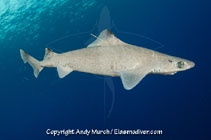 Centrophorus granulosus
Photo de Murch, A.
Images | Images Google
Photo de Murch, A.
Classification / Noms Noms communs | Synonymes | Catalog of Fishes(Genre, Espèce) | ITIS | CoL | WoRMS | Cloffa
Élasmobranches (requins et raies) (sharks and rays) > Squaliformes (Sleeper and dogfish sharks) > Centrophoridae (Gulper sharks)
Etymology: Centrophorus: centr[um] (L.), prickle or sharp point; phorus, from phoreus (Gr.), bearer or carrier, referring to grooved spines on dorsal fins (See ETYFish); granulosus: granum (L.), seed or grain; -osus, Latin suffix connoting fullness, referring to its granular brown skin (See ETYFish).
More on authors: Bloch & Schneider.
Etymology: Centrophorus: centr[um] (L.), prickle or sharp point; phorus, from phoreus (Gr.), bearer or carrier, referring to grooved spines on dorsal fins (See ETYFish); granulosus: granum (L.), seed or grain; -osus, Latin suffix connoting fullness, referring to its granular brown skin (See ETYFish).
More on authors: Bloch & Schneider.
Environnement : milieu / zone climatique / profondeur / gamme de distribution Écologie
marin bathydémersal; profondeur 98 - 1700 m (Ref. 94782), usually 200 - 600 m (Ref. 247). Deep-water; 58°N - 43°S, 98°W - 156°E
Distribution Territoires | Zones FAO | Écosystèmes | Occurrences | Carte par point | Introductions | Faunafri
Circumglobal: all ocean basins except in the Eastern Pacific and in the Mediterranean.
Longueur à la première maturité / Taille / Poids / Âge
Maturité: Lm ? range ? - ? cm
Max length : 124 cm TL mâle / non sexé; (Ref. 94782); 165.0 cm TL (female)
Max length : 124 cm TL mâle / non sexé; (Ref. 94782); 165.0 cm TL (female)
Description synthétique Clés d'identification | Morphologie | Morphométrie
Vertèbres: 106 - 115. This species is distinguished by the following characters: large (>1.5 m maximum total length); body moderately robust; head moderately long (20.6-24.9% TL, 3.9-4.9 times in total length) and very robust; snout relatively short, horizontal preorbital length 4.8-8.1% TL, moderately rounded in dorsal view; first dorsal fin low and long, its height 4.4-6.5% TL, its soft length 11.0-16.6% TL), inner margin very long which is more than length from insertion of exposed spine to fin insertion; second dorsal fin large, similar in heigfree rear tip varying from slightly elongate in small individuals with free rear tip extension 0.9-2.2% TL in individuals < 70.0 cm TL, to moderately elongate in adults, 1.9-4.1% TL; lateral trunk denticles elevated on low, broad pedicel with strongly tricuspidate crowns in juveniles < 70.0 cm TL; denticles of large individuals low, not on pedicels, crown tear-drop shaped with one long posterior cusp; upper teeth of juveniles < 50.0 cm TL are strongly oblique; upper teeth of individuals > 70.0 cm TL with erect to slightly oblique cusps; lower teeth of all sizes are much larger than upper teeth, strongly oblique, blade-like; total vertebral centra 106-115; teeth 30-37/27-32; body uniformly brownish (sometimes greyish to greyish brown), slightly paler ventrally (Ref. 94782).
Cross section: oval.
Cross section: oval.
A common deepwater dogfish of the outer continental shelves and upper slopes, commonest below 200 m (Ref. 247); usually benthic and epibenthic at depths from 50-1440 m with most records from 200-600 m (Compagno, pers. comm. 07/07). Solitary (Ref. 26340). Adults feed mainly on bony fishes such as hake, epigonids, lanternfish, herring, smelts, cods, rattails, squid and crustaceans (Ref. 247, IUCN workshop 07/07). Males mature at about 105-118 cm TL (Ref. 94782). Ovoviviparous (Ref. 50449). This species is fished in Eastern Atlantic by bottom trawls, long lines, fixed bottom nets, hook and line and pelagic trawls; caught and discarded, or utilised from by-catch fisheries (IUCN discussion 07/07). Marketed smoked and dried salted for human consumption; also processed into fishmeal and a source of liver oil for squalene (Ref. 247).
Cycle de vie et comportement reproducteur Maturité | Reproduction | Frai | Œufs | Fécondité | Larves
Ovoviviparous, embryos feed solely on yolk (Ref. 50449). Young are born from 30 to 42 cm or more (Ref. 247). Distinct pairing with embrace (Ref. 205).
Référence principale
Téléchargez vos références | Références | Coordinateur : Compagno, Leonard J.V. | Collaborateurs
White, W.T., D.A. Ebert, G.J.P. Naylor, H.-H. Ho, P. Clerkin, A. Veríssimo and C.F. Cotton, 2013. Revision of the genus Centrophorus (Squaliformes: Centrophoridae): Part 1 -Redescription of Centrophorus granulosus (Bloch & Schneider), a senior synonym of C. acus and C. niaukang Teng. Zootaxa 3752(1):035-072. (Ref. 94782)
Statut dans la liste rouge de l'IUCN (Ref. 130435: Version 2025-2 (Global))
Menacé (EN) (A2bd); Date assessed: 27 February 2024
CITES
Not Evaluated
Menace pour l'homme
Harmless
Utilisations par l'homme
Pêcheries: intérêt commercial mineur
FAO - pêcheries: débarquements, Résumé espèce; Publication: search | FishSource | Sea Around Us
Plus d'informations
Écologie trophique
Aliments (proies)
Composition du régime alimentaire
Consommation alimentaire
Rations alimentaires
Prédateurs
Aliments (proies)
Composition du régime alimentaire
Consommation alimentaire
Rations alimentaires
Prédateurs
Dynamique des populations
Paramètres de croissance
Âges / tailles maximales
Longueur-poids rel.
Rel. longueur-longueur.
Fréquences de longueurs
Conversion de masse
Recrutement
Abondance
Paramètres de croissance
Âges / tailles maximales
Longueur-poids rel.
Rel. longueur-longueur.
Fréquences de longueurs
Conversion de masse
Recrutement
Abondance
Cycle de vie
Reproduction
Maturité
Maturité/épines rel.
Fécondité
Frai
Agrégats de frai
Œufs
Développement de l'œuf
Larves
Dynamique des populations larvaires
Reproduction
Maturité
Maturité/épines rel.
Fécondité
Frai
Agrégats de frai
Œufs
Développement de l'œuf
Larves
Dynamique des populations larvaires
Physiologie
Composition corporelle
Nutriments
Consommation d'oxygène
Type de natation
Vitesse de nage
Pigments visuels
Son de poisson
Maladies et parasites
Toxicité (CL50)
Composition corporelle
Nutriments
Consommation d'oxygène
Type de natation
Vitesse de nage
Pigments visuels
Son de poisson
Maladies et parasites
Toxicité (CL50)
Liées à l'homme
Systèmes d'aquaculture
Profils d'aquaculture
Souches
Cas de ciguatera
Timbres, pièces de monnaie, divers
Systèmes d'aquaculture
Profils d'aquaculture
Souches
Cas de ciguatera
Timbres, pièces de monnaie, divers
Outils
E-book | Guide de terrain | Clés d'identification | Générateur de fréquences de longueur | Outil de dynamique de population | Carte par point |
Capture-MSY |
Articles particuliers
Télécharger en XML
Sources Internet
AFORO (otoliths) | Aquatic Commons | BHL | Cloffa | Websites from users | FishWatcher | CISTI | Catalog of Fishes: Genre, Espèce | DiscoverLife | ECOTOX | FAO - pêcheries: débarquements, Résumé espèce; Publication: search | Faunafri | Fishipedia | Fishtrace | GloBI | Google Books | Google Scholar | Google | IGFA World Record | Bases de données nationales | OneZoom | Open Tree of Life | Otolith Atlas of Taiwan Fishes | PubMed | Reef Life Survey | Socotra Atlas | TreeBase | Arbre de Vie | Wikipedia: aller à, chercher | World Records Freshwater Fishing | Zoological Record
Estimations basées sur des modèles
Température préférée (Réf. 123201): 7.7 - 17.3, mean 11.4 °C (based on 1031 cells).
Indice de diversité phylogénétique (Réf. 82804): PD50 = 0.5001 [Uniqueness, from 0.5 = low to 2.0 = high].
Bayesian length-weight: a=0.00204 (0.00163 - 0.00256), b=3.21 (3.14 - 3.28), in cm total length, based on LWR estimates for this species (Ref. 93245).
Niveau trophique (Réf. 69278): 4.1 ±0.4 se; based on diet studies.
Generation time: 11.4 ( na - na) years. Estimated as median ln(3)/K based on 1 growth studies.
Résilience (Réf. 120179): Faible, temps minimum de doublement de population : 4,5 à 14 années (Fec assumed to be <100).
Nutriments (Ref. 124155): Calcium = 5.65 [1.11, 28.95] mg/100g; Iron = 0.304 [0.071, 0.977] mg/100g; Protein = 19.9 [17.6, 22.1] %; Omega3 = 0.279 [0.102, 0.876] g/100g; Selenium = 19.5 [6.0, 56.9] μg/100g; VitaminA = 8.25 [1.82, 38.80] μg/100g; Zinc = 0.248 [0.118, 0.466] mg/100g (wet weight);