



Centrophorus granulosus (Bloch & Schneider, 1801)
Gulper shark
Waarneming toevoegen in Fish Watcher
| Native range | All suitable habitat | Point map | Year 2050 |

|
| This map was computer-generated and has not yet been reviewed. |
| Centrophorus granulosus AquaMaps Data sources: GBIF OBIS |
Uploaden van uw Foto's en video's
Afbeeldingen | Google afbeelding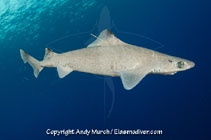 Centrophorus granulosus
Afbeelding van Murch, A.
Afbeeldingen | Google afbeelding
Afbeelding van Murch, A.
Classificatie / Namen Lokale namen | Synoniemen | Catalog of Fishes(Genus, Soort(en)) | ITIS | CoL | WoRMS | Cloffa
Elasmobranchii (haaien en roggen) (sharks and rays) > Squaliformes (Sleeper and dogfish sharks) > Centrophoridae (Gulper sharks)
Etymology: Centrophorus: centr[um] (L.), prickle or sharp point; phorus, from phoreus (Gr.), bearer or carrier, referring to grooved spines on dorsal fins (See ETYFish); granulosus: granum (L.), seed or grain; -osus, Latin suffix connoting fullness, referring to its granular brown skin (See ETYFish).
More on authors: Bloch & Schneider.
Etymology: Centrophorus: centr[um] (L.), prickle or sharp point; phorus, from phoreus (Gr.), bearer or carrier, referring to grooved spines on dorsal fins (See ETYFish); granulosus: granum (L.), seed or grain; -osus, Latin suffix connoting fullness, referring to its granular brown skin (See ETYFish).
More on authors: Bloch & Schneider.
Milieu: milieu / Klimaatzone / Diepte / verspreidingsgebied Ecologie
marien bathydemersaal; diepte 98 - 1700 m (Ref. 94782), usually 200 - 600 m (Ref. 247). Deep-water; 58°N - 43°S, 98°W - 156°E
Verspreiding Gebieden | FAO regio's | Ecosystemen | Voorkomen | Verspreidingskaart | Introducties | Faunafri
Circumglobal: all ocean basins except in the Eastern Pacific and in the Mediterranean.
Lengte bij maturiteit / Grootte / Gewicht / Leeftijd
Maturiteit: Lm ? range ? - ? cm
Max length : 124 cm TL mannelijk / geslacht onbekend; (Ref. 94782); 165.0 cm TL (female)
Max length : 124 cm TL mannelijk / geslacht onbekend; (Ref. 94782); 165.0 cm TL (female)
Korte beschrijving Determinatiesleutels | Morfologie | Morfometrie
Wervels: 106 - 115. This species is distinguished by the following characters: large (>1.5 m maximum total length); body moderately robust; head moderately long (20.6-24.9% TL, 3.9-4.9 times in total length) and very robust; snout relatively short, horizontal preorbital length 4.8-8.1% TL, moderately rounded in dorsal view; first dorsal fin low and long, its height 4.4-6.5% TL, its soft length 11.0-16.6% TL), inner margin very long which is more than length from insertion of exposed spine to fin insertion; second dorsal fin large, similar in heigfree rear tip varying from slightly elongate in small individuals with free rear tip extension 0.9-2.2% TL in individuals < 70.0 cm TL, to moderately elongate in adults, 1.9-4.1% TL; lateral trunk denticles elevated on low, broad pedicel with strongly tricuspidate crowns in juveniles < 70.0 cm TL; denticles of large individuals low, not on pedicels, crown tear-drop shaped with one long posterior cusp; upper teeth of juveniles < 50.0 cm TL are strongly oblique; upper teeth of individuals > 70.0 cm TL with erect to slightly oblique cusps; lower teeth of all sizes are much larger than upper teeth, strongly oblique, blade-like; total vertebral centra 106-115; teeth 30-37/27-32; body uniformly brownish (sometimes greyish to greyish brown), slightly paler ventrally (Ref. 94782).
Cross section: oval.
Cross section: oval.
A common deepwater dogfish of the outer continental shelves and upper slopes, commonest below 200 m (Ref. 247); usually benthic and epibenthic at depths from 50-1440 m with most records from 200-600 m (Compagno, pers. comm. 07/07). Solitary (Ref. 26340). Adults feed mainly on bony fishes such as hake, epigonids, lanternfish, herring, smelts, cods, rattails, squid and crustaceans (Ref. 247, IUCN workshop 07/07). Males mature at about 105-118 cm TL (Ref. 94782). Ovoviviparous (Ref. 50449). This species is fished in Eastern Atlantic by bottom trawls, long lines, fixed bottom nets, hook and line and pelagic trawls; caught and discarded, or utilised from by-catch fisheries (IUCN discussion 07/07). Marketed smoked and dried salted for human consumption; also processed into fishmeal and a source of liver oil for squalene (Ref. 247).
Levenscyclus en paargedrag Maturiteit | Voortplanting | Paaien | Eieren | Fecunditeit | Larven
Ovoviviparous, embryos feed solely on yolk (Ref. 50449). Young are born from 30 to 42 cm or more (Ref. 247). Distinct pairing with embrace (Ref. 205).
Hoofdreferentie
Upload uw referenties | Referenties | Coördinator : Compagno, Leonard J.V. | Medewerkers
White, W.T., D.A. Ebert, G.J.P. Naylor, H.-H. Ho, P. Clerkin, A. Veríssimo and C.F. Cotton, 2013. Revision of the genus Centrophorus (Squaliformes: Centrophoridae): Part 1 -Redescription of Centrophorus granulosus (Bloch & Schneider), a senior synonym of C. acus and C. niaukang Teng. Zootaxa 3752(1):035-072. (Ref. 94782)
Status op de Rode Lijst van het IUCN (Ref. 130435: Version 2025-2 (Global))
Bedreigd (EN) (A2bd); Date assessed: 27 February 2024
CITES
Not Evaluated
Gevaar voor de mens
Harmless
Gebruik door de mens
Visserij: van minder commercieel belang
FAO - visserij: aanvoer, soortsprofiel; Publication: search | FishSource | Sea Around Us
Meer informatie
Trofische ecologie
Voedsel (prooien)
Dieetsamenstelling
Voedselconsumptie
Voedselrantsoenen
Predatoren
Voedsel (prooien)
Dieetsamenstelling
Voedselconsumptie
Voedselrantsoenen
Predatoren
Populatiedynamica
Groeiparameters
Max. leeftijden / maten
Lengte-gewicht rel.
Lengte-lengte rel.
Lengtefrequenties
Massaconversie
Rekrutering
Abundantie
Groeiparameters
Max. leeftijden / maten
Lengte-gewicht rel.
Lengte-lengte rel.
Lengtefrequenties
Massaconversie
Rekrutering
Abundantie
Levenscyclus
Voortplanting
Maturiteit
Rijpheid/kieuwen rel.
Fecunditeit
Paaien
Paaibestanden
Eieren
Ontwikkeling van de eieren
Larven
Larvale populatiedynamiek
Voortplanting
Maturiteit
Rijpheid/kieuwen rel.
Fecunditeit
Paaien
Paaibestanden
Eieren
Ontwikkeling van de eieren
Larven
Larvale populatiedynamiek
Fysiologie
Lichaamssamenstelling
Voedingsstoffen
Zuurstofverbruik
Type zwemmen
Zwemsnelheid
Visuele pigmenten
Vis geluid
Ziekten en parasieten
Toxiciteit (LC50)
Lichaamssamenstelling
Voedingsstoffen
Zuurstofverbruik
Type zwemmen
Zwemsnelheid
Visuele pigmenten
Vis geluid
Ziekten en parasieten
Toxiciteit (LC50)
Menselijk gerelateerd
Aquacultuursystemen
Aquacultuurprofielen
Kweeklijnen
Ciguatera gevallen
Postzegels, munten, diversen.
Aquacultuursystemen
Aquacultuurprofielen
Kweeklijnen
Ciguatera gevallen
Postzegels, munten, diversen.
Tools
E-boek | Veldgids | Determinatiesleutels | Lengtefrequentie Tool | Levenscyclus tool | Verspreidingskaart |
Vangst-MSY |
Speciale rapporten
Bekijk gegevens voor het houden in een aquarium | Bekijk Fact Sheets voor de soort | Bekijk Aquacultuur Fact Sheets
Download XML
Internetbronnen
AFORO (otoliths) | Aquatic Commons | BHL | Cloffa | Websites from users | Bekijk FishWatcher | CISTI | Catalog of Fishes: Genus, Soort(en) | DiscoverLife | ECOTOX | FAO - visserij: aanvoer, soortsprofiel; Publication: search | Faunafri | Fishipedia | Fishtrace | GloBI | Google Books | Google Scholar | Google | IGFA World Record | Nationale databanken | OneZoom | Open Tree of Life | Otolith Atlas of Taiwan Fishes | PubMed | Reef Life Survey | Socotra Atlas | TreeBase | Tree of Life | Wikipedia: ga naar, zoek | World Records Freshwater Fishing | Zoological Record
Schattingen op basis van modellen
Gewenste temperatuur (Ref. 123201): 7.7 - 17.3, mean 11.4 °C (based on 1031 cells).
Fylogenetische diversiteitsindex (Ref. 82804): PD50 = 0.5001 [Uniqueness, from 0.5 = low to 2.0 = high].
Bayesian length-weight: a=0.00204 (0.00163 - 0.00256), b=3.21 (3.14 - 3.28), in cm total length, based on LWR estimates for this species (Ref. 93245).
Trofisch niveau (Ref. 69278): 4.1 ±0.4 se; based on diet studies.
Generation time: 11.4 ( na - na) years. Estimated as median ln(3)/K based on 1 growth studies.
Weerstandsvermogen (Ref. 120179): laag, minimale populatieverdubbelingstijd 4,5-14 jaar (Fec assumed to be <100).
Voedingsstoffen (Ref. 124155): Calcium = 5.65 [1.11, 28.95] mg/100g; Iron = 0.304 [0.071, 0.977] mg/100g; Protein = 19.9 [17.6, 22.1] %; Omega3 = 0.279 [0.102, 0.876] g/100g; Selenium = 19.5 [6.0, 56.9] μg/100g; VitaminA = 8.25 [1.82, 38.80] μg/100g; Zinc = 0.248 [0.118, 0.466] mg/100g (wet weight);