



Bathytoshia brevicaudata (Hutton, 1875)
Short-tail stingray
Lägg till din observation i Fish Watcher
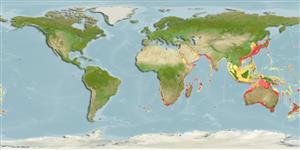
| Native range | All suitable habitat | Point map | Year 2050 |
|
| This map was computer-generated and has not yet been reviewed. |
| Bathytoshia brevicaudata AquaMaps Data sources: GBIF OBIS |
Klassificering / Namn Populärnamn | synonymer | Catalog of Fishes(Släkte, Arter) | ITIS | CoL | WoRMS | Cloffa
Elasmobranchii (hajar och rockor) (sharks and rays) > Myliobatiformes (Stingrays) > Dasyatidae (Stingrays) > Dasyatinae
Miljö: miljö / Klimatzon / djupintervall / distributionsområde Ekologi
marina; brackvatten bottenlevande; djupintervall 0 - 476 m (Ref. 5578), usually 0 - 200 m (Ref. 89422). Temperate; 15°C - 29°C (Ref. 130650)
Utbredning Territorier | FAO områden | Ekosystem | Förekomster | Prickkarta | Utplanteringar | Faunafri
Indo-West Pacific: antitropical; from southern Africa to New Zealand, and off Japan and Peter the Great Bay (eastern Russia).
Längd vid första mognad / Storlek / Vikt / Ålder
Könsmognad: Lm ?, range 120 - ? cm
Max length : 430 cm TL hane/ej könsbestämd; (Ref. 5578); common length : 125 cm TL hane/ej könsbestämd; (Ref. 9258)
Max length : 430 cm TL hane/ej könsbestämd; (Ref. 5578); common length : 125 cm TL hane/ej könsbestämd; (Ref. 9258)
Kort beskrivning Bestämningsnycklar | Morfologi | Morfometri
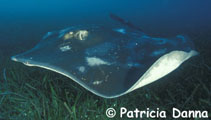
Taggstrålar i ryggfenan (totalt) : 0. This species is huge, plain-coloured, with a disc broad and rhombic, belly with transverse groove, tail short tapering strongly before caudal sting, thorns when present are confined to tail before sting, pectoral fin with an oblique rows of white spots dorsally; disc width ca. 1.1-1.2 times its length, very thick trunk; narrowly-rounded pectoral-fin apex; short snout, obtuse with tip barely extended and anterior margins weakly convex; small eyes with orbit length and spiracle 2.0-2.2 in snout length; broad interorbital space, up to 4 times orbit length in adults; mouth often with 5-7 oral papillae, deep labial furrows, weakly convex lower jaw; very broadly skirt-shaped nasal curtain, its margin fringed; oblique oval nostrils; smooth skin, no derml denticles, with specimens > 45 cm WD having a row of spear-shaped or starry-based thorns and tubercles on mid-line of tail before the caudal sting and the tail beyond this is covered with sharp thornlets; very broad tail depressed at the base, often shorter that width disc, often with one caudal sting, its ventral fold is short but prominent (extending to just beyond tip of sting), its dorsal fold reduced to a hard ridge; pelvic fins are rather small with narrowly-rounded apices. Colour of upper surface uniformly greyish brown and darkest on tail tip and above the eye; white inside of spiracles, pores around side of head and diagonal row of pores on each side of anterior disc; white ventrally; disc margin and undersurface of tail dusky (Ref. 114953).
Body shape (shape guide): other; Cross section: flattened.
Body shape (shape guide): other; Cross section: flattened.
Occurs offshore, on the outer shelf and uppermost slope; sometimes close inshore (Ref. 5578), in very shallow ( 0 m) depths (Ref. 26346). Found on sandy bottoms, in bays, harbors, and near rocky reefs (Ref. 12951). Often in aggregations (Ref. 12951). Feeds on fishes, bivalves, squid, and crustaceans (Ref. 12951). Ovoviviparous (Ref. 50449). Reputed to be the largest stingray in the world weighing more than 350,000 g (Ref. 6871). Frequently raises its tail in a scorpion-like fashion when approached, but is considered more as inquisitive rather than aggressive (Ref. 6871). The barbed tail however can inflict a severe or potentially fatal wound (Ref. 6871). Sometimes caught by anglers (Ref. 5578). It is parasitised by the monogenean Heterocotyle tokoloshei in the gills (Ref. 124053)
Livscykel och parningsbeteende Könsmognad | Reproduktion | Lek | Ägg | Fekunditet | Larver
Exhibit ovoviparity (aplacental viviparity), with embryos feeding initially on yolk, then receiving additional nourishment from the mother by indirect absorption of uterine fluid enriched with mucus, fat or protein through specialised structures (Ref. 50449). Distinct pairing with embrace (Ref. 205). During courtship, the male will hold onto the pectoral margin of a female (sometimes for hours) as she swims through the water. The male flips under the female and inserts a clasper. The male beats his tail from side to side to move the clasper backward and forward in the cloca. Copulation lasts 3-5 minutes. Males have been observed to nudge the female's abdomen during parturition. Viviparous, young born at about 36 cm WD (Ref. 6871).
Huvudreferens
Ladda upp dina referenser | referenser | Koordinator : McEachran, John | Medarbetare
Last, P.R., W.T. White, M.R. de Carvalho, B. Séret, M.F.W. Stehmann and G.J.P. Naylor, 2016. Rays of the world. CSIRO Publishing, Comstock Publishing Associates. i-ix + 1-790. (Ref. 114953)
Status på IUCN:s rödlista (Ref. 130435: Version 2025-2 (Global))
Least Concern (LC) ; Date assessed: 27 November 2020
CITES
Not Evaluated
Hot mot människor
Venomous (Ref. 4716)
Mänskliga användningsområden
Fiskeri: kommersiell; sportfisk: ja; Akvarium: Offentliga akvarier
FAO - Publication: search | FishSource |
Ytterligare information
Populationsdynamik
Tillväxtparametrar
Max. åldrar / storlekar
Längd-vikt rel.
Längd-längd rel.
Längd-frekvenser
Massakonvertering
Rekrytering
Abundans
Tillväxtparametrar
Max. åldrar / storlekar
Längd-vikt rel.
Längd-längd rel.
Längd-frekvenser
Massakonvertering
Rekrytering
Abundans
Livscykel
Reproduktion
Könsmognad
Mognad/Gills rel.
Fekunditet
Lek
Lekande aggregat
Ägg
Utveckling av ägg
Larver
Larvdynamik
Reproduktion
Könsmognad
Mognad/Gills rel.
Fekunditet
Lek
Lekande aggregat
Ägg
Utveckling av ägg
Larver
Larvdynamik
Fysiologi
Kroppssammansättning
Näringsämnen
Syreförbrukning
Typ av simning
Simhastighet
Visuella pigment
Ljud från fisk
Sjukdomar & Parasiter
Toxicitet (LC50)
Kroppssammansättning
Näringsämnen
Syreförbrukning
Typ av simning
Simhastighet
Visuella pigment
Ljud från fisk
Sjukdomar & Parasiter
Toxicitet (LC50)
Människorelaterad
Vattenbrukssystem
Vattenbruksprofiler
Avelslinjer
Ciguatera-fall
Frimärken, mynt, diverse.
Vattenbrukssystem
Vattenbruksprofiler
Avelslinjer
Ciguatera-fall
Frimärken, mynt, diverse.
Verktyg
Organisk frågesport | E-bok | Fälthandbok | Bestämningsnycklar | Längdfördelnings-verktyg | Livshistorie-verktyg | Prickkarta |
Fångst-MSY |
Särskilda rapporter
Kontrollera för underhåll av akvarium | Kontrollera om det finns faktablad om arter | Kontrollera om det finns faktablad om vattenbruk
Ladda ner XML
Internet-källor
AFORO (otoliths) | Aquatic Commons | BHL | Cloffa | Websites from users | Check FishWatcher | CISTI | Catalog of Fishes: Släkte, Arter | DiscoverLife | ECOTOX | FAO - Publication: search | Faunafri | Fishipedia | Fishtrace | GloBI | Google Books | Google Scholar | Google | IGFA World Record | OneZoom | Open Tree of Life | Otolith Atlas of Taiwan Fishes | PubMed | Reef Life Survey | Socotra Atlas | TreeBase | Tree of Life | Wikipedia: Go, sök | World Records Freshwater Fishing | Zoologiskt register
Uppskattningar baserade på modeller
Önskad temperatur (Ref. 123201): 14.6 - 28.5, mean 24.1 °C (based on 2002 cells).
Index för fylogenetisk mångfald (Ref. 82804): PD50 = 0.6250 [Uniqueness, from 0.5 = low to 2.0 = high].
Bayesian length-weight: a=0.00447 (0.00189 - 0.01058), b=3.12 (2.92 - 3.32), in cm total length, based on LWR estimates for this (Sub)family-body shape (Ref. 93245).
Trofisk nivå (Ref. 69278): 3.9 ±0.45 se; based on food items.
Näringsämnen (Ref. 124155): Calcium = 2.46 [0.37, 44.68] mg/100g; Iron = 0.194 [0.018, 2.273] mg/100g; Protein = 21.3 [18.7, 24.0] %; Omega3 = 0.362 [0.114, 1.026] g/100g; Selenium = 21.7 [4.4, 114.2] μg/100g; VitaminA = 1.89 [0.16, 20.28] μg/100g; Zinc = 0.26 [0.02, 2.86] mg/100g (wet weight);